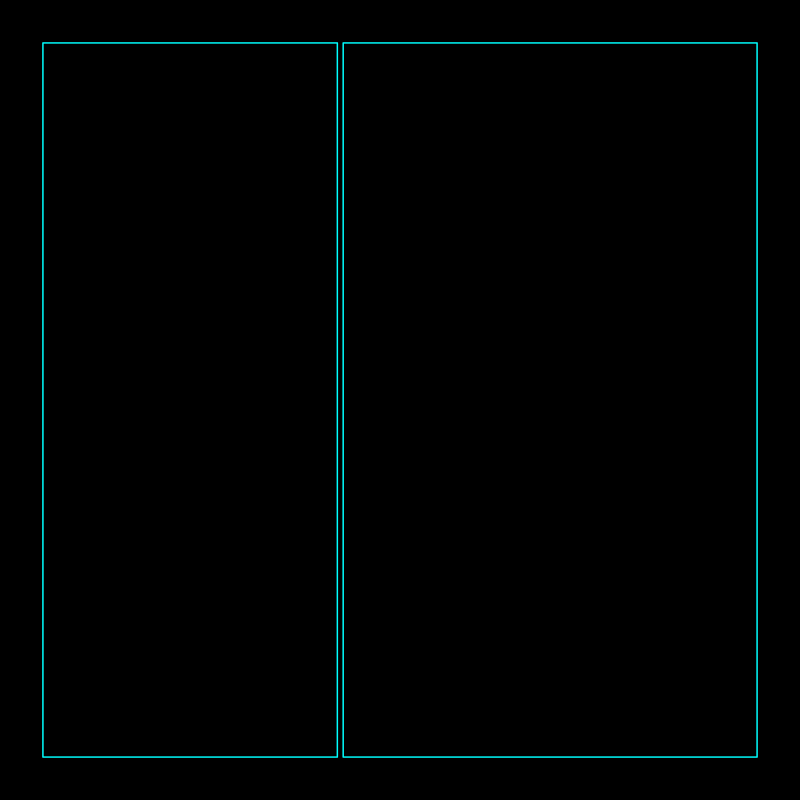
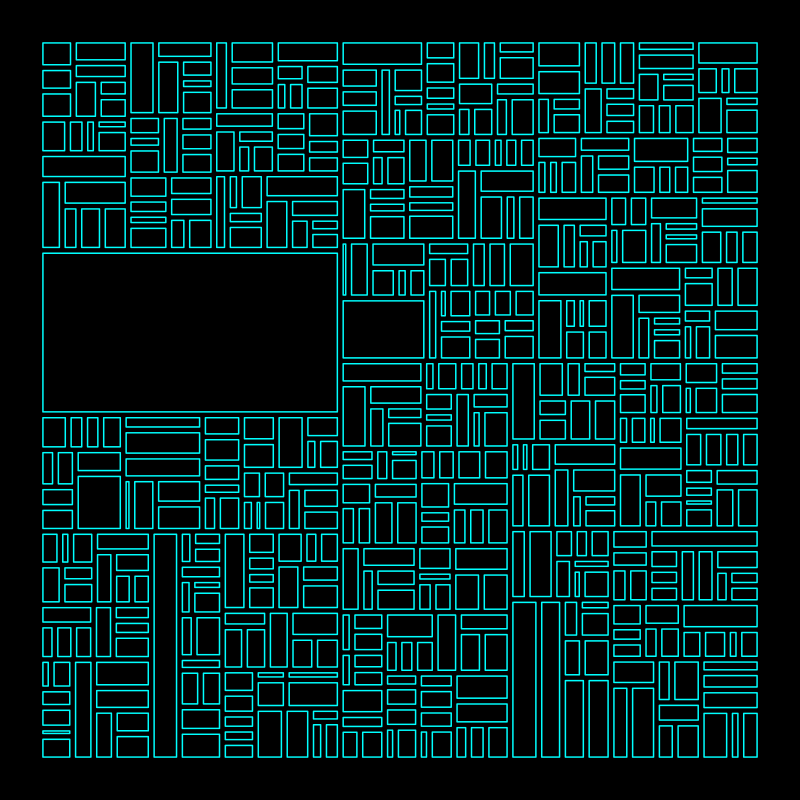
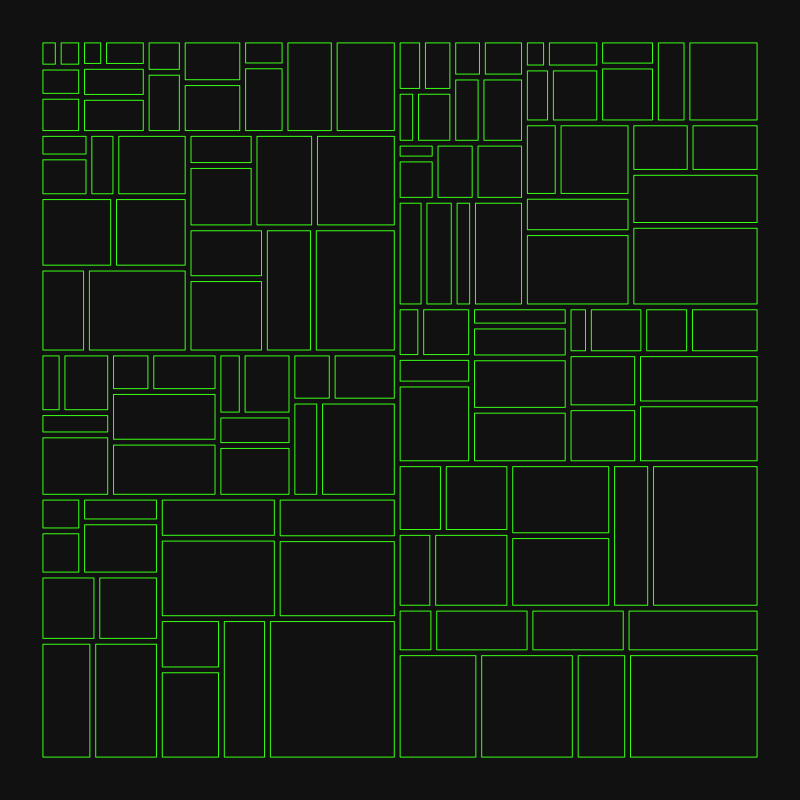
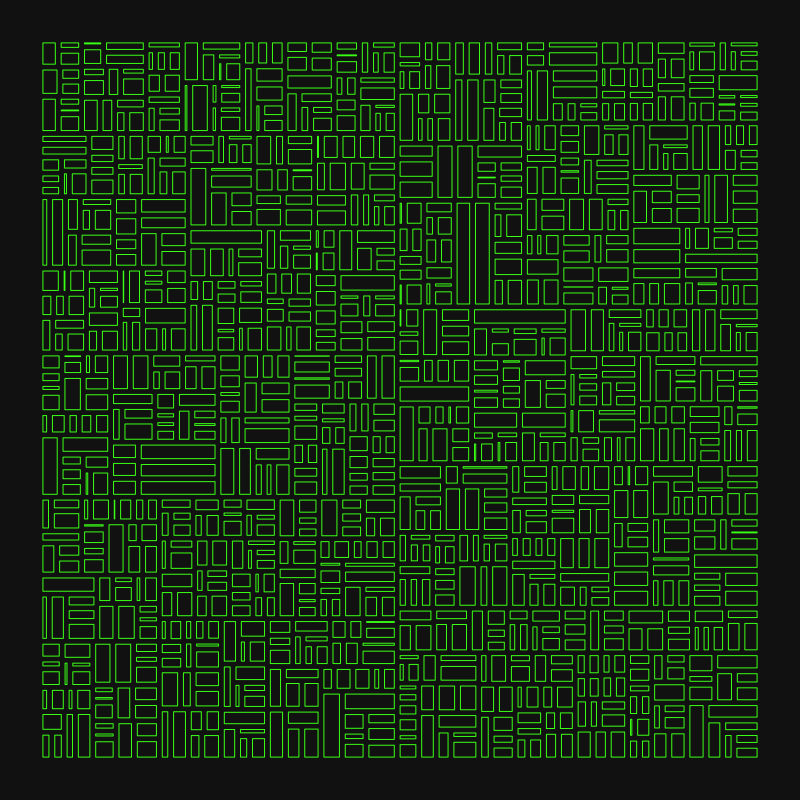
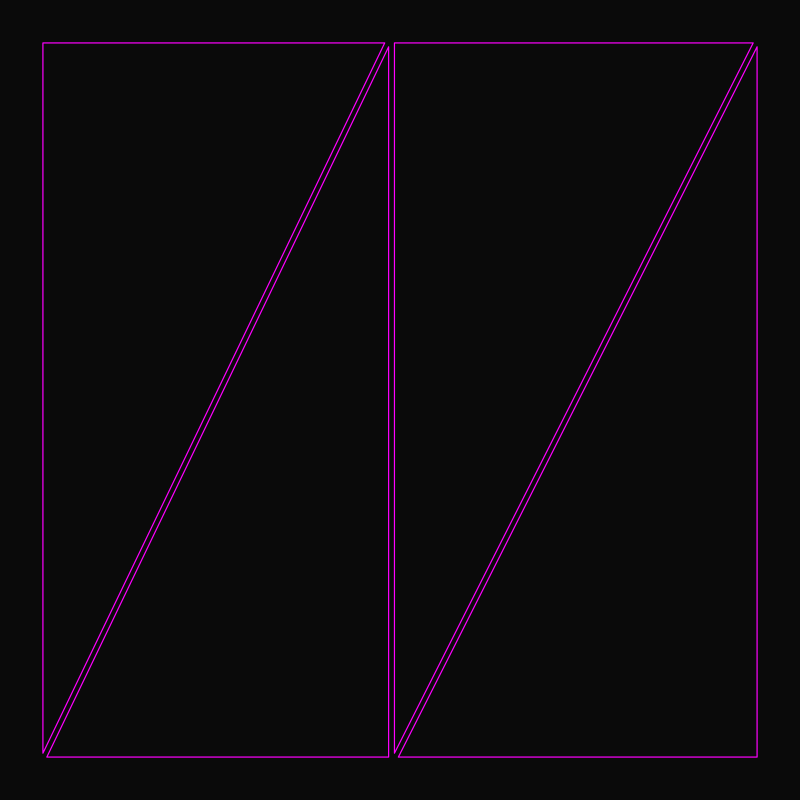
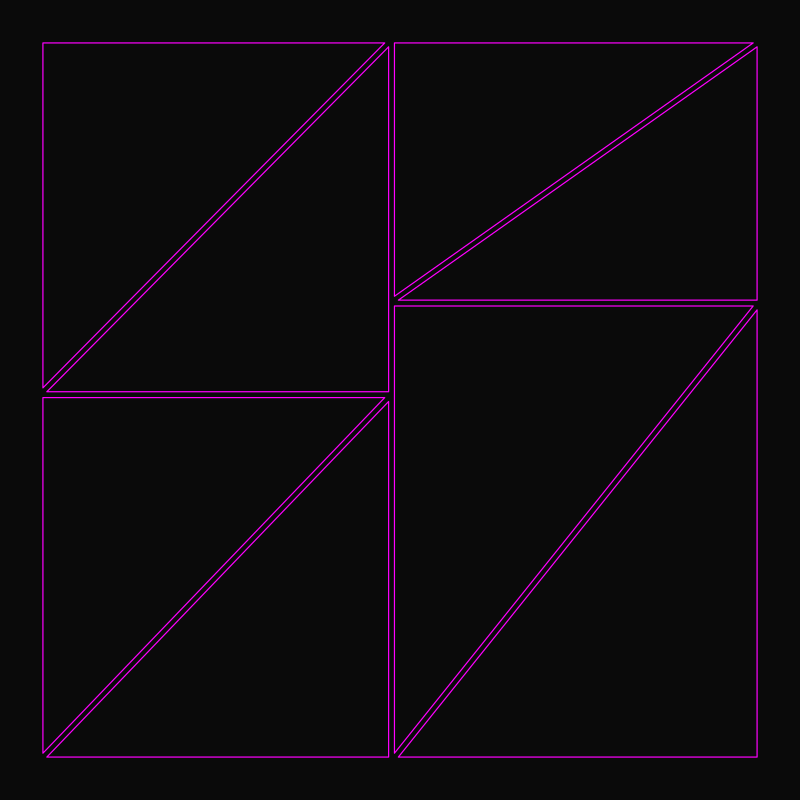
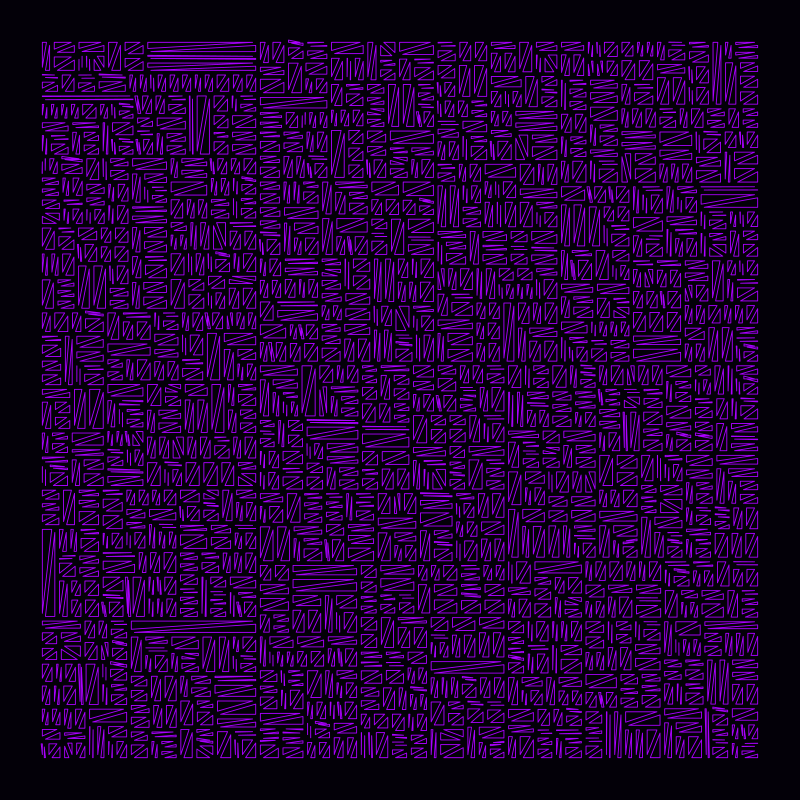
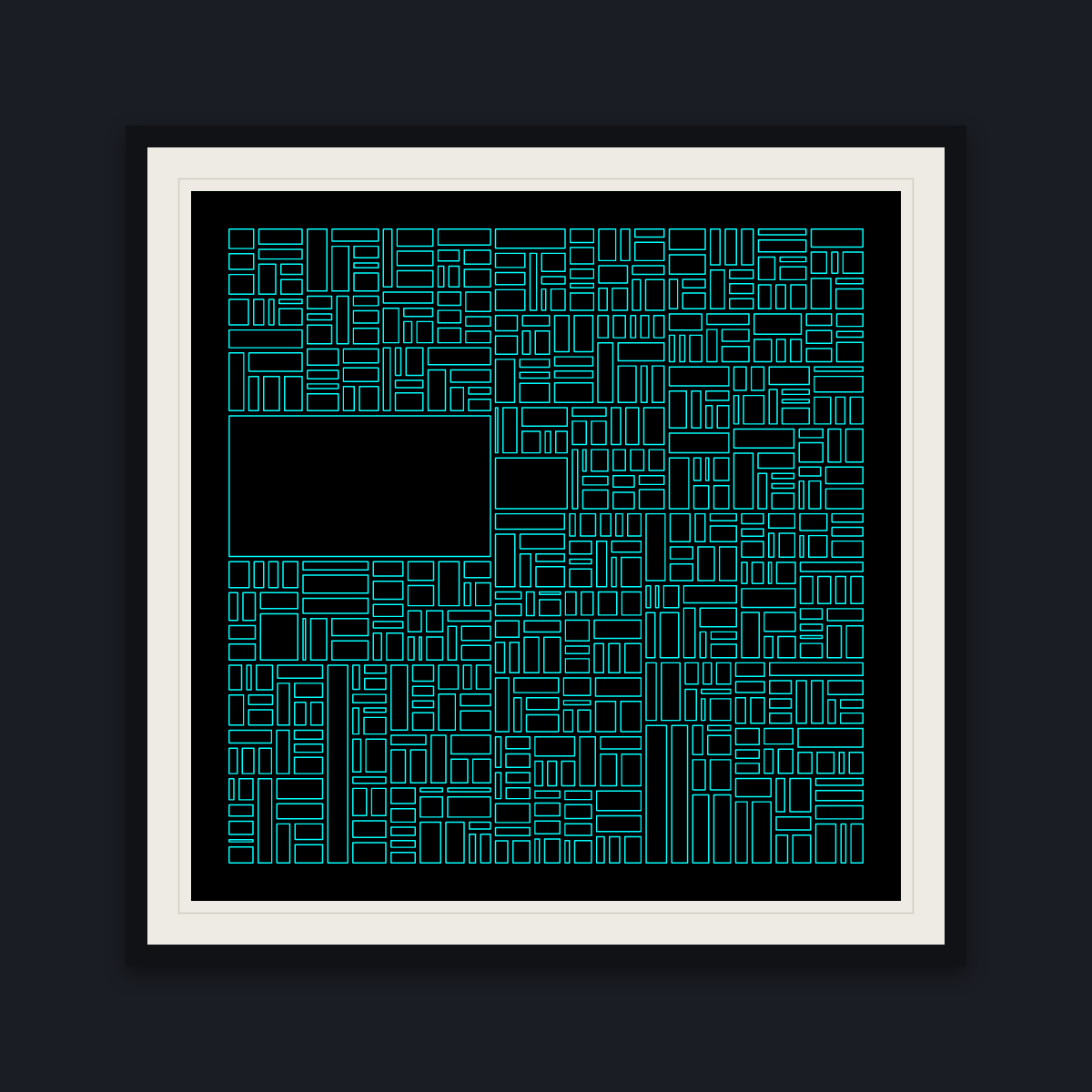
Split a rectangle in two, split the halves, and stop when a cell gets too small to bother with.
Split, recurse, stop
A k-d tree partitions space by repeatedly cutting it with axis-aligned planes. Here
the space is a rectangle and the planes are lines:
if (verticalSplit)
{
    area1 = new[] { area[0], area[1], area[2], area[3] * r };
    area2 = new[] { area[0], area[1] + area[3] * r, area[2], area[3] * (1f - r) };
}
Parent removed, two children added, and each child considered for splitting again. The
finished drawing is the leaves.
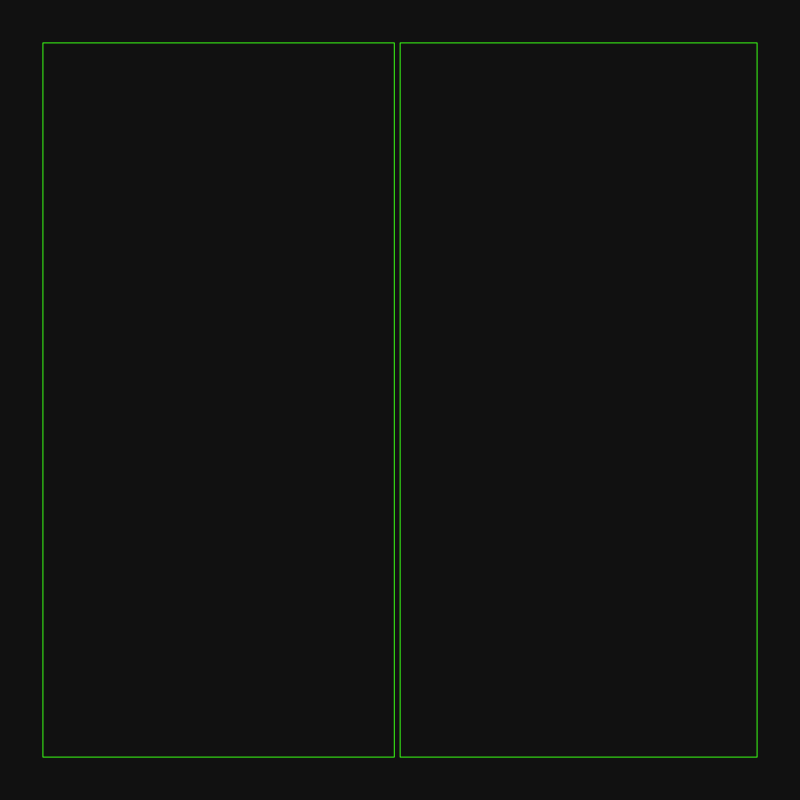
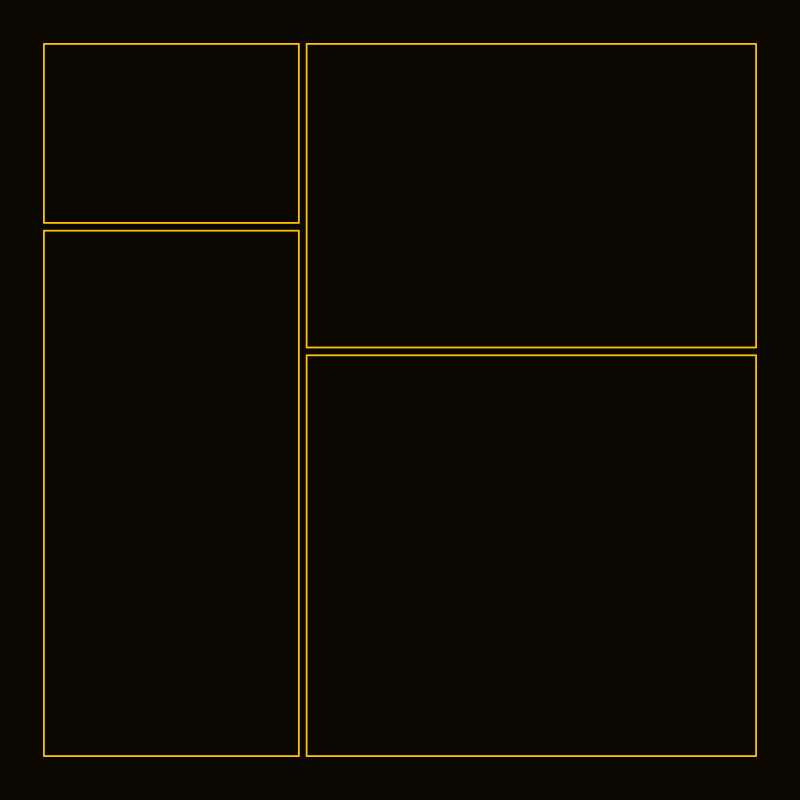
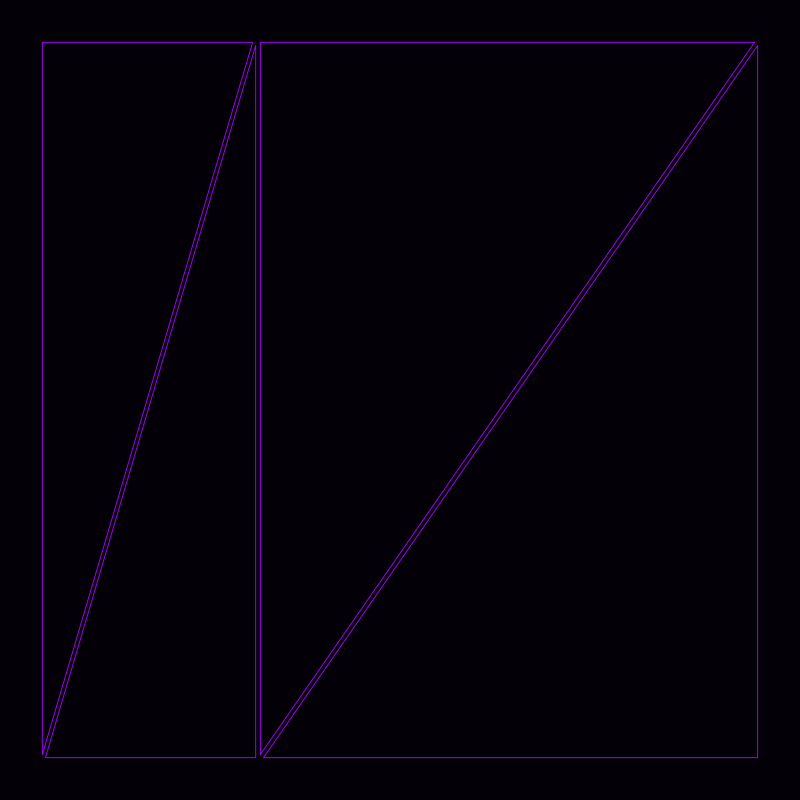
One split.
Three coins, each doing something different
The piece’s character comes entirely from three balance parameters, and they are not
interchangeable.
Balance1 — where the cut falls.
var b1 = 1f - Balance1;
var r = 0.5f - b1 / 2f + (float)rng.NextDouble() * b1 / 2f;
At Balance1 = 1 the cut is exactly at the midpoint every time and the drawing is a
grid of powers of two. At 0 it is anywhere in the left half. The presets sit near
0.5, which gives a cut a little left of centre with modest variation — enough
irregularity to be alive, not enough to produce slivers.
Balance2 — which axis is cut.
var verticalSplit = rng.NextDouble() > 0.5;
if (rng.NextDouble() < Balance2)
    verticalSplit = area[2] < area[3];
The axis starts as a fair coin, and then with probability Balance2 is overridden by
the sensible choice: cut the longer side. At 0.85 that override applies most of the
time, which is why the cells stay roughly square rather than degenerating into strips —
and why the occasional cell that got the coin instead reads as a deliberate long
rectangle.
Balance3 — whether to recurse.
if (rng.NextDouble() > MathF.Pow(Balance3, 3))
    Subdivide(…);
Note the cube. At Balance3 = 0.15 the stopping probability is 0.15³ ≈ 0.0034, so a
cell that is big enough to split almost always does. The tree is bounded by
MinSize, not by this coin — the coin exists to leave the occasional large cell
undivided, and cubing it makes those genuinely rare.
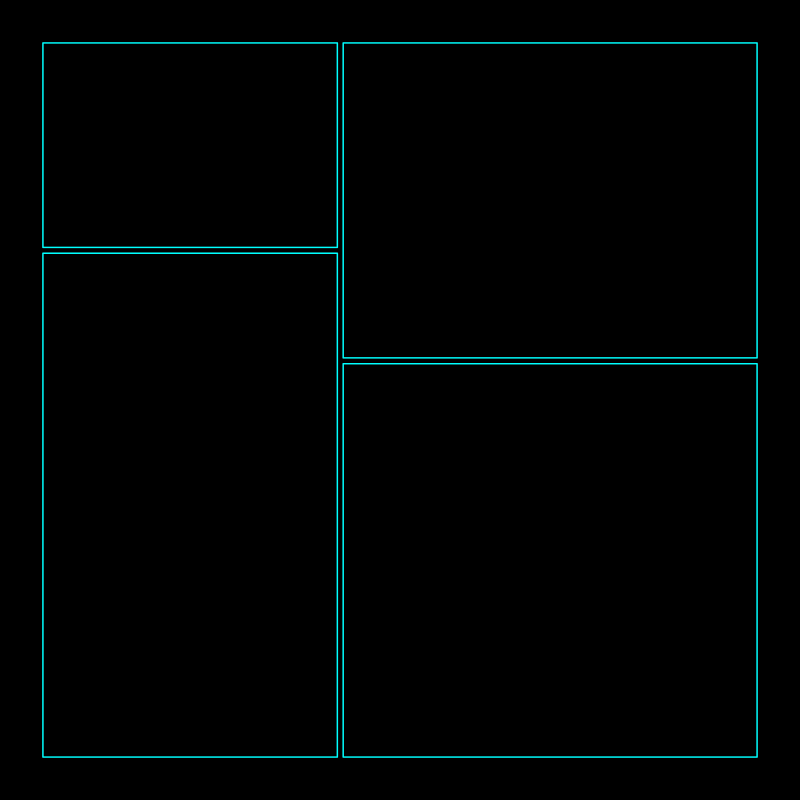
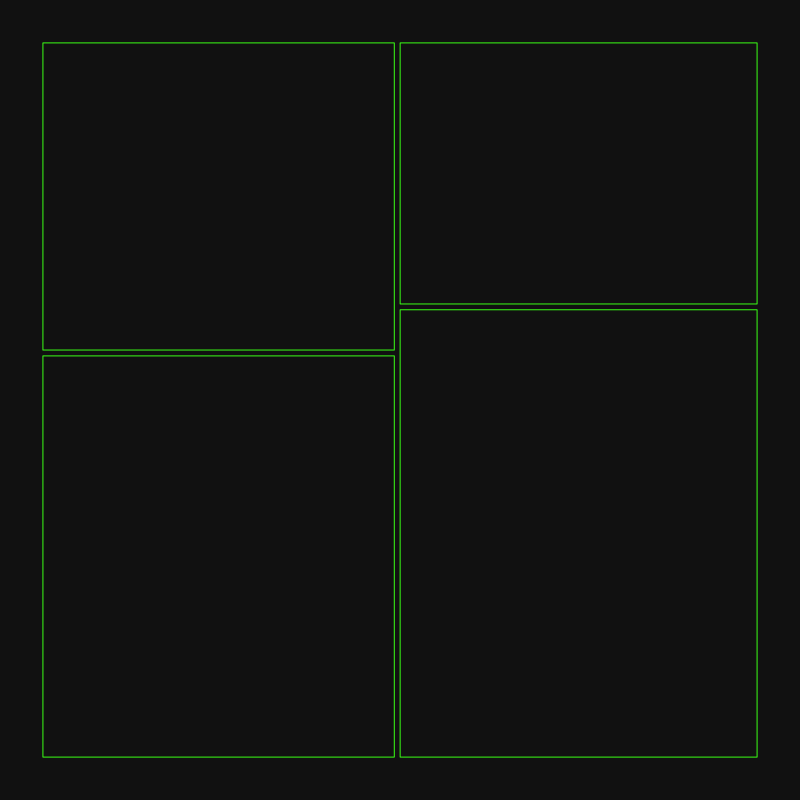
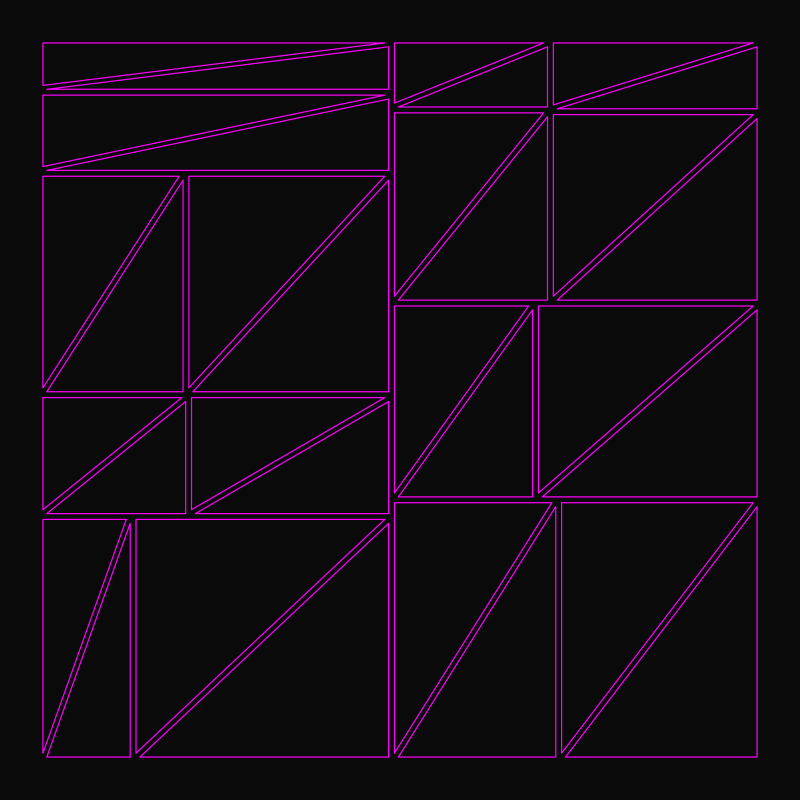
Two rounds.
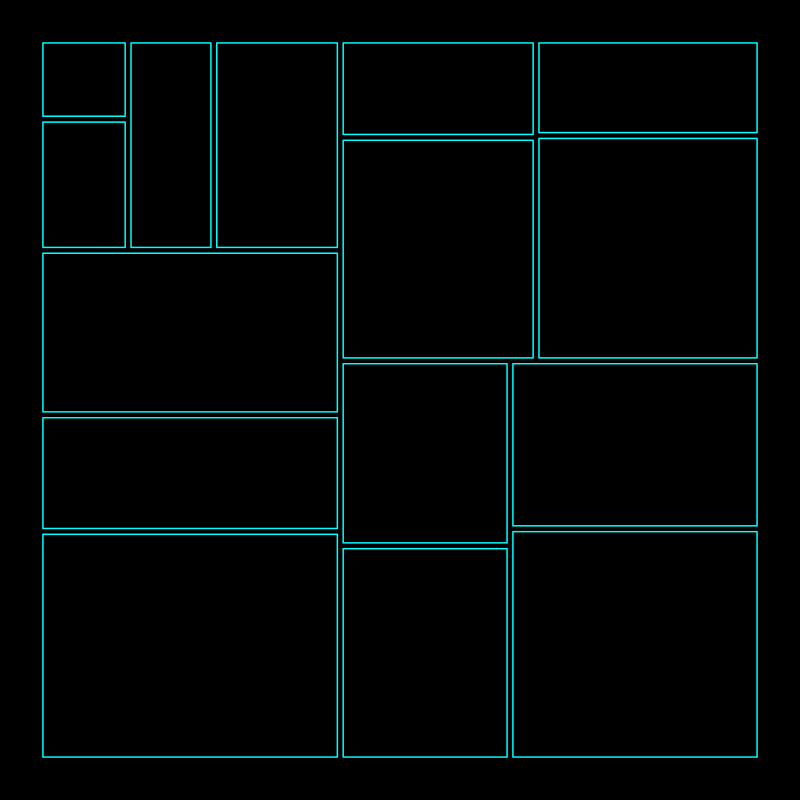
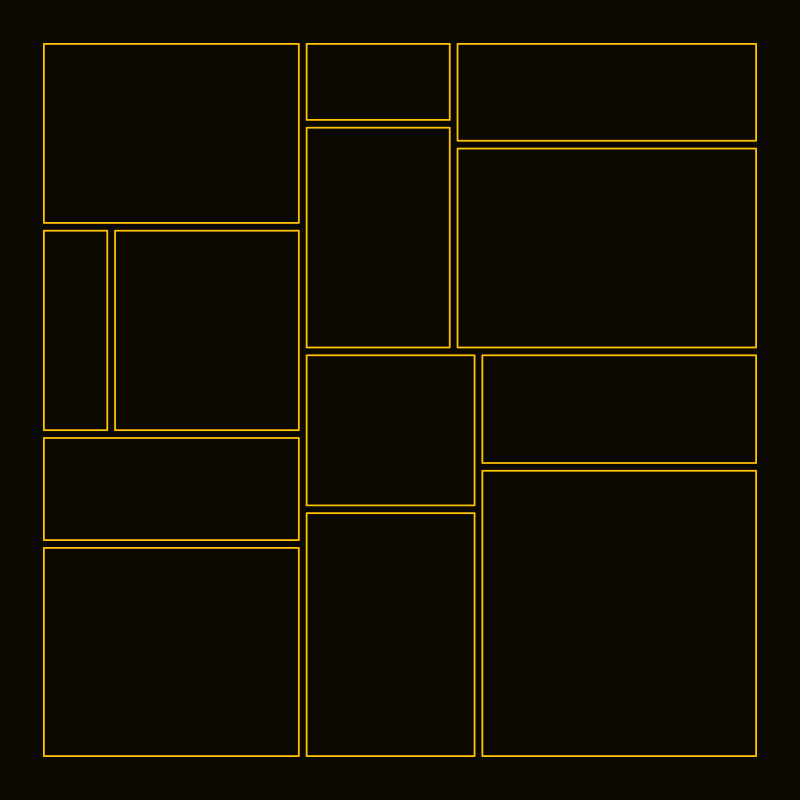
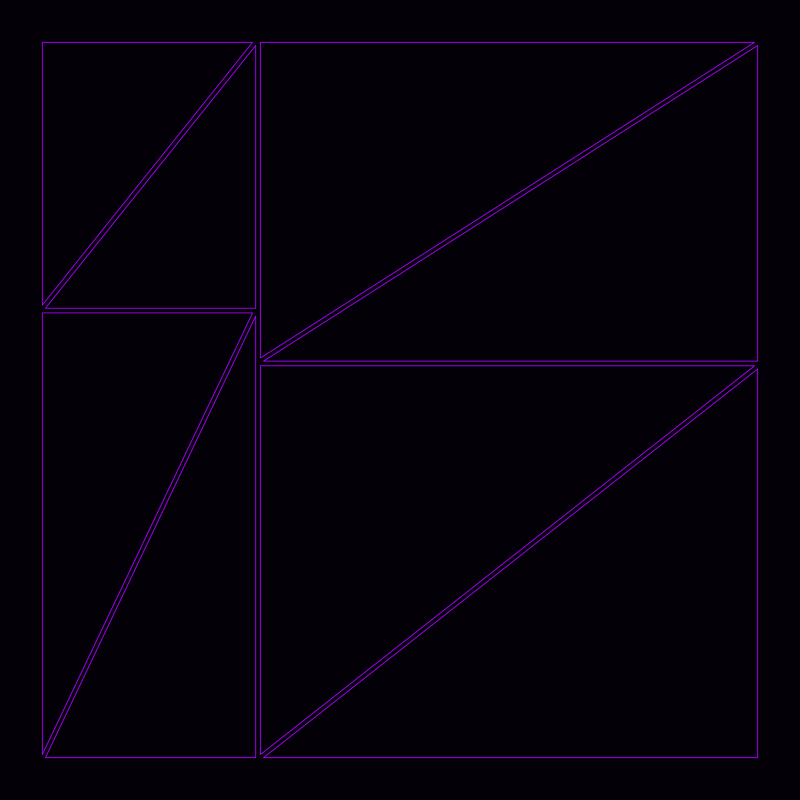
Four. The tree is already unbalanced: some branches have hit the minimum size and
stopped while others are still splitting, and it is MinSize that decides which.
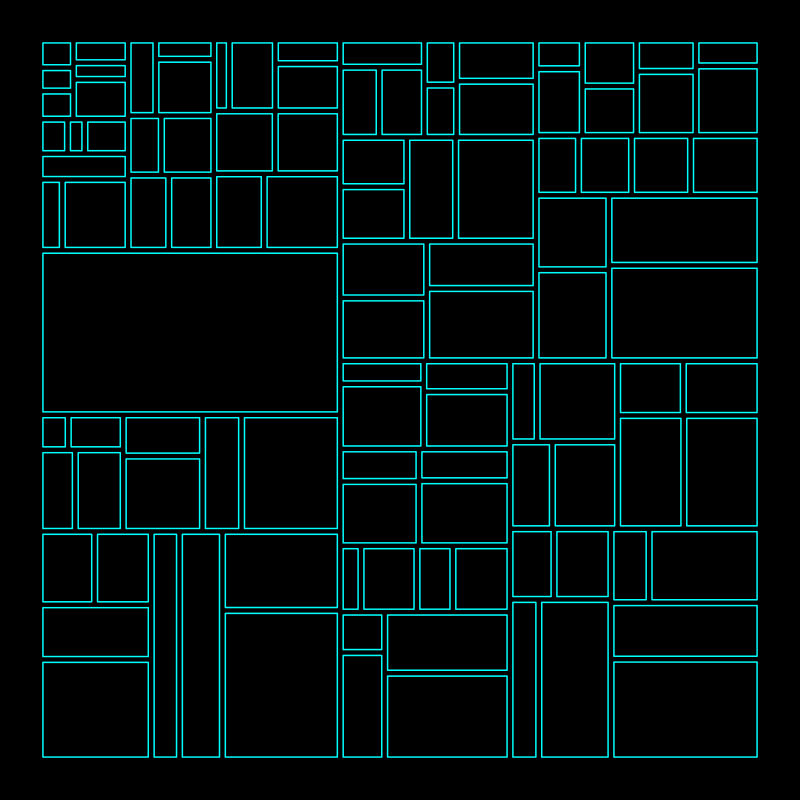
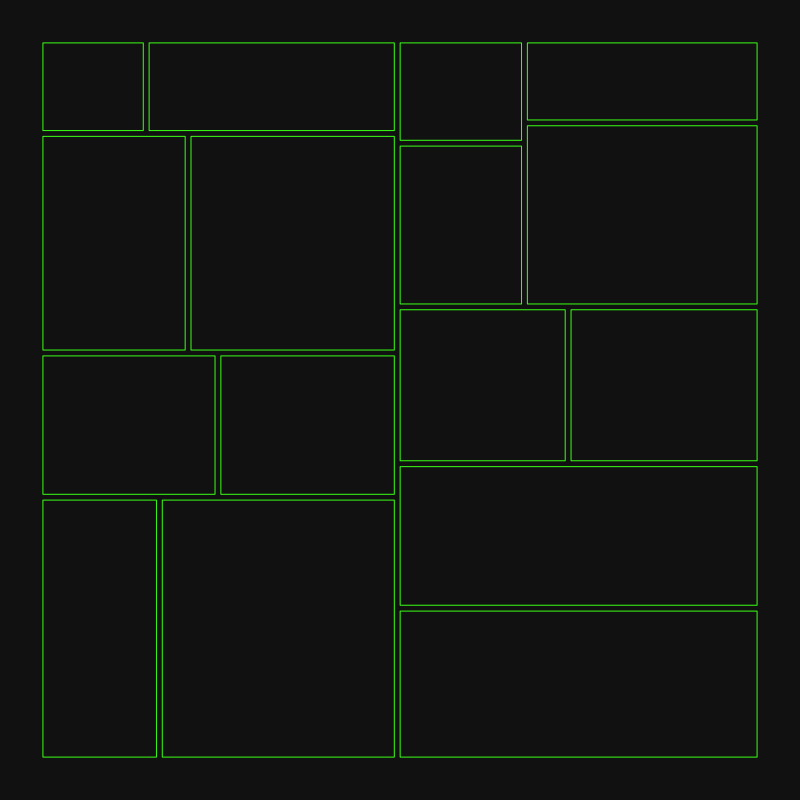
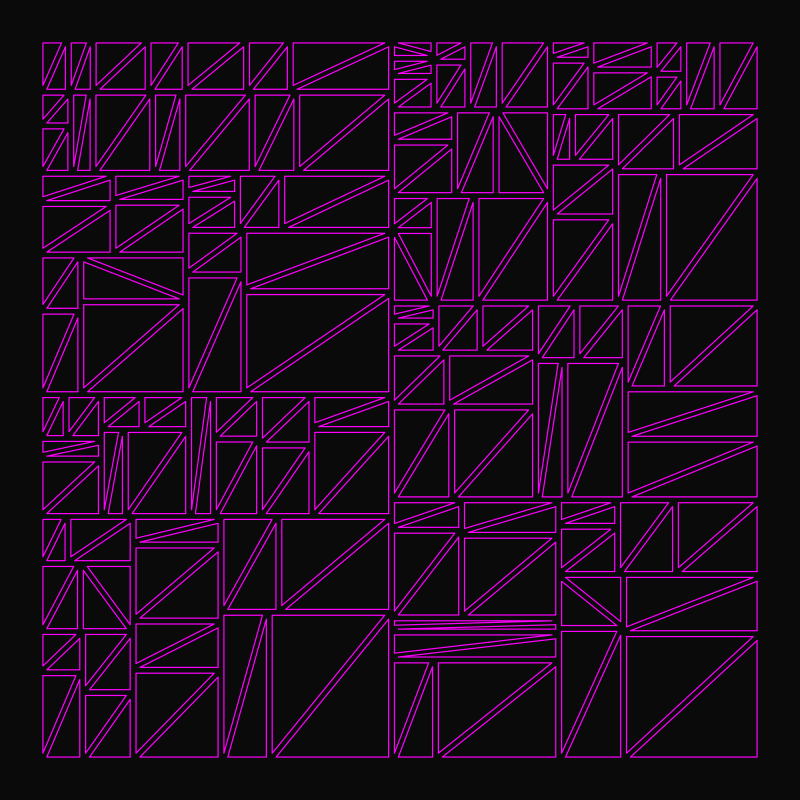
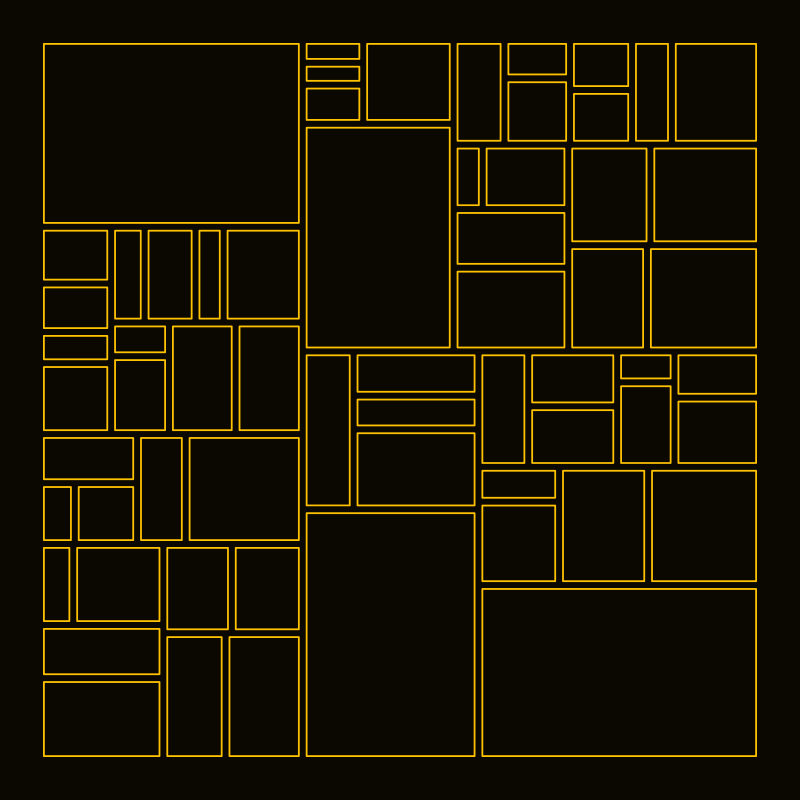
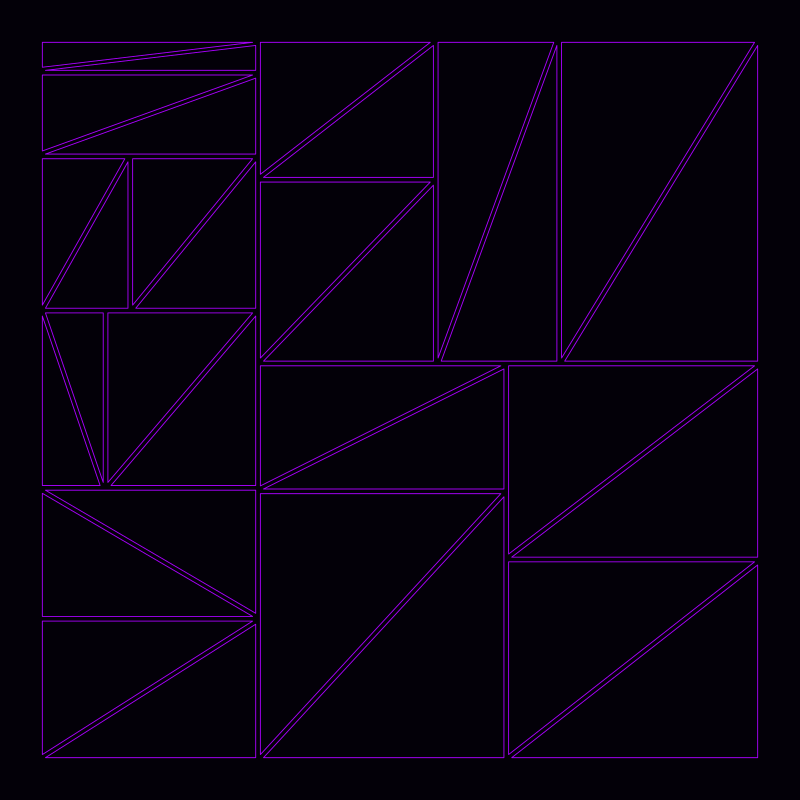
Seven rounds.
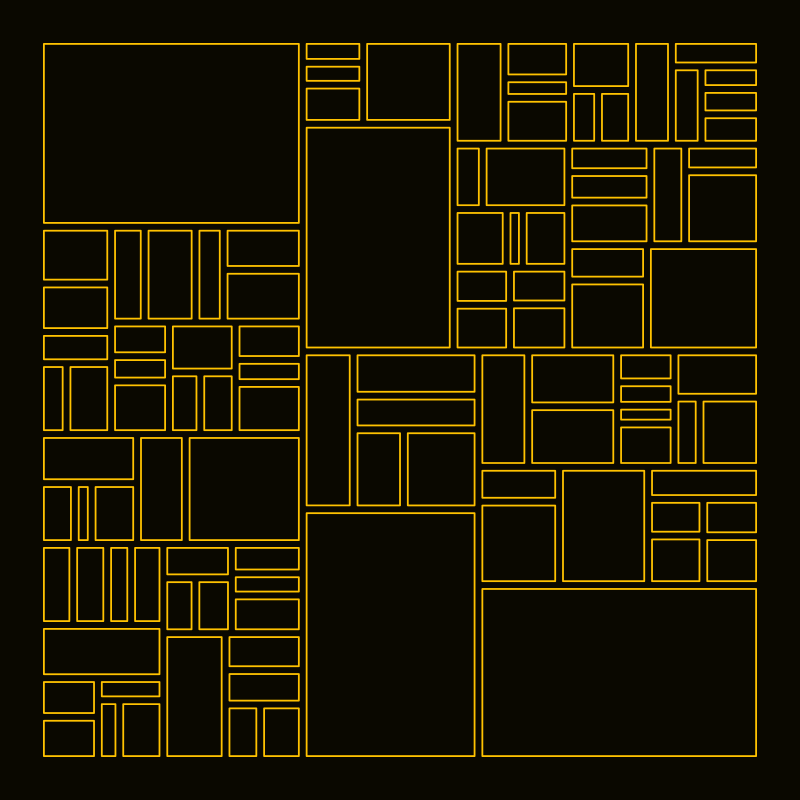
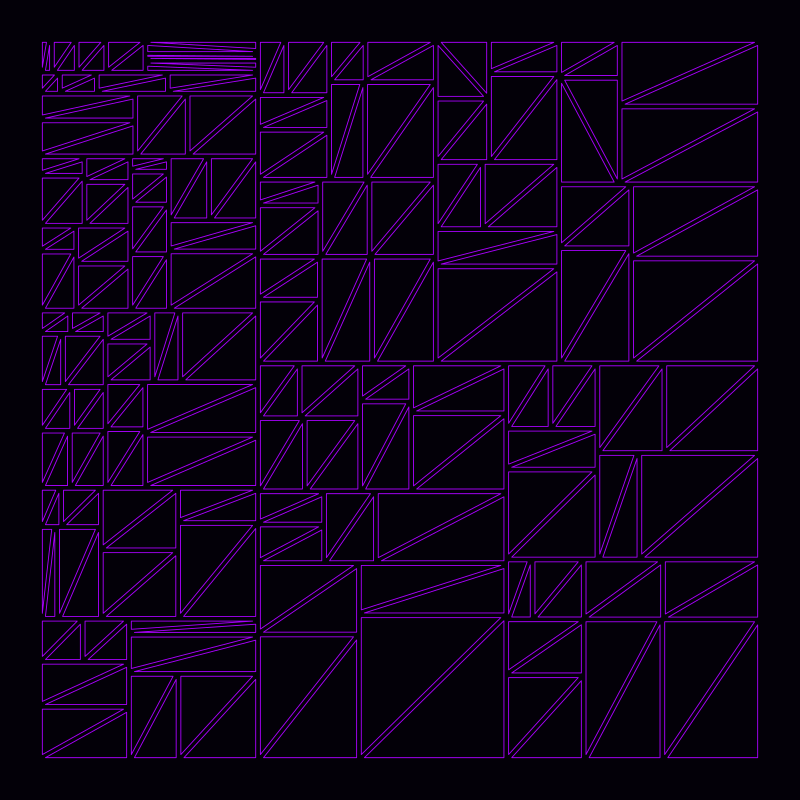
The leaves. A cell is a leaf when it is smaller than MinSize + Spacing in either
direction, or when the recursion coin came up against it. Because the split position
is random, two sibling cells reach that threshold at different depths — so the
finished partition has cells that are seven splits deep next to cells that are three.
That is the whole visual argument for a k-d tree over a grid: the cell sizes cluster
but do not repeat, and the layout looks composed without anything having composed it.
The gap
Every cell is inset by Spacing / 2 on each side before it is drawn, so neighbouring
cells separate by a full Spacing and the partition reads as tiles rather than as a
web of shared lines. Cells that would collapse under the inset are skipped:
if (bx <= ax || by <= ay) continue;
which is what stops the smallest leaves from drawing as degenerate marks.
The renderings
| Rendering | Shape | Density | Ink |
|---|
| Void Cyan | rectangles | medium | cyan on black |
| Void Lime | rectangles | fine | lime on near-black |
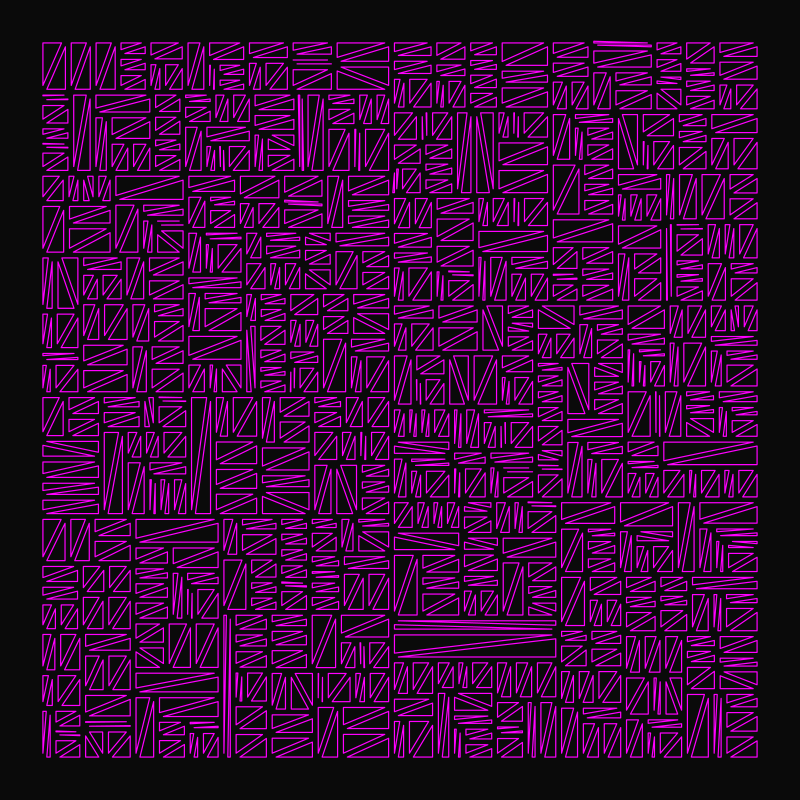
| Void Magenta | triangle pairs | medium | magenta on near-black |
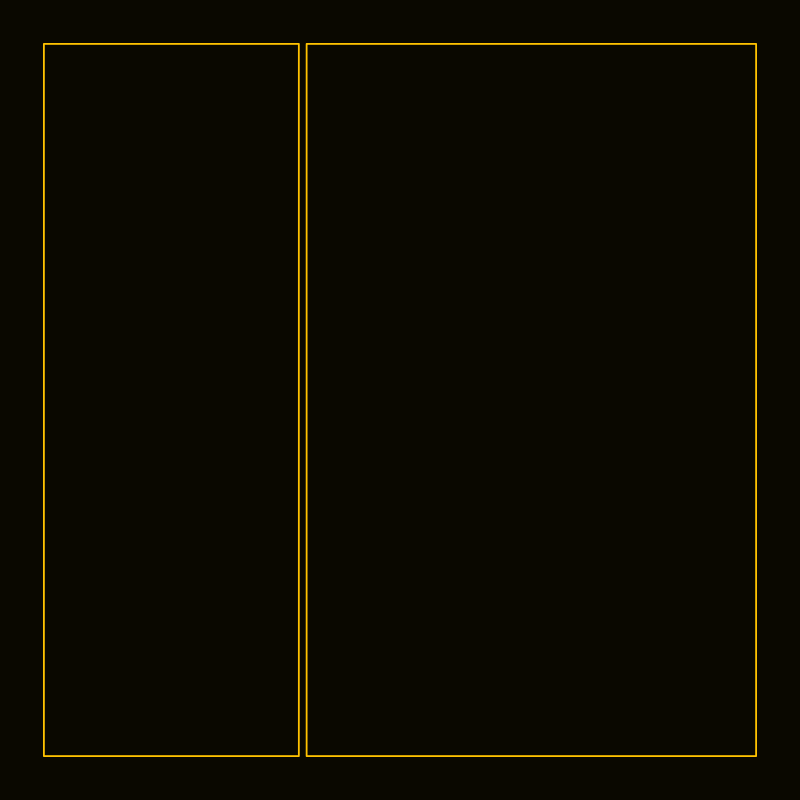
| Void Amber | rectangles | sparse | amber on warm near-black |
| Void Violet | triangle pairs | fine | violet on deep near-black |
| Void Cyan — Museum | rectangles | medium | cyan on black, museum frame |
Shape = 1 replaces each rectangle with a pair of triangles, chosen per cell — the
same partition read as a different set of tiles.
The museum rendering presents the lead preset in a full museum frame — wall, mat,
and frame — as a gallery piece rather than a direct sample.
Determinism
One Random is created per draw, seeded from the preset, and consumed in the
recursion’s own depth-first order: split position, axis coin, axis override, then two
recursion coins. The generator is System.Random, which the project’s determinism
policy flags as not guaranteed stable across .NET versions.