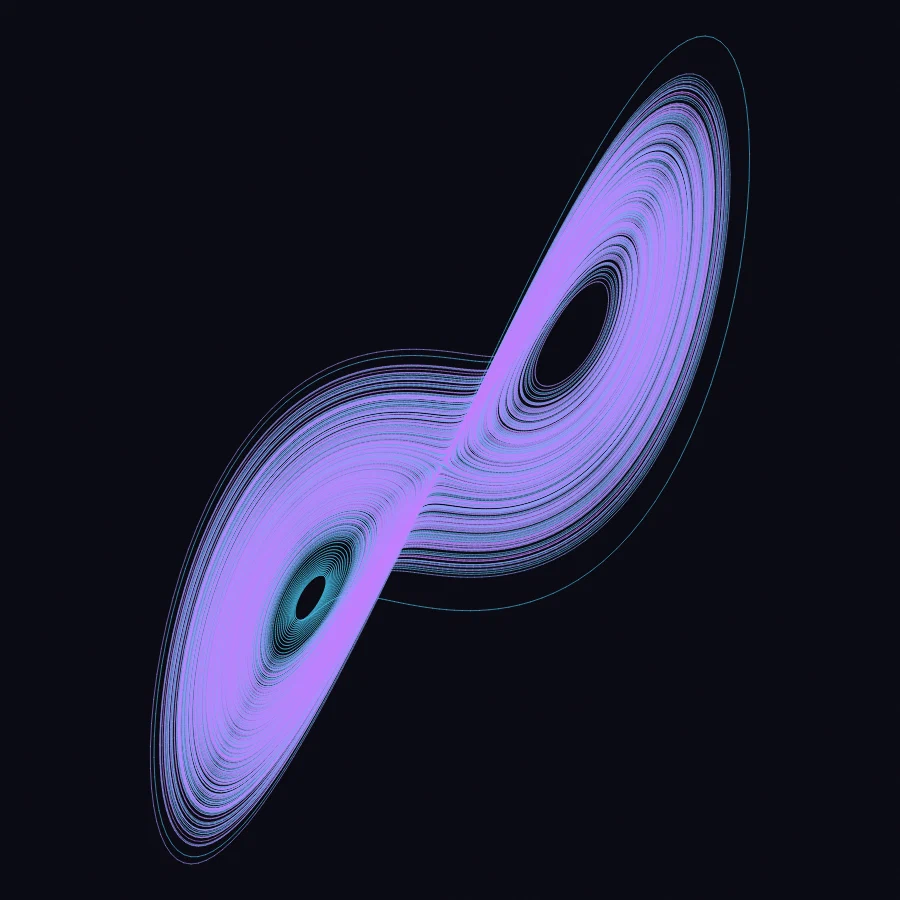
One trajectory, two hundred thousand steps, never repeating and never leaving.
Three equations
dx/dt = σ(y − x)
dy/dt = x(ρ − z) − y
dz/dt = xy − βz
Edward Lorenz wrote these down in 1963 as a stripped-down model of convection in the
atmosphere. Two of the three are linear; the whole of the behaviour comes from the two
product terms, xz and xy.
At σ = 10, ρ = 28, β = 8/3 — the values used here, and the ones in Lorenz’s paper
— the system has no stable fixed point and no periodic orbit. It has a strange
attractor: a bounded set that trajectories approach and never leave, and never
repeat on.
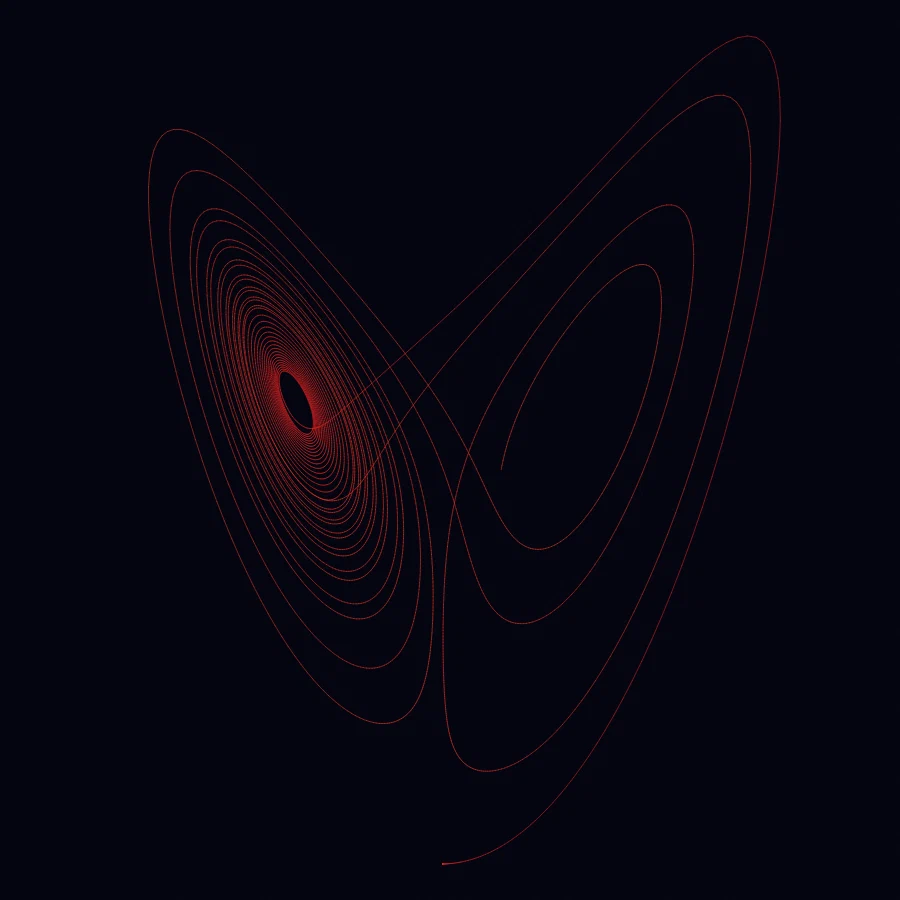
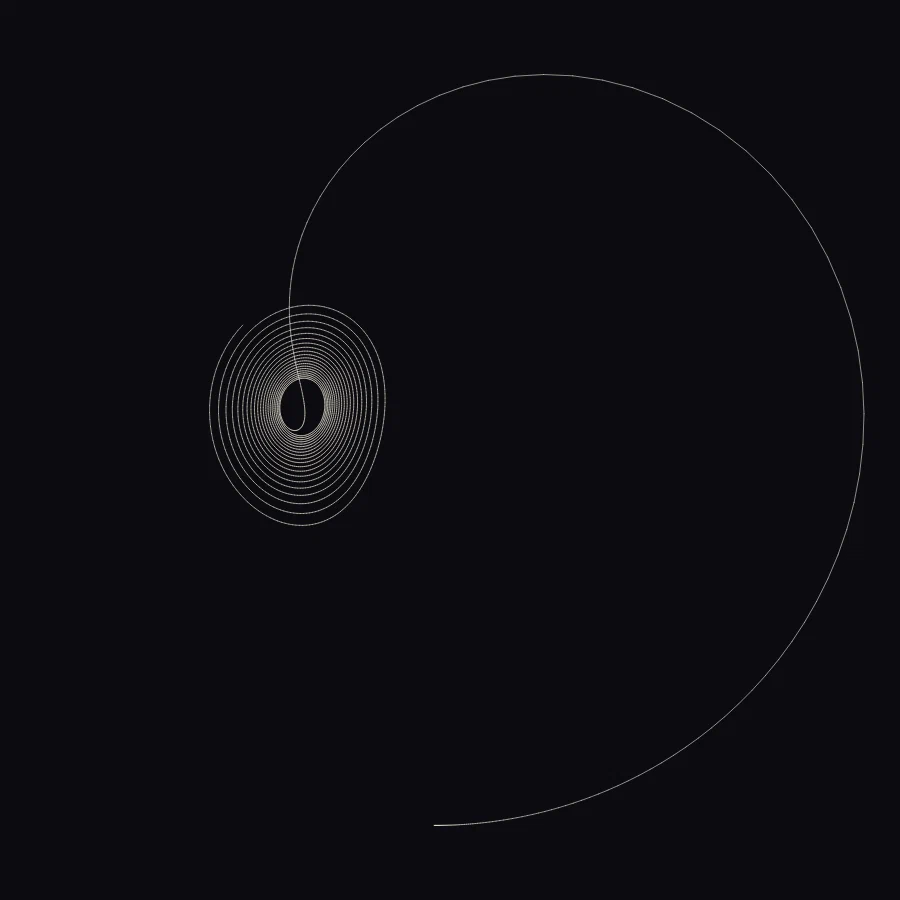
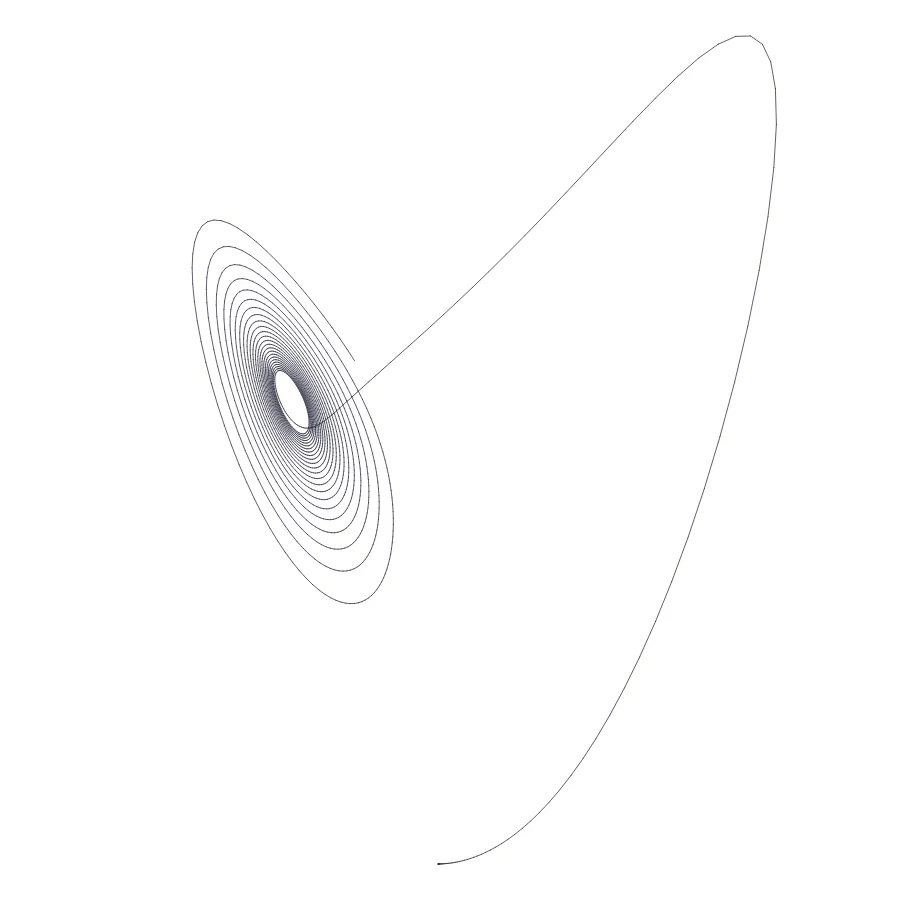
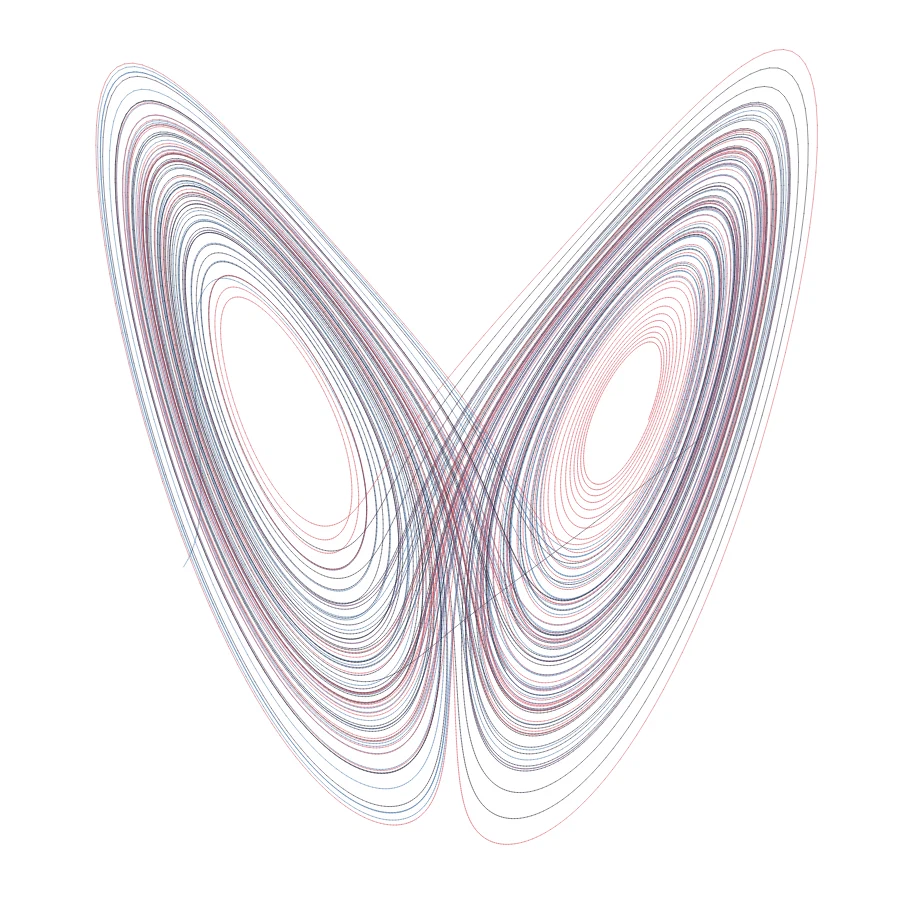
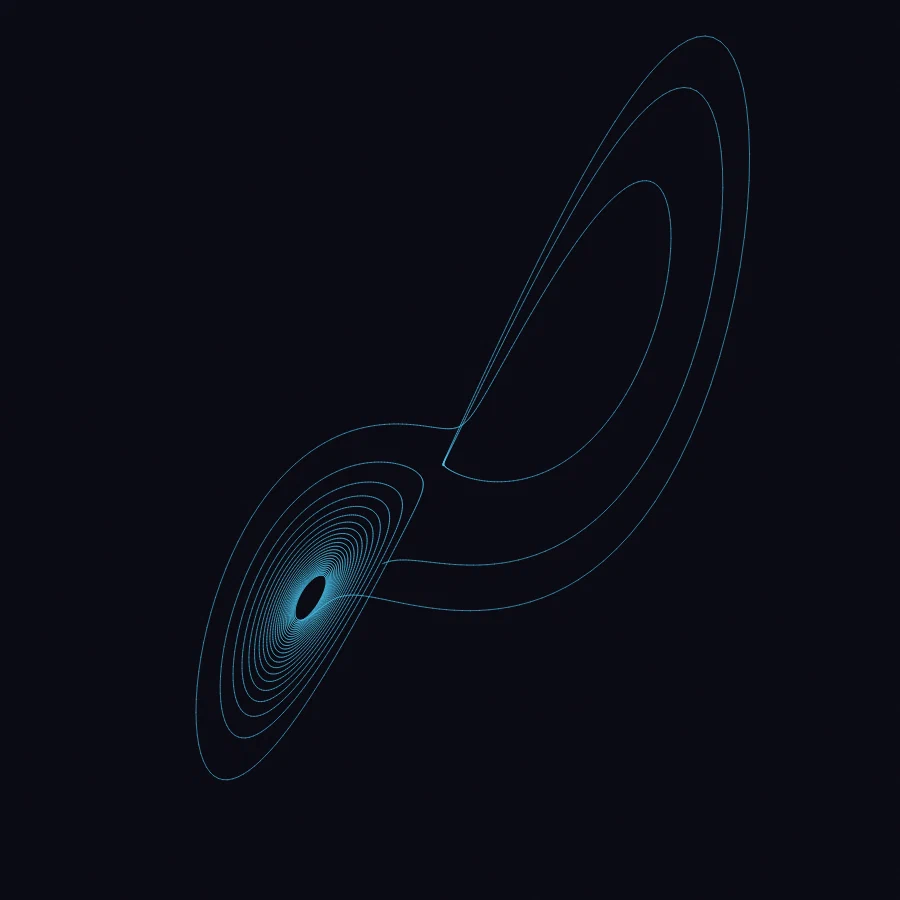
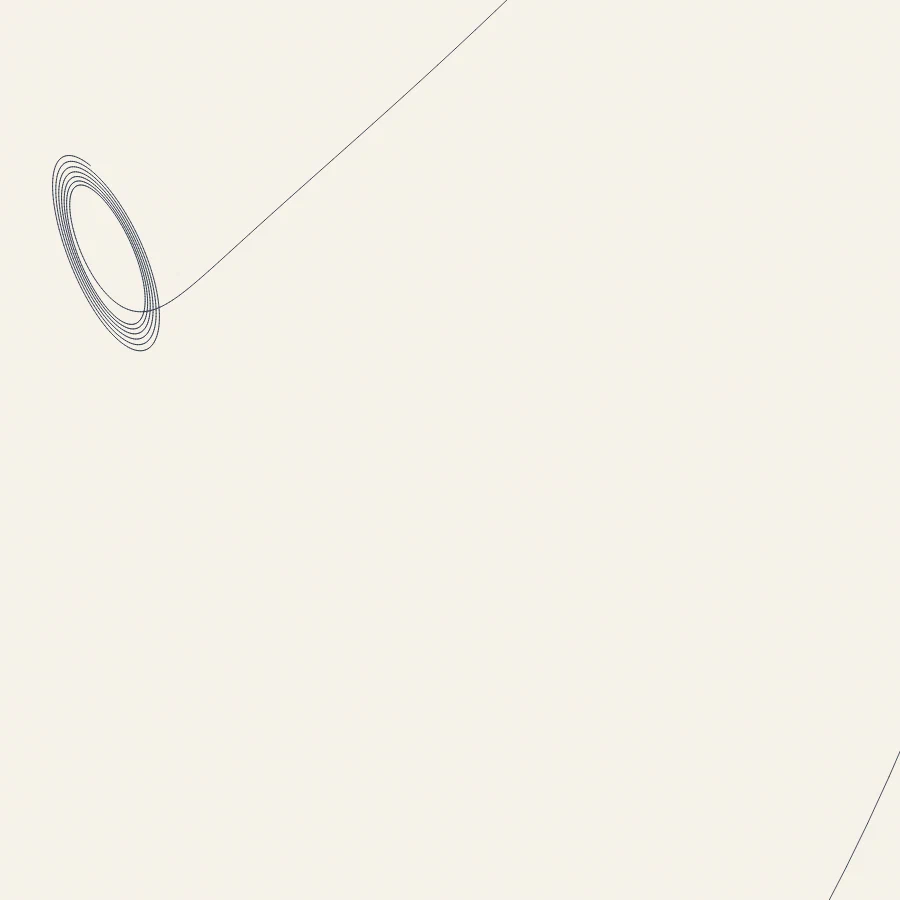
Five thousand steps. The trajectory has already fallen onto the attractor — that
happens within a few hundred steps from almost any starting point — and is circling
one lobe.
RK4, and why the step size matters
The integration is fourth-order Runge–Kutta at dt = 0.005. That is not caution for
its own sake. A chaotic system amplifies error exponentially: the Lorenz attractor’s
largest Lyapunov exponent is about 0.9 per unit time, so any discrepancy roughly
doubles every 0.8 time units.
Over 200,000 steps at dt = 0.005 that is a thousand time units — enough for an error
of one part in 10¹⁵ to grow to the size of the attractor itself. The trajectory drawn
here is therefore not the true trajectory from its initial condition. It is a true
trajectory of some initial condition indistinguishably close by, which is the strongest
statement anyone can make about a numerically integrated chaotic system.
That it does not matter to the picture is the point: every trajectory traces the same
attractor.
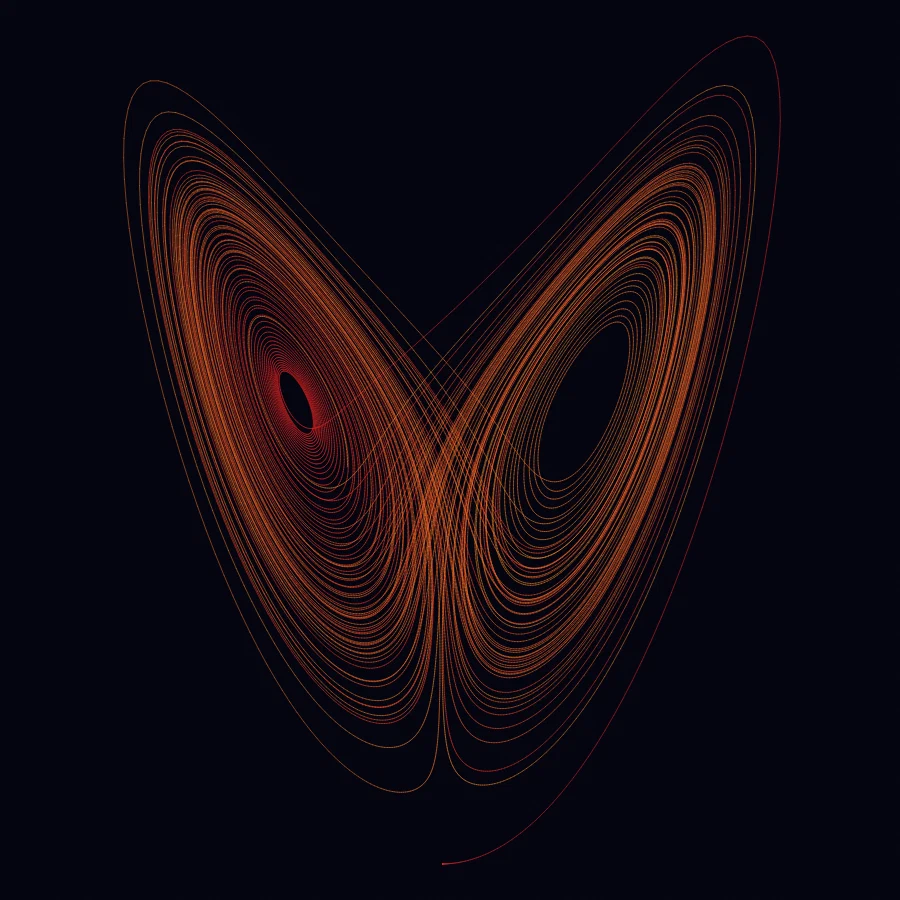
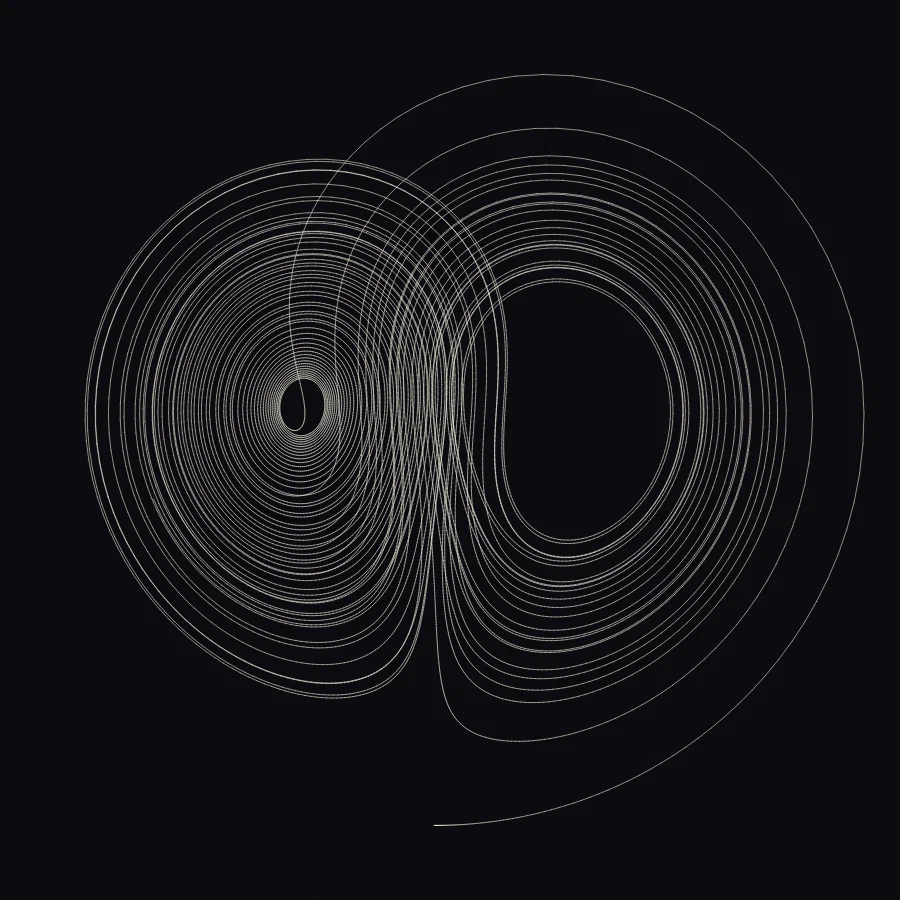
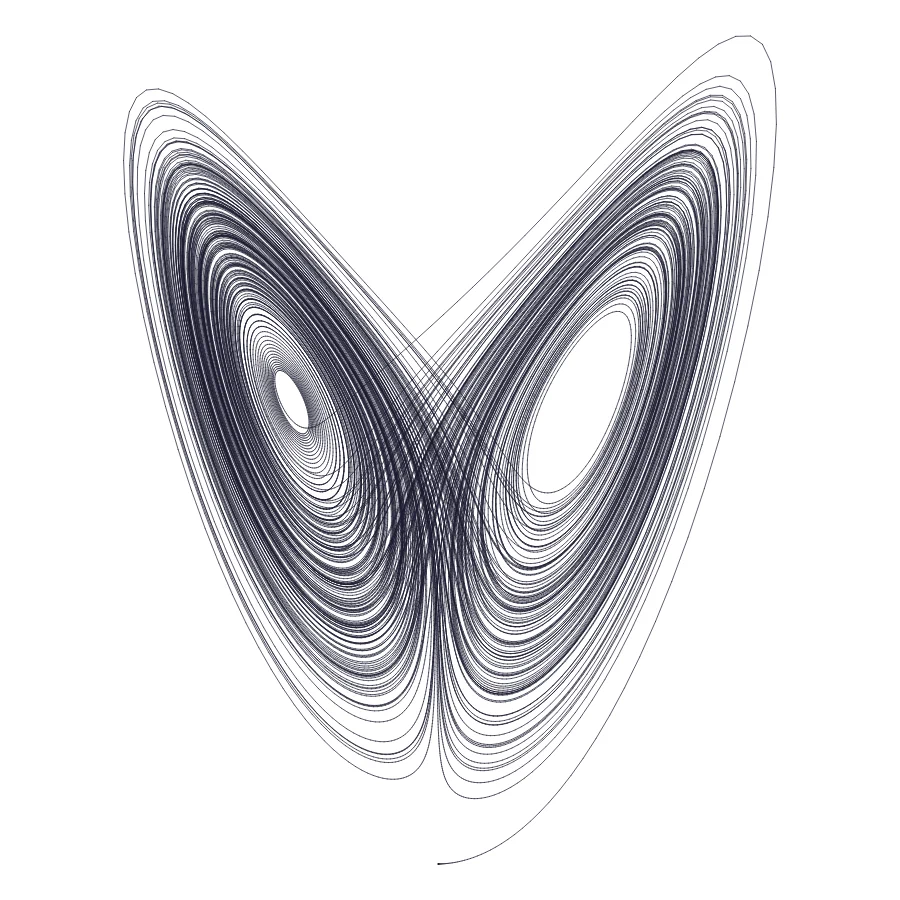
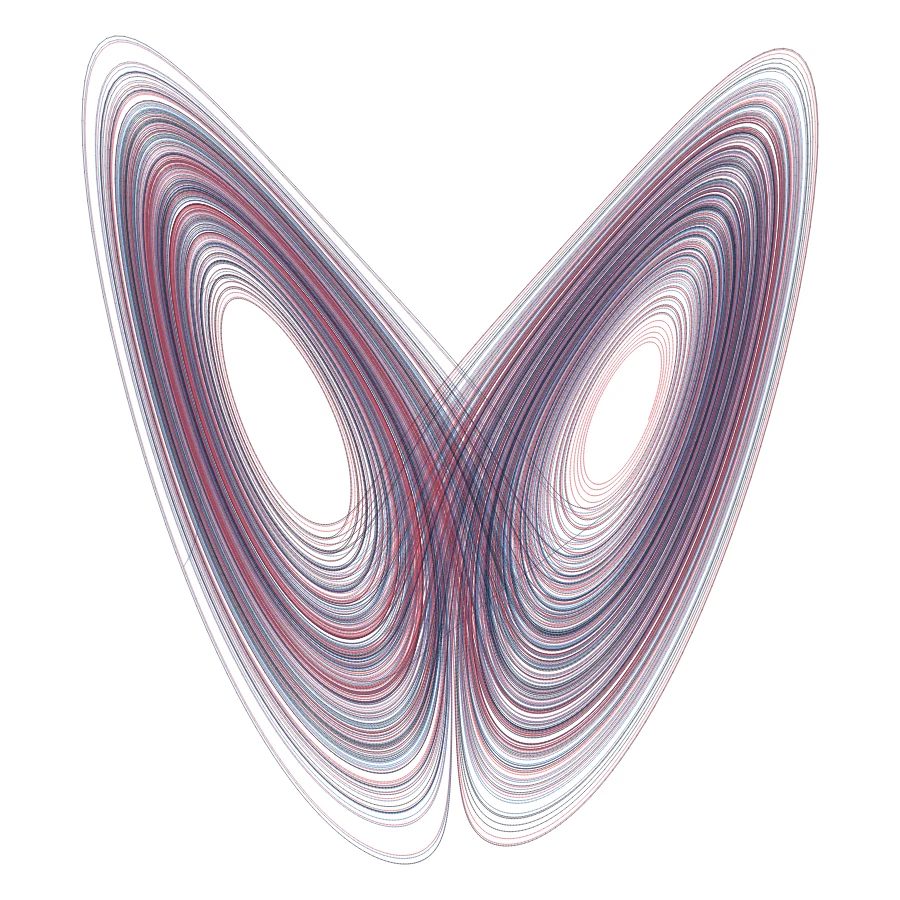
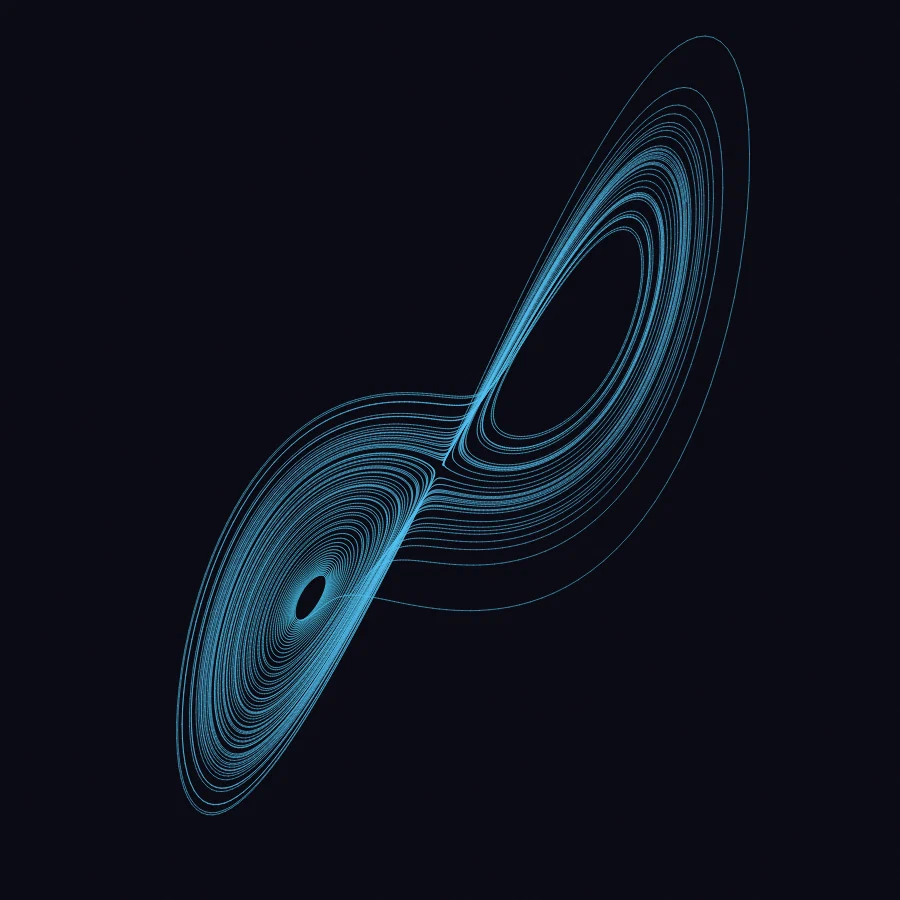
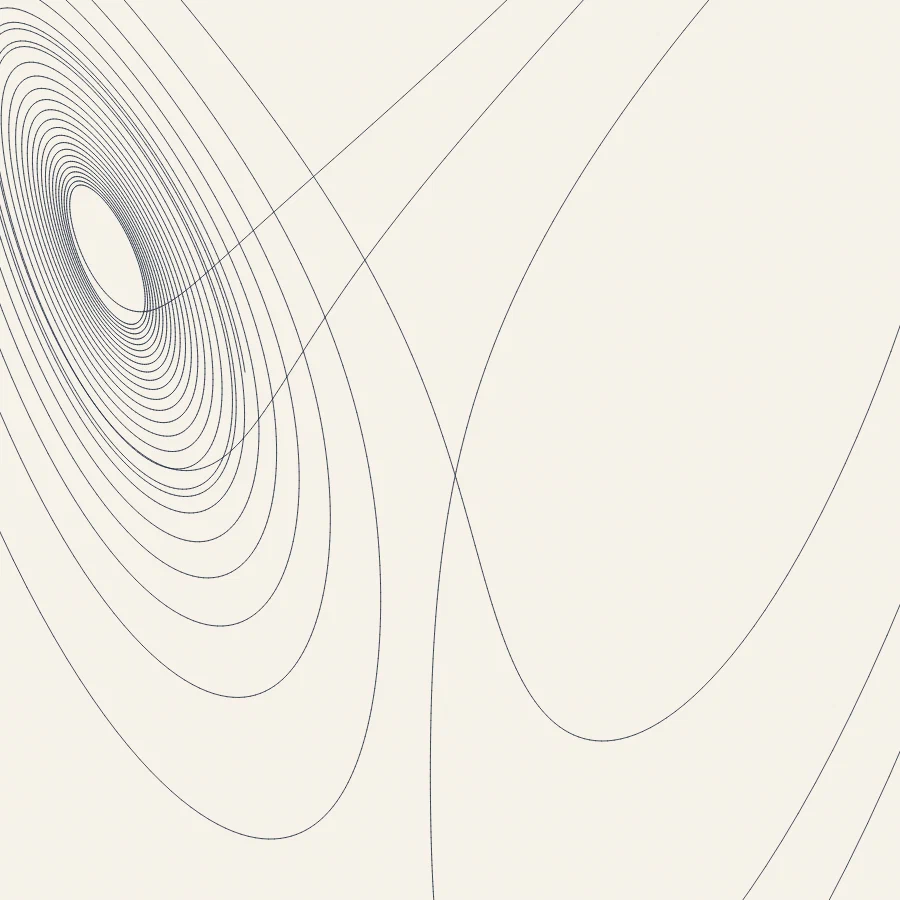
Twenty thousand steps. The path has switched lobes. How many times it circles before
switching is the sensitive quantity — it is what makes the system chaotic, and it is
determined by the equations rather than chosen.
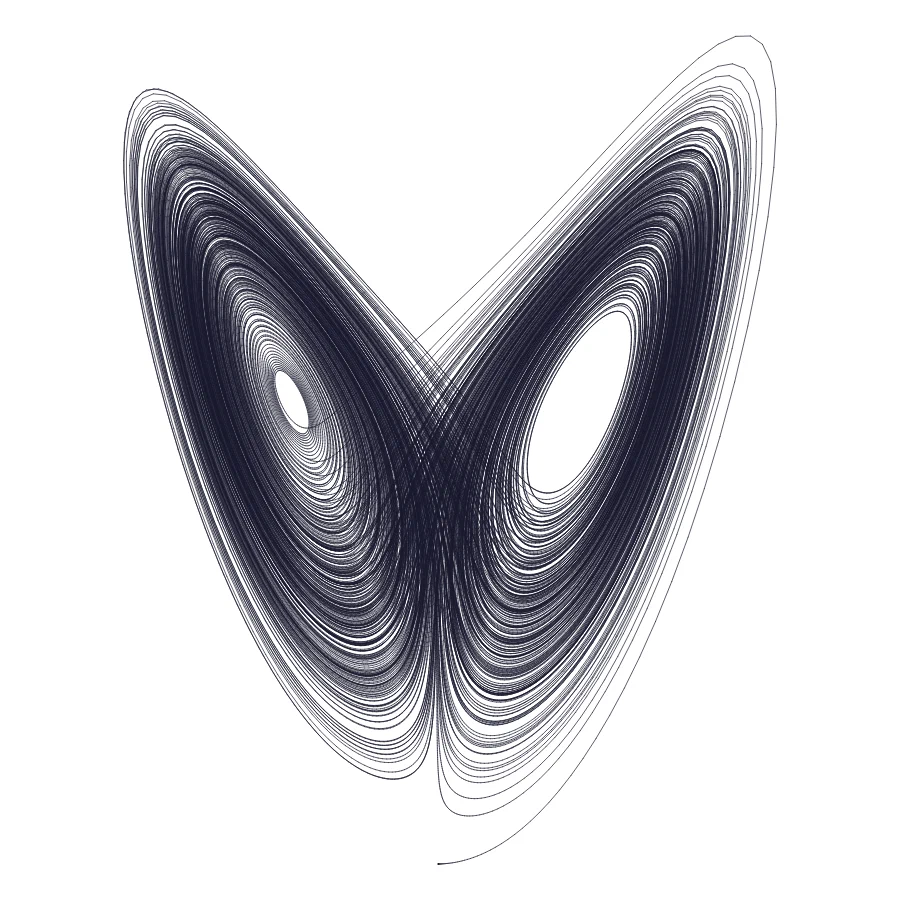
A third of the run. The lobes are filling in, and the trajectory has still not crossed
itself: in three dimensions it cannot, because a trajectory that returned to a previous
point would have to repeat from there.
The sheets are not sheets
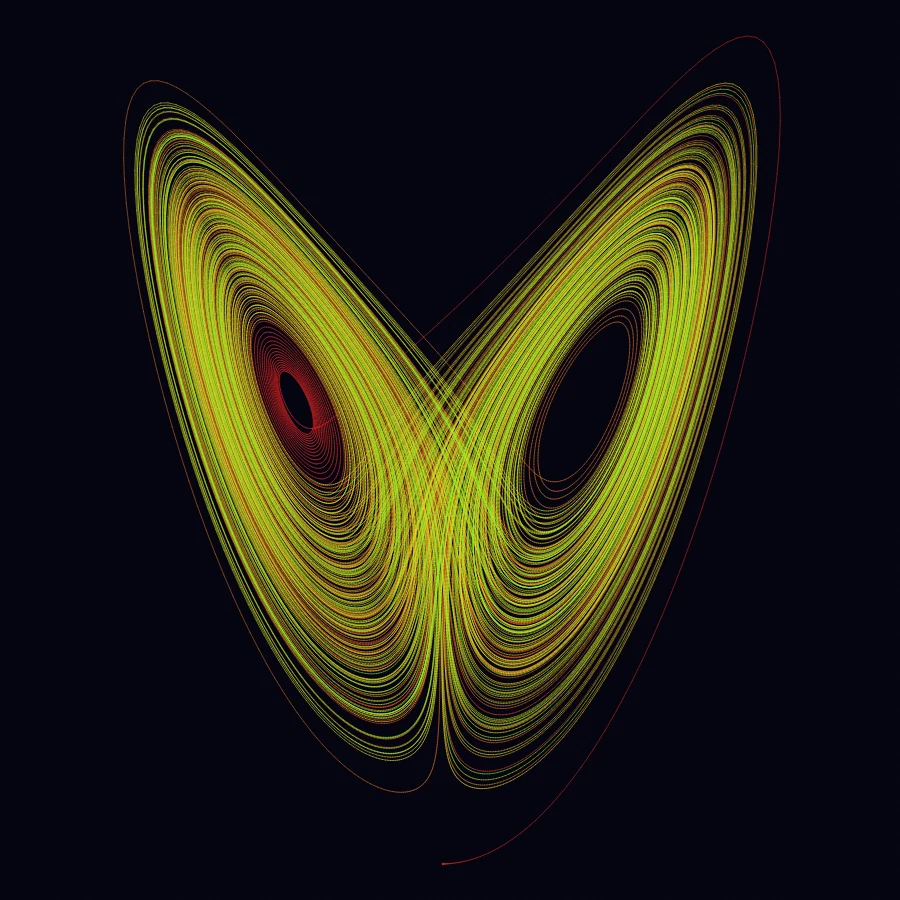
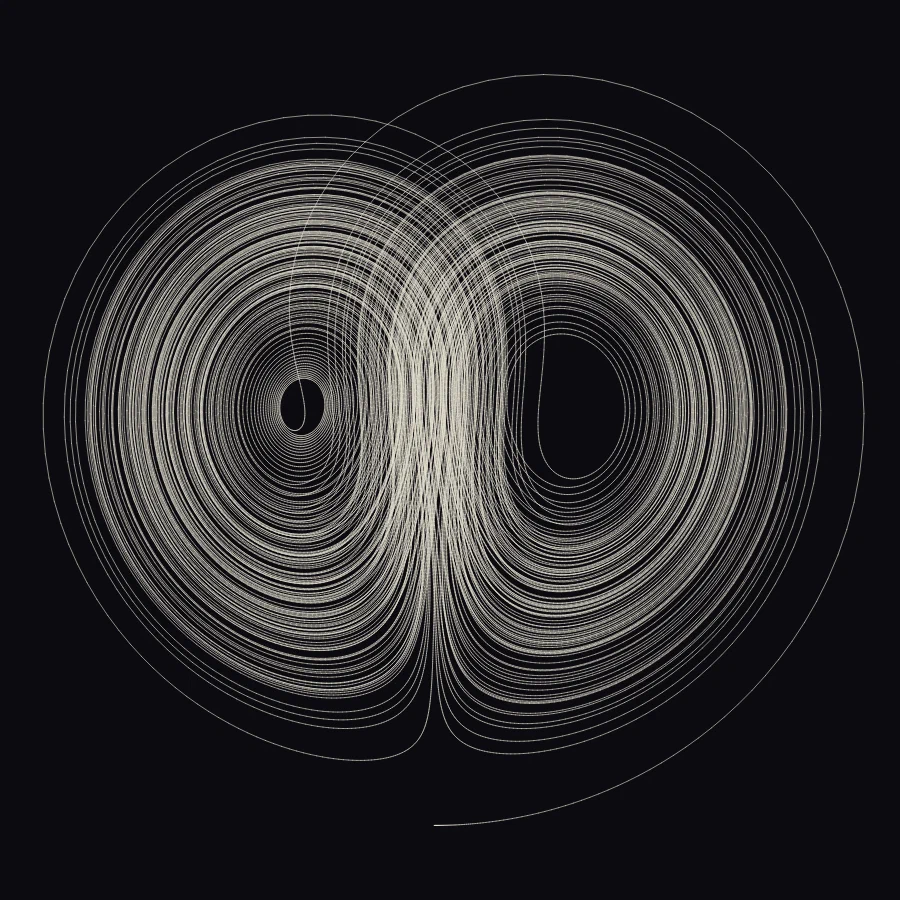
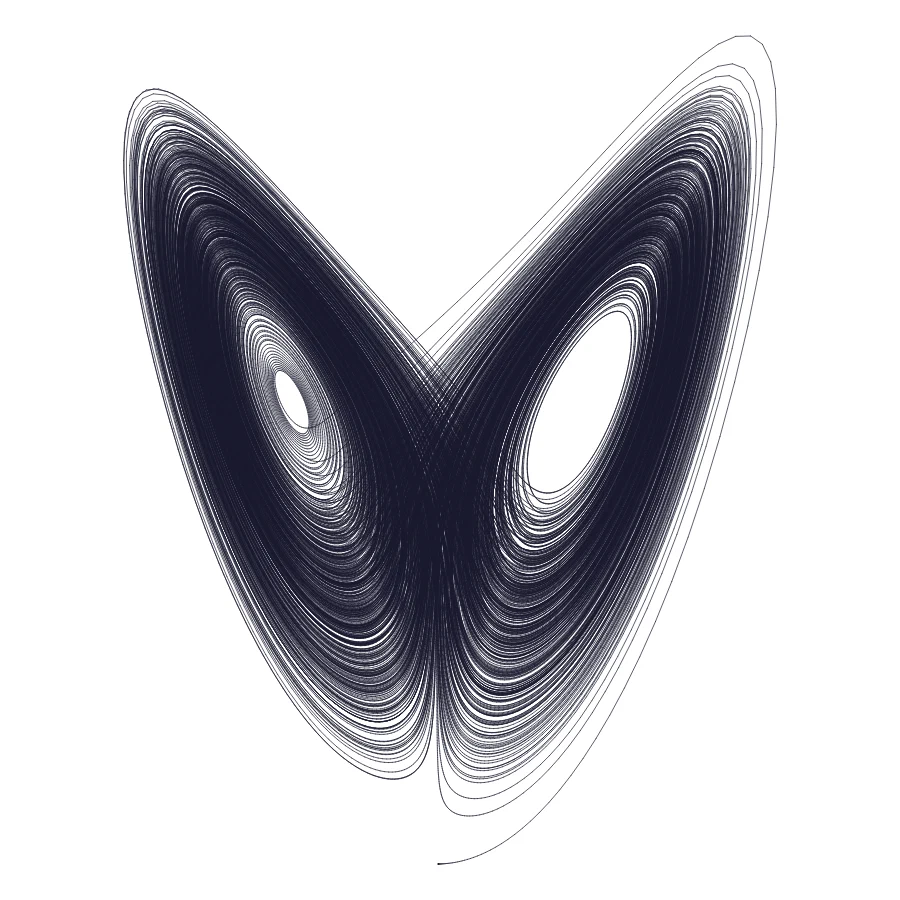
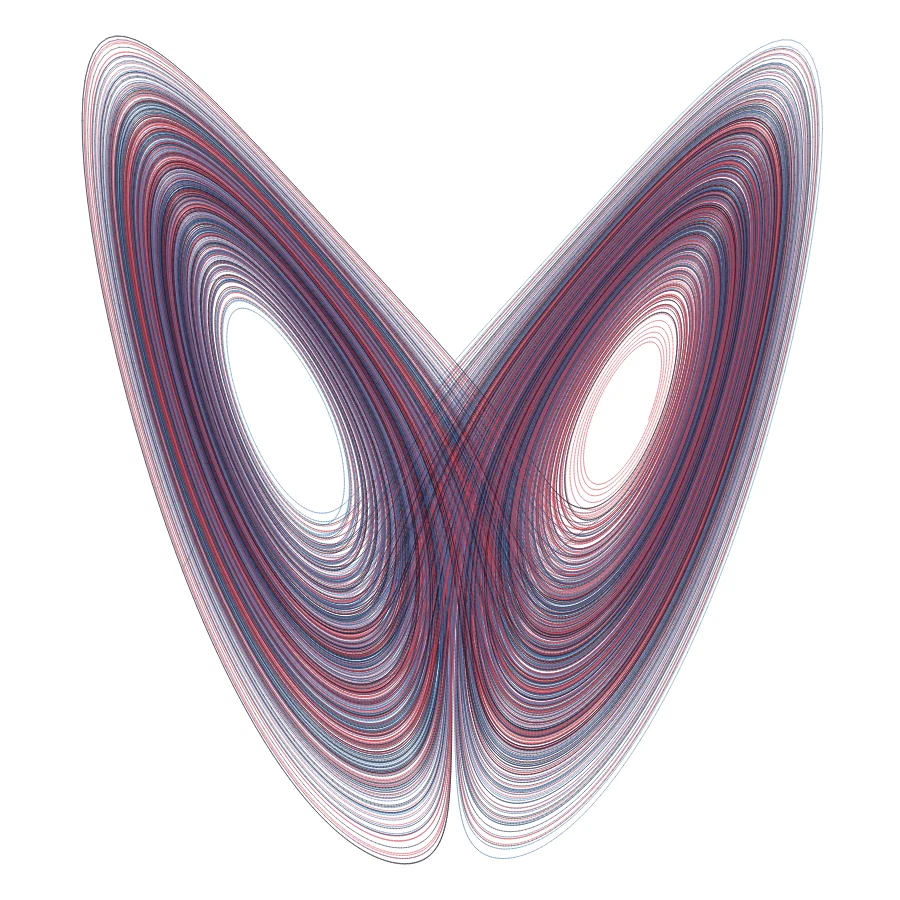
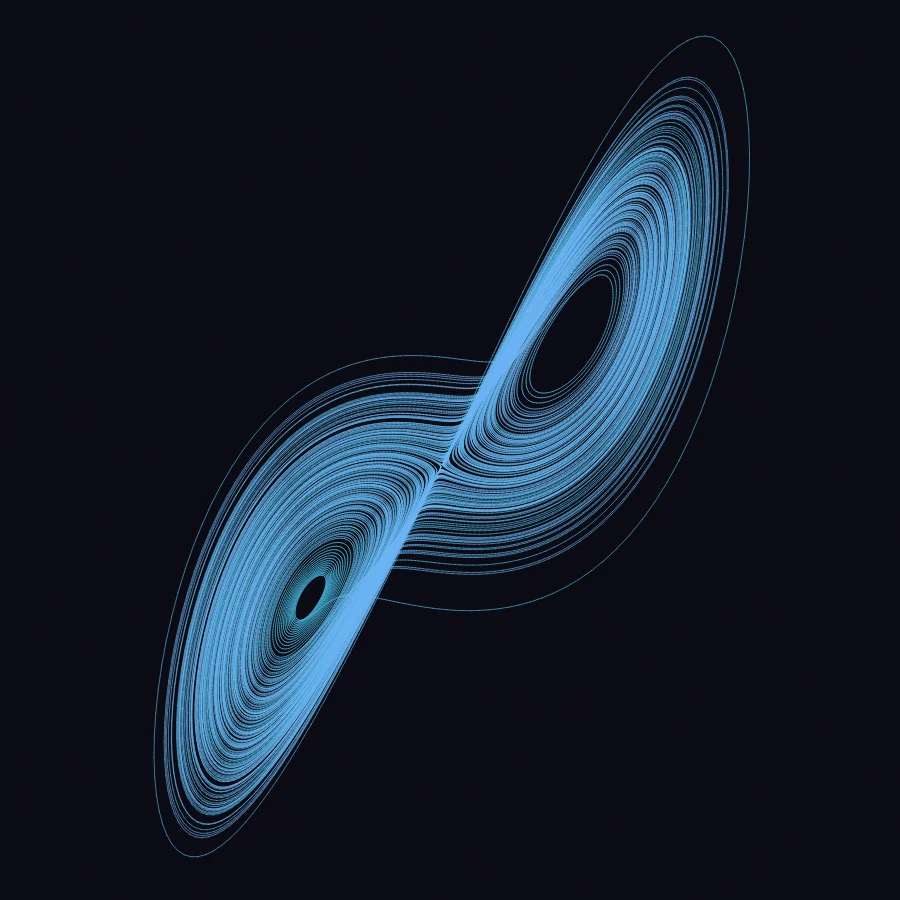
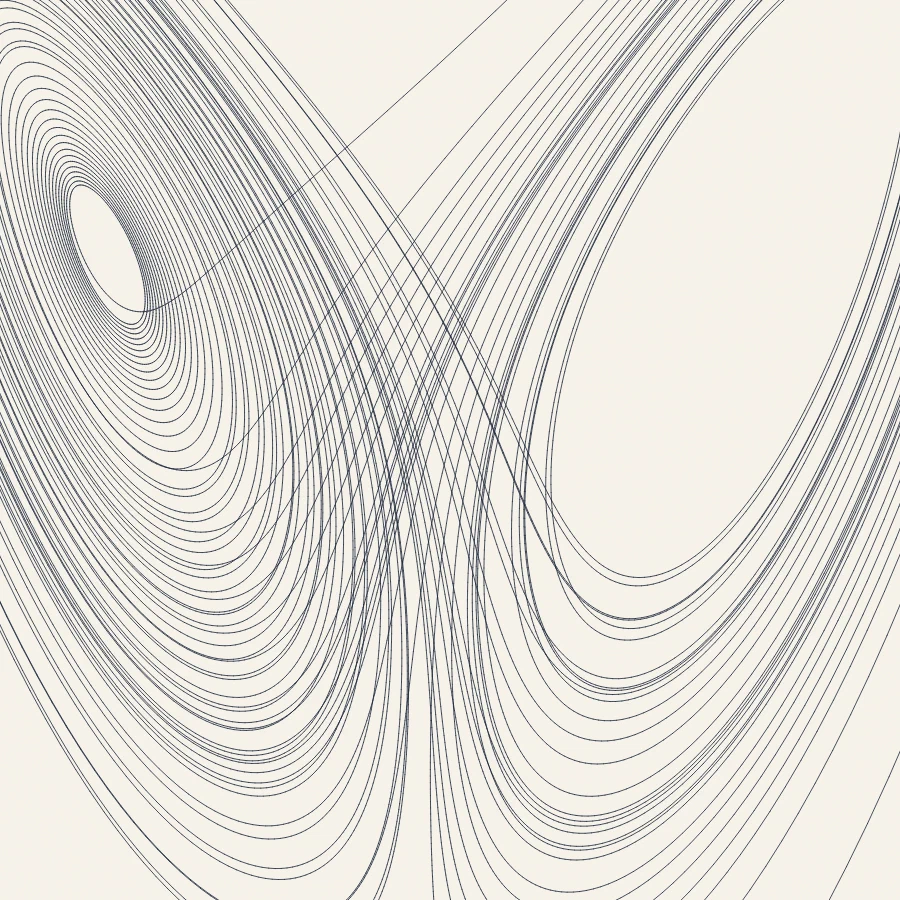
Two thirds. What look like two smooth surfaces are not. The attractor has fractal
dimension about 2.06 — more than a surface, less than a solid — and every apparent
sheet is really infinitely many sheets stacked with gaps at every scale.
The apparent crossings are the projection. The trajectory lives in three dimensions and
this is a picture of two of them, so lines that appear to intersect are passing at
different depths.
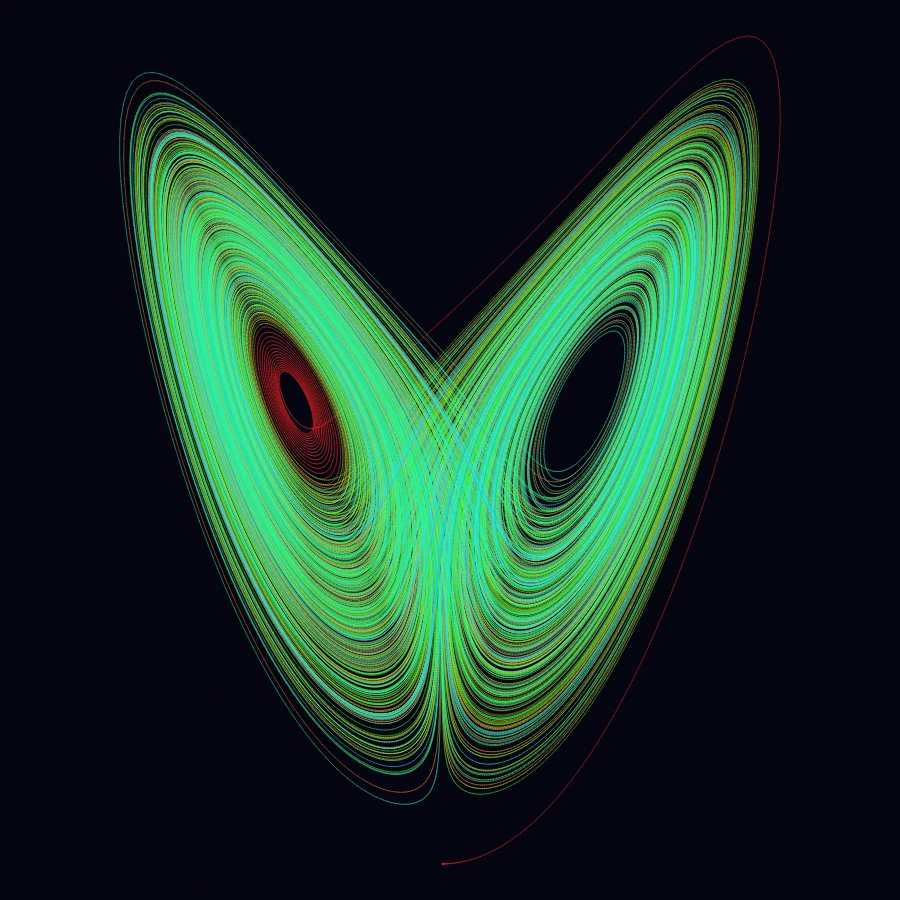
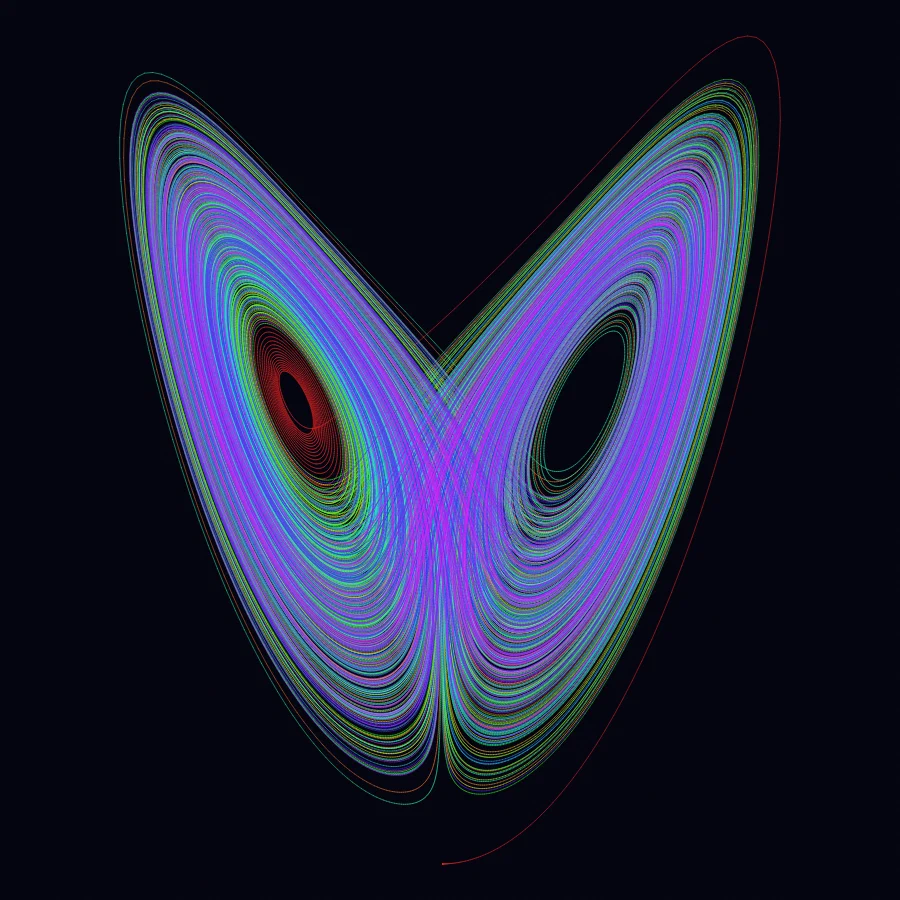
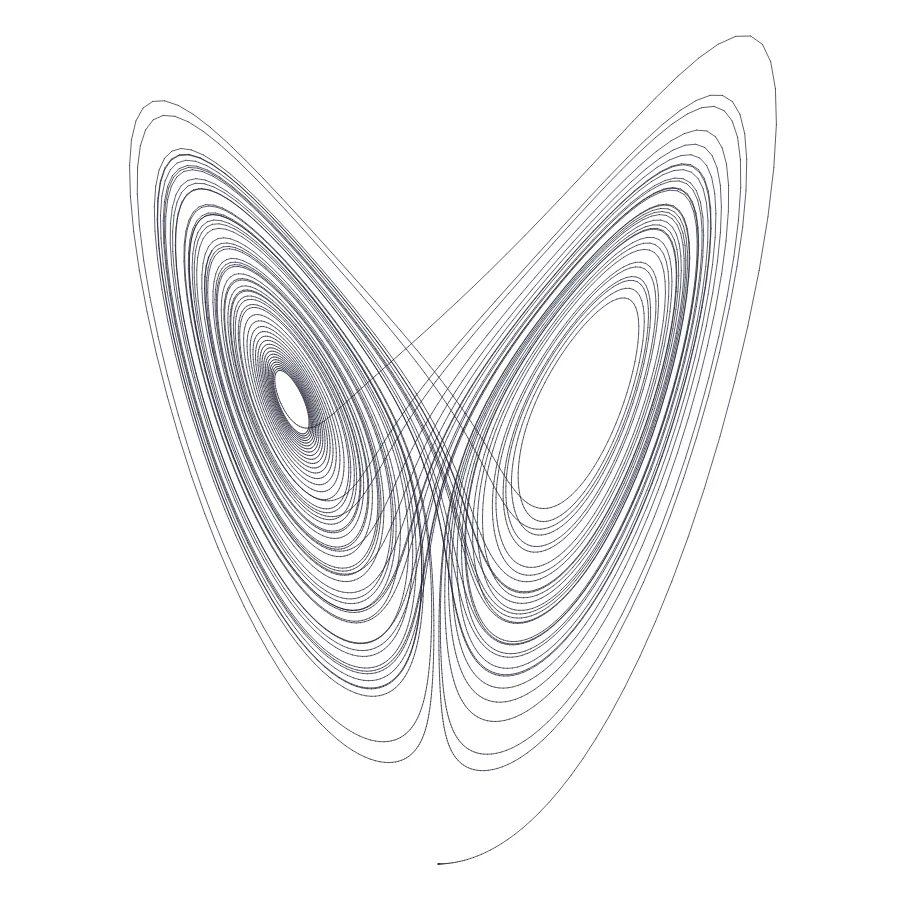
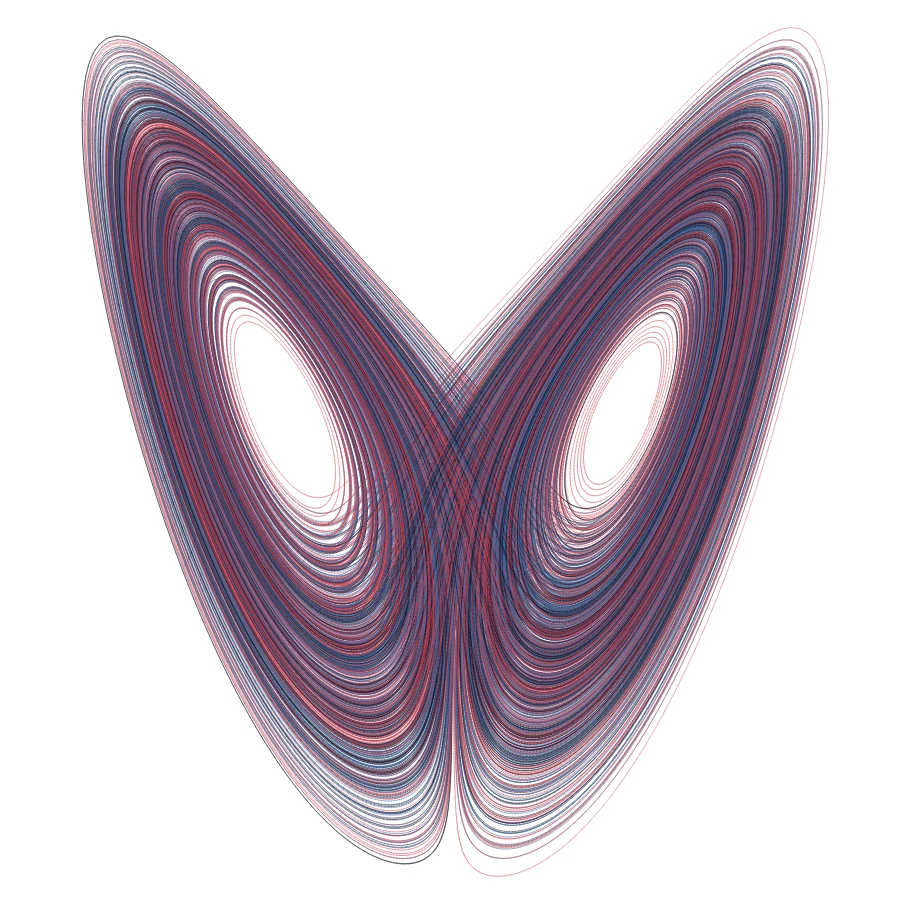
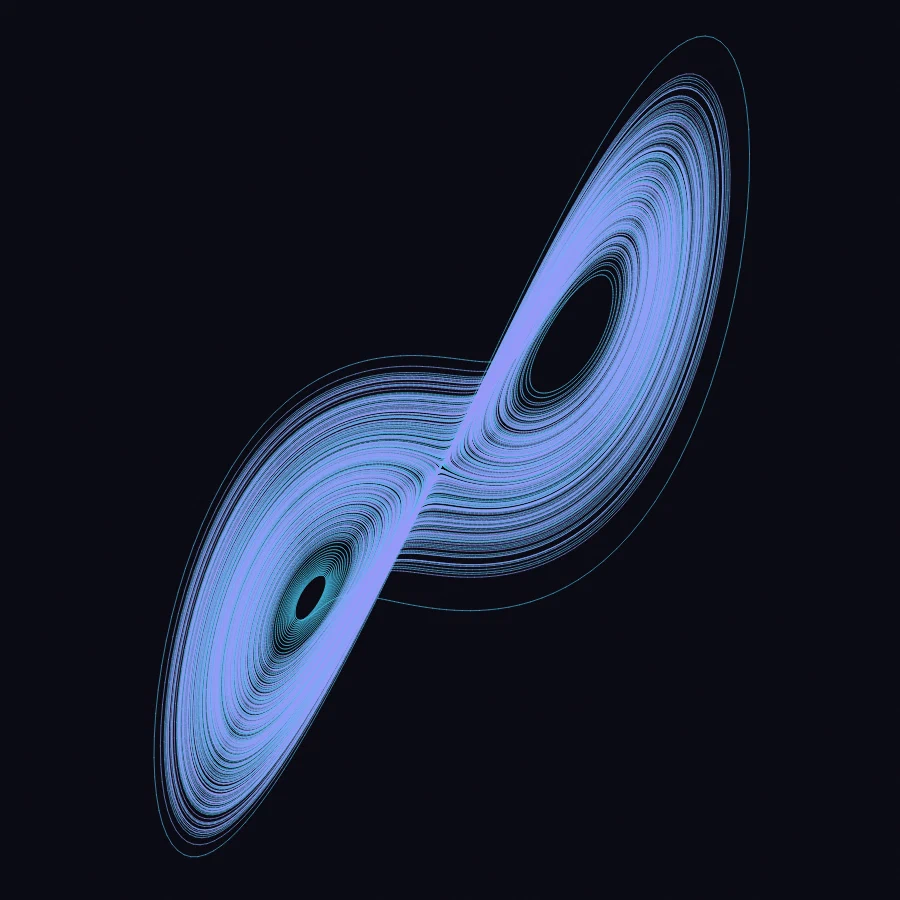
The full run: 200,000 steps of one continuous path.
Six renderings
| Rendering | Projection | Steps | Colour |
|---|
| Butterfly | x against −z | 200,000 | hue sweep along the path |
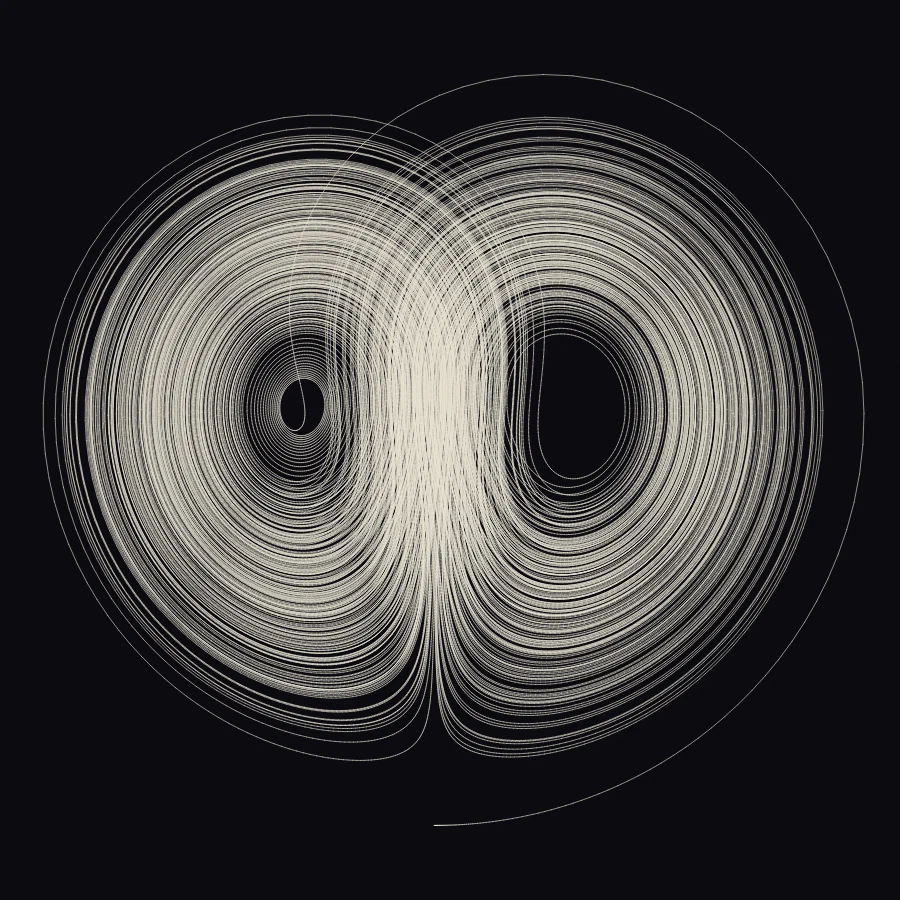
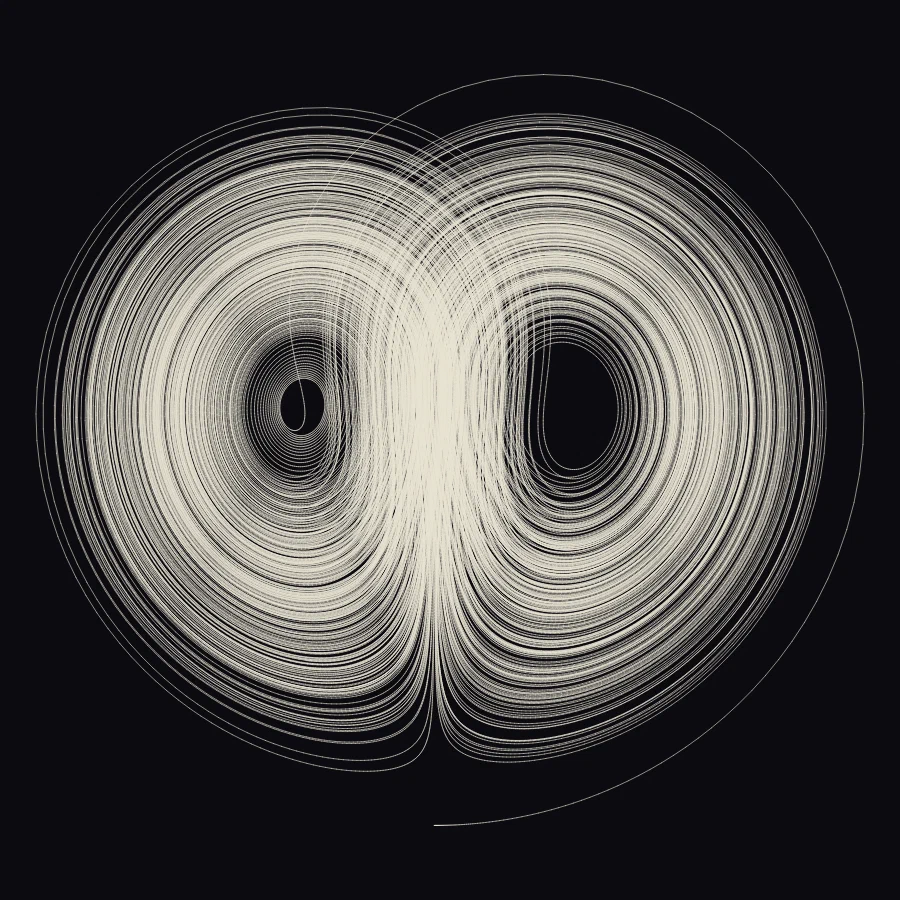
| Flank YZ | y against −z | 110,000 | flat ivory on near-black |
| Sparse White | x against −z | 80,000 | flat ink on white |
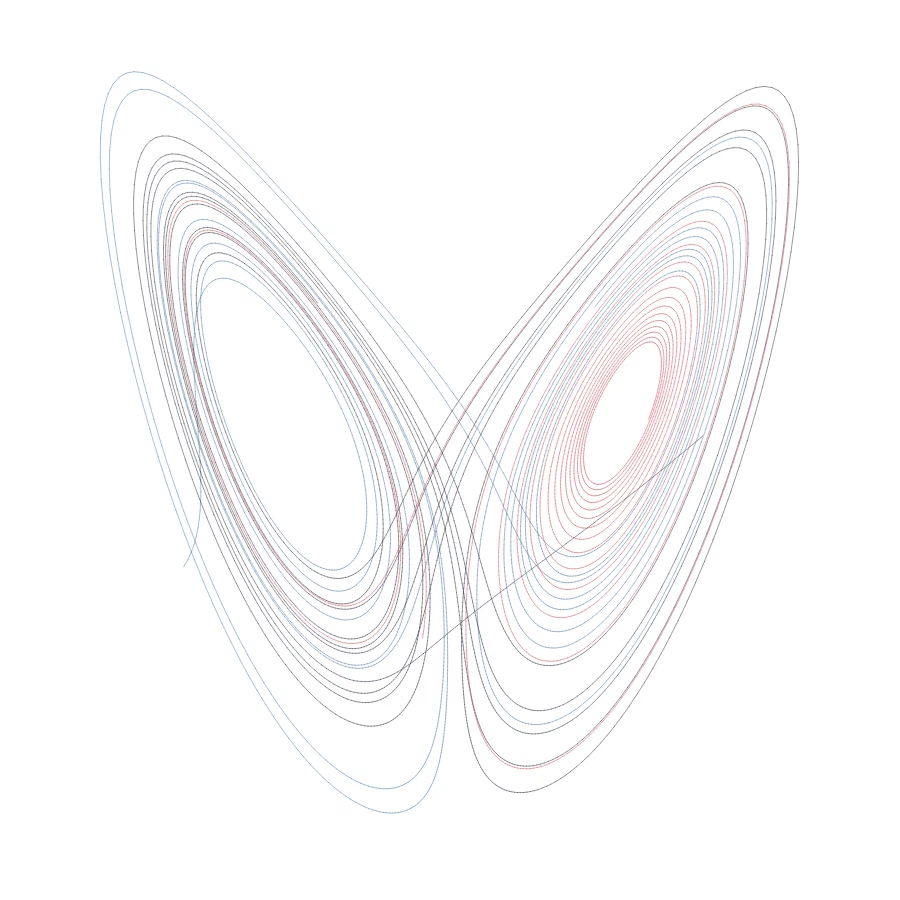
| Threads | x against −z | 90,000 | three colours, three trajectories |
| Velocity XY | x against −y | 150,000 | cyan-to-violet along the path |
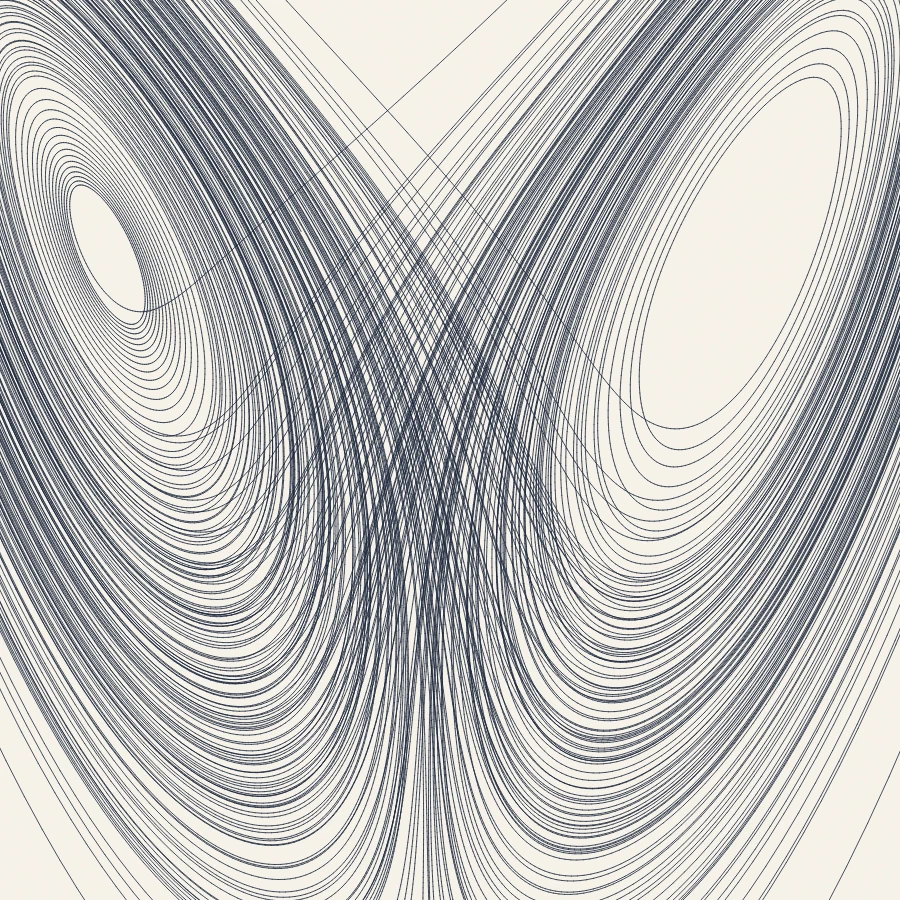
| Weave | x against −z, ×2.2 | 40,000 | bold ink on warm paper |
Butterfly, Flank YZ, and Velocity XY are the same trajectory seen from different sides.
The XZ view is the familiar butterfly — the one on every poster — because the two lobes
separate cleanly in x and z. The YZ view turns it edge-on: the same two lobes, seen
from the side, stacked into a figure of eight. The XY view collapses them: x and y
are strongly correlated, so the figure becomes a diagonal band and the lobe structure
nearly disappears.
Nothing about the system changed for any of these. The information that makes the
butterfly recognisable is in which two coordinates you choose to plot.
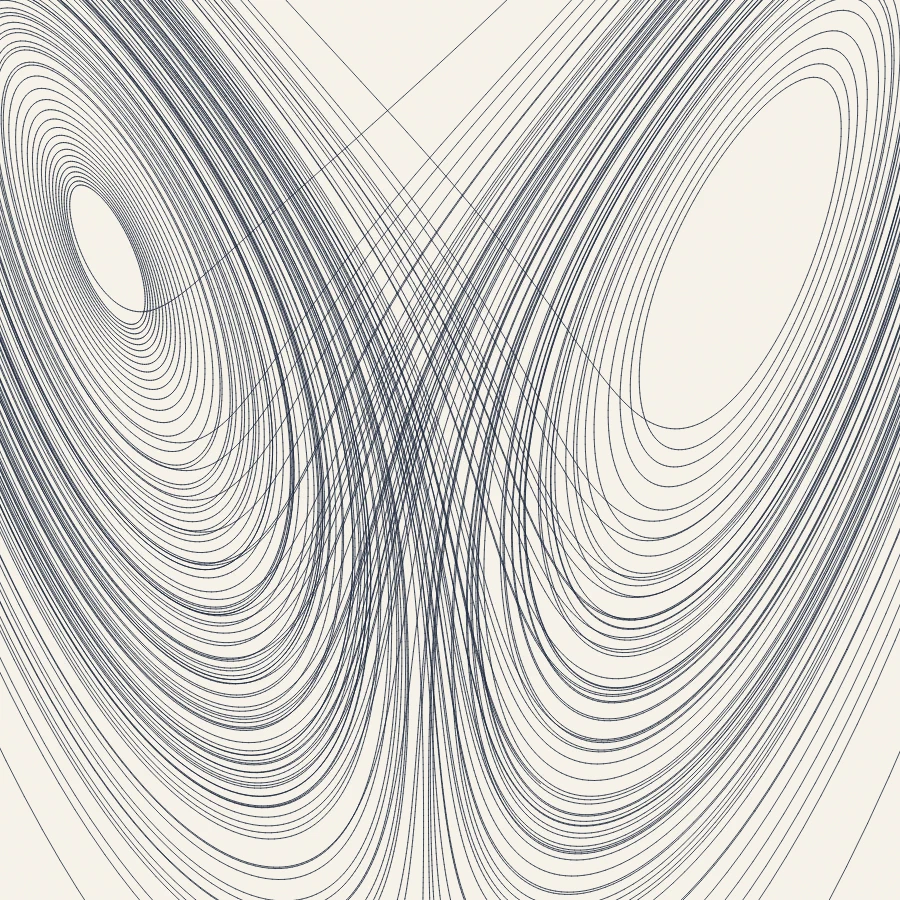
The other three take the XZ view apart. Sparse White stops after eighty thousand steps
at a coarser step size, so the paper stays visible between the orbits and the drawing
reads like pen on paper. Threads starts three trajectories from three different points
of the attractor and draws them one segment at a time in three different colours, so
the strands interweave instead of lying in layers. Weave is the Butterfly’s own first
forty thousand steps, but the frame is pushed in to where the two lobes meet: forty
thousand crossings of one filament over another, a fabric woven by the equations.
The framed piece
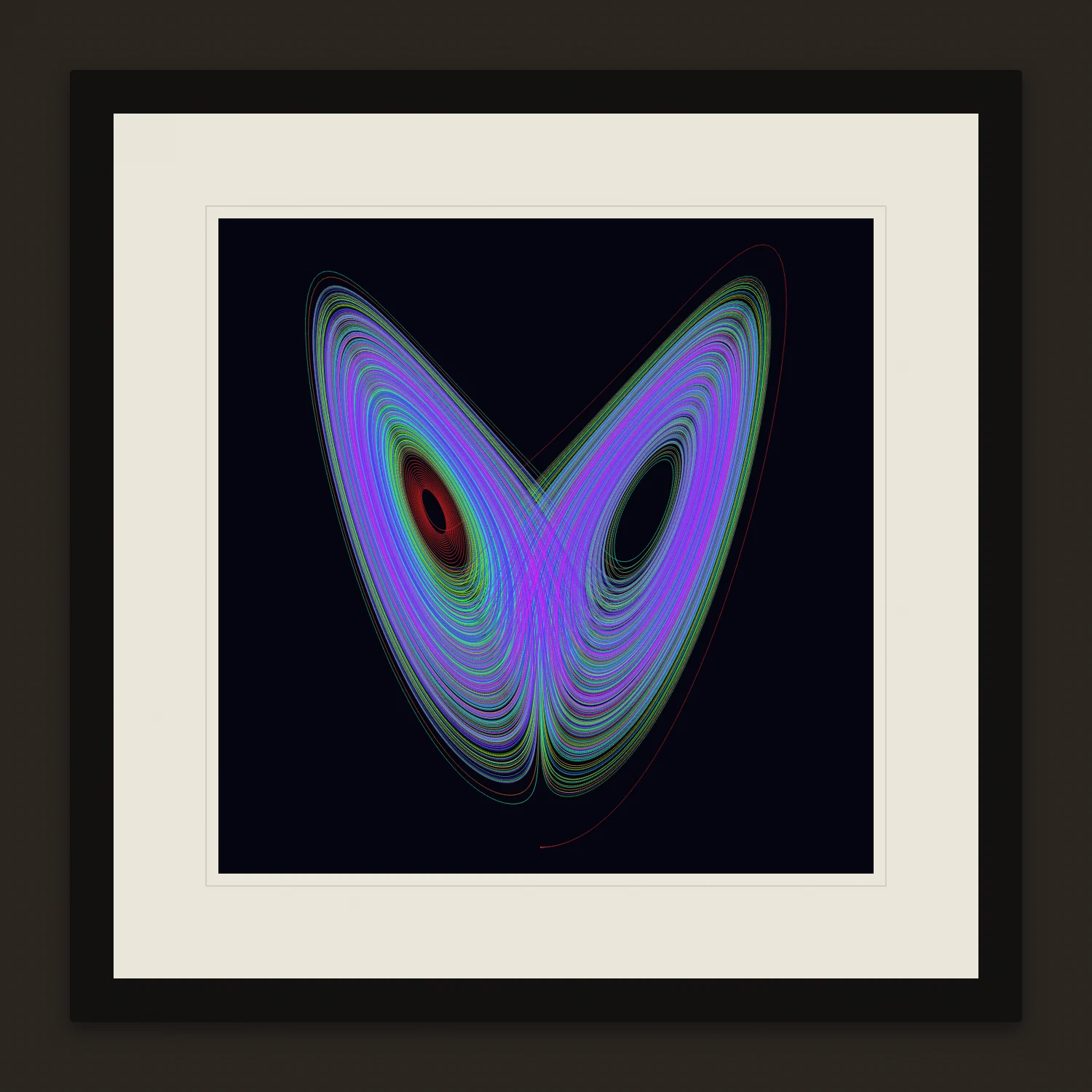
The framed plate in the gallery is not a seventh rendering. It is the first one, hung:
the Butterfly, at its own scale, sitting in a mat, a frame and a wall. The framing is a
presentation layer drawn around the render, not a change to it — the artwork is drawn
at its own size into a window of its own size, so nothing inside the frame differs
from the picture above. It is the same separation a museum keeps: what the work is,
and how it is shown.
Determinism
Nothing is seeded and nothing is random. The initial condition is a constant, the
integrator is fixed-step RK4, and the framing is measured from the trajectory itself.
Two runs on the same machine produce identical output; the chaos is in the system, not
in the computation.