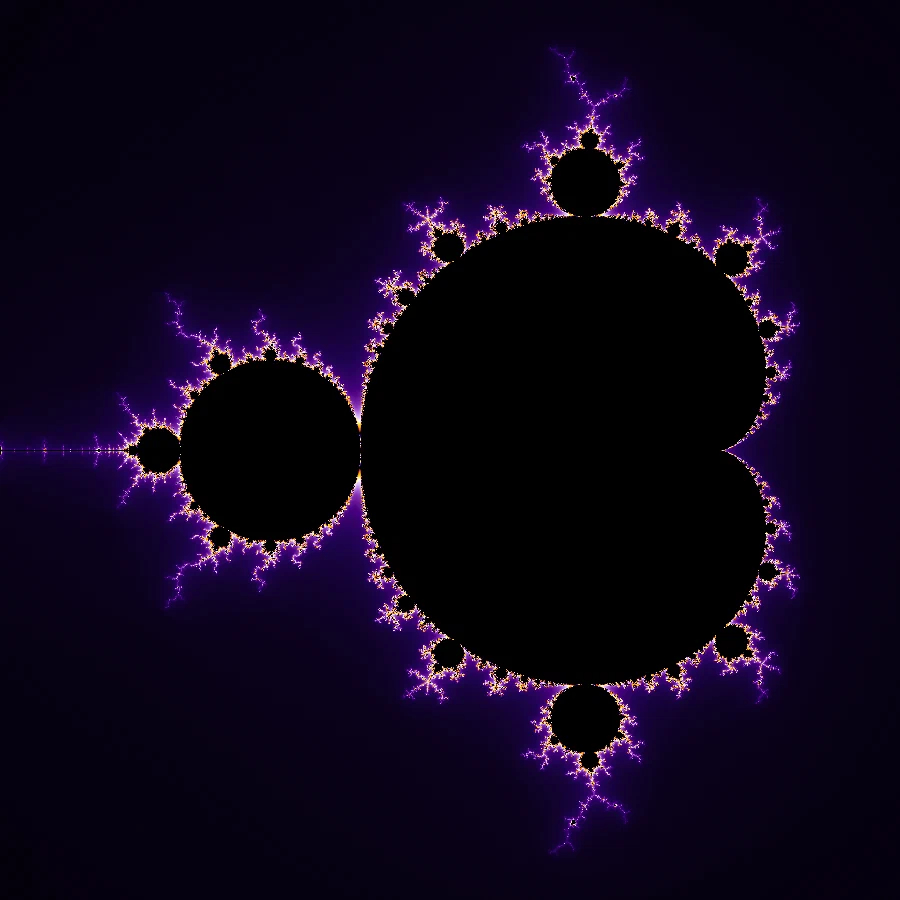
The set of complex numbers whose orbit under z² + c never runs away — and the atlas of every Julia set.
The same iteration, the other way round
z ← z² + c, starting from z = 0
For the Julia set, c is fixed and the pixel supplies z. Here it is reversed: z
starts at zero and the pixel supplies c. The Mandelbrot set is the set of c
values whose orbit stays bounded.
That inversion makes it a map rather than a picture. Every point of the Mandelbrot set
names a c, and every c names a whole Julia set — and Mandelbrot’s set is precisely
the set of c for which that Julia set is connected rather than dust. It is an
atlas of an infinite family of other objects.
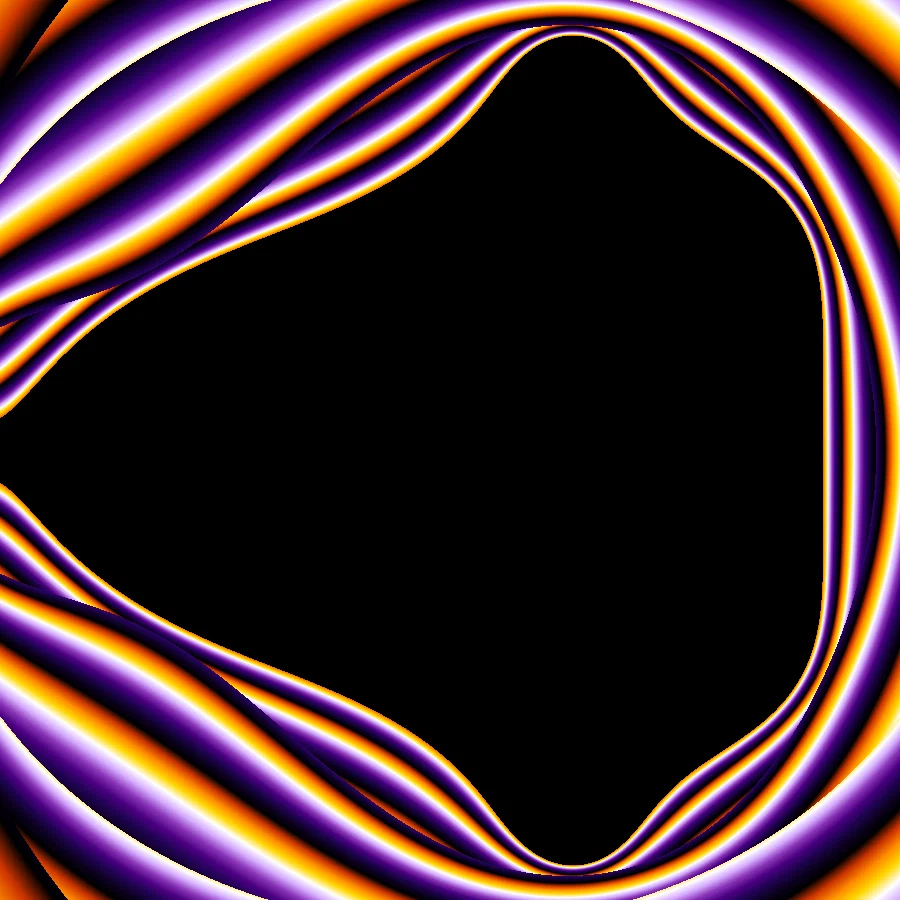
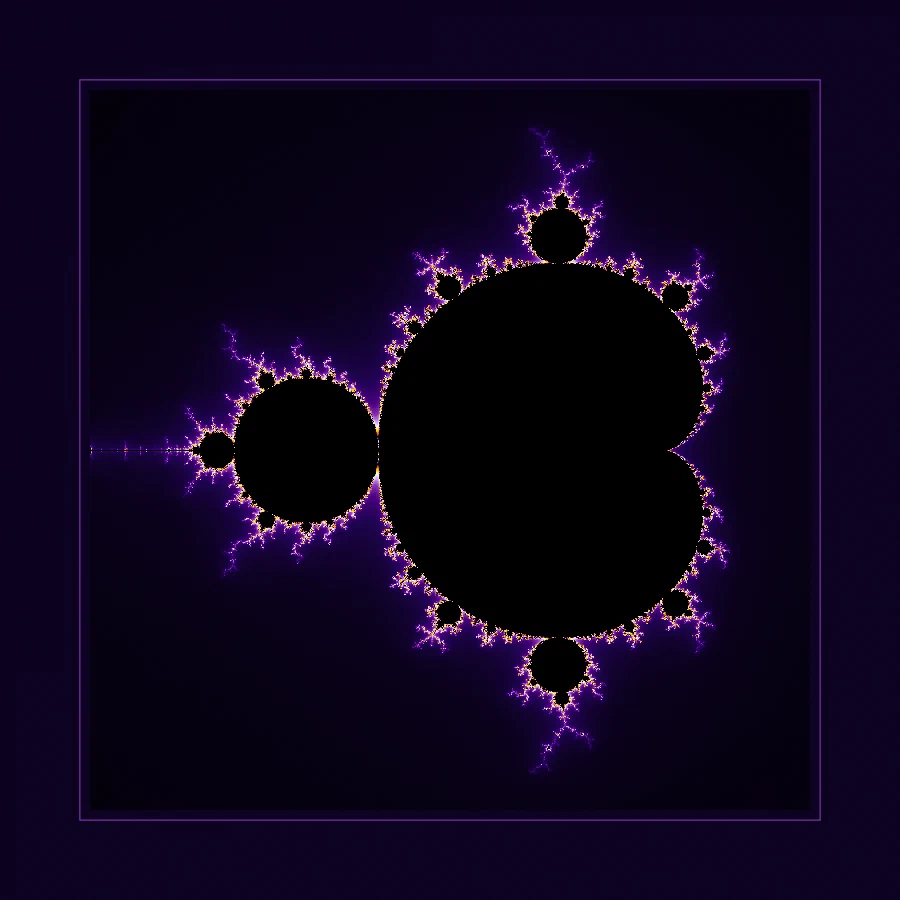
Five iterations. Only points well outside the set have had time to exceed the escape
radius; everything else is still a candidate, and drawn black.
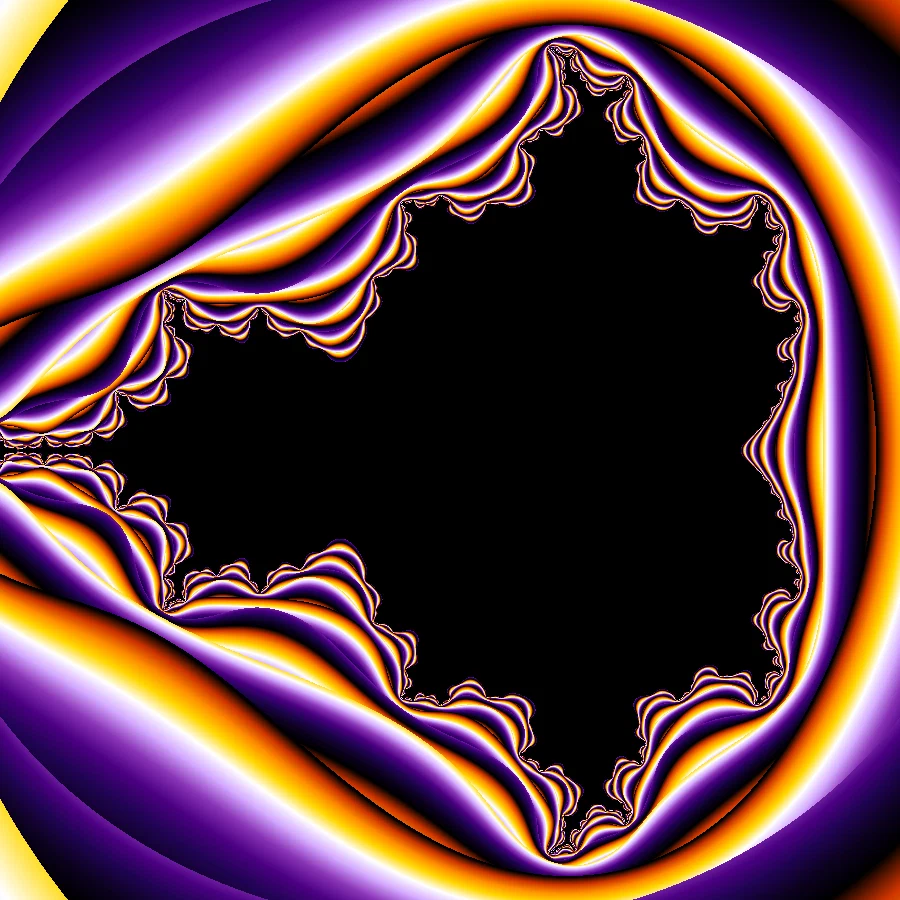
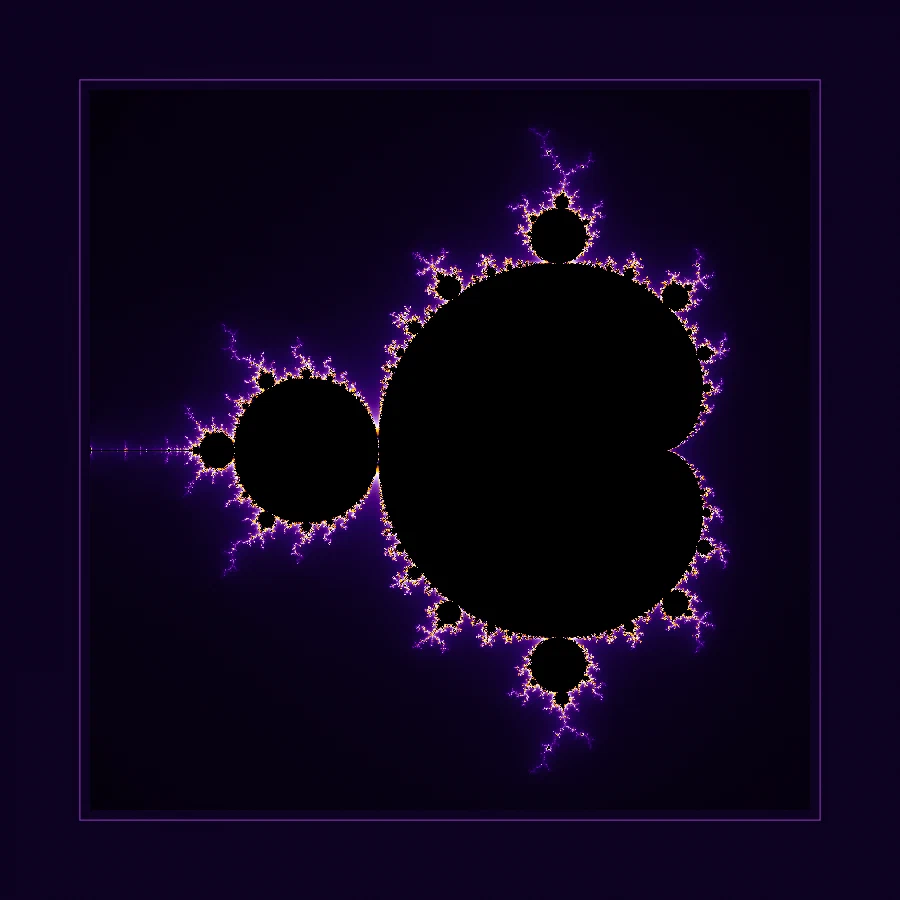
Twelve iterations, and two features have already separated: the large cardioid on the
right and the circular bulb on its left.
Both are known exactly. The cardioid is the set of c for which the orbit converges to
a fixed point, and it is the image of the unit circle under c = μ/2 − μ²/4. The bulb
is a true circle of radius 1/4 centred at −1, and it is where the orbit settles into
a two-cycle instead.
Every smaller bulb around the boundary is the same thing for a longer cycle: period
three, four, five, and so on, arranged around the cardioid in an order given by the
rationals. The picture is not decorative in that region; it is a diagram of which
periods occur where.
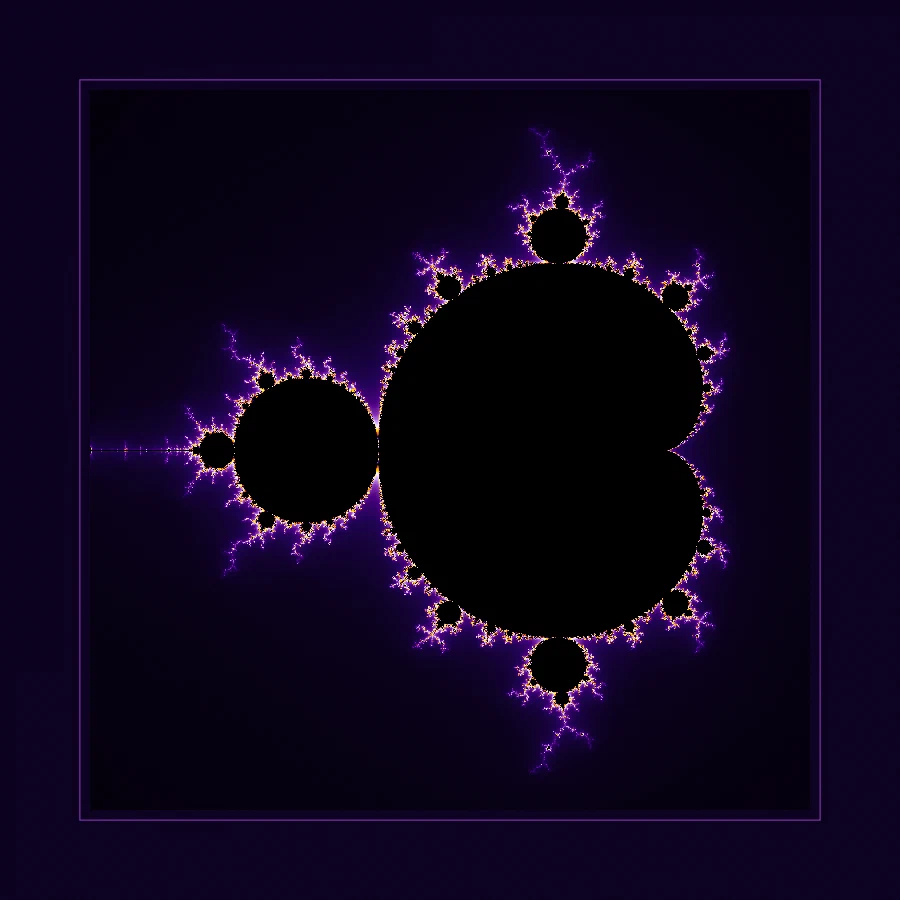
Thirty iterations. The smaller bulbs are visible, each with its own miniature
attachments.
It is connected
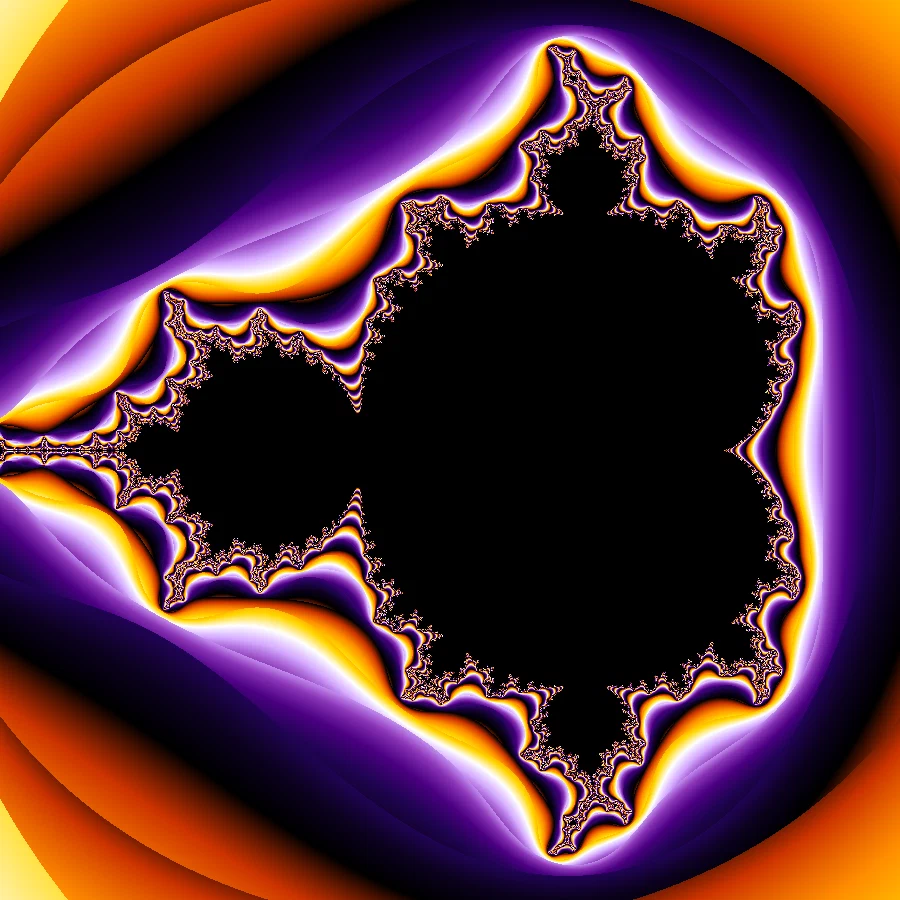
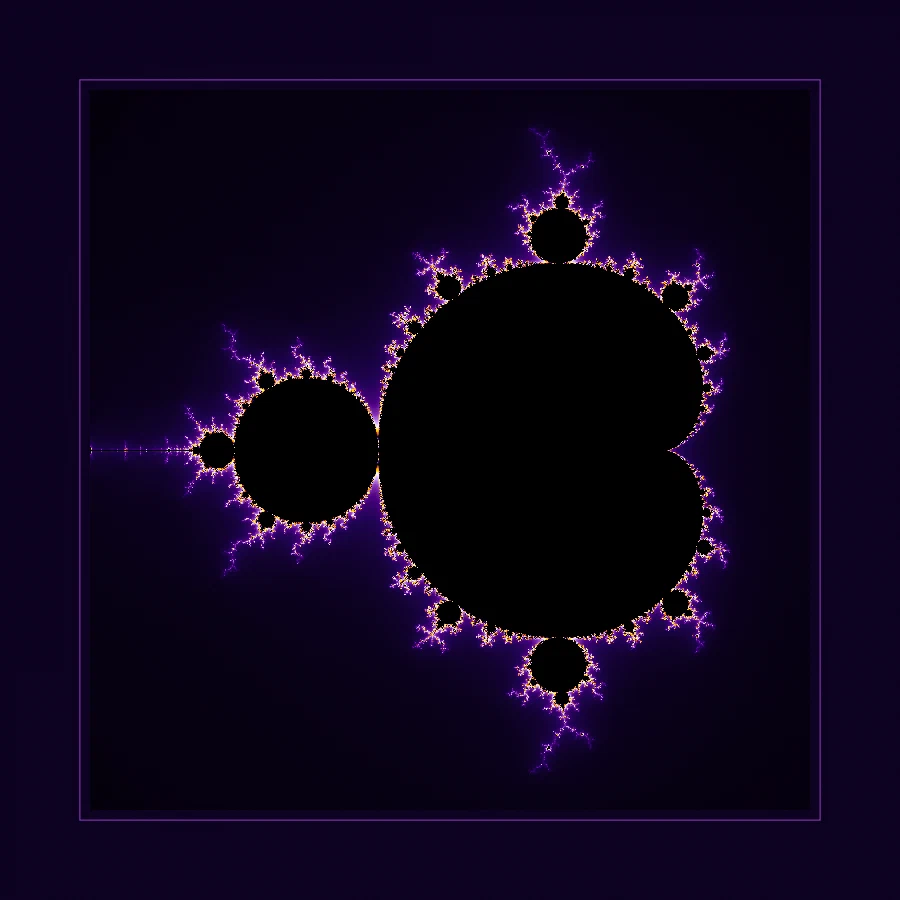
A hundred iterations. The filaments and the small copies of the whole set that dot them
look like separate islands, and they are not. Douady and Hubbard proved in 1982 that
the Mandelbrot set is connected: every apparently isolated speck is joined to the
main body by a filament, and the filaments are simply thinner than any resolution.
Every “island” in this picture is attached by something too fine to draw.
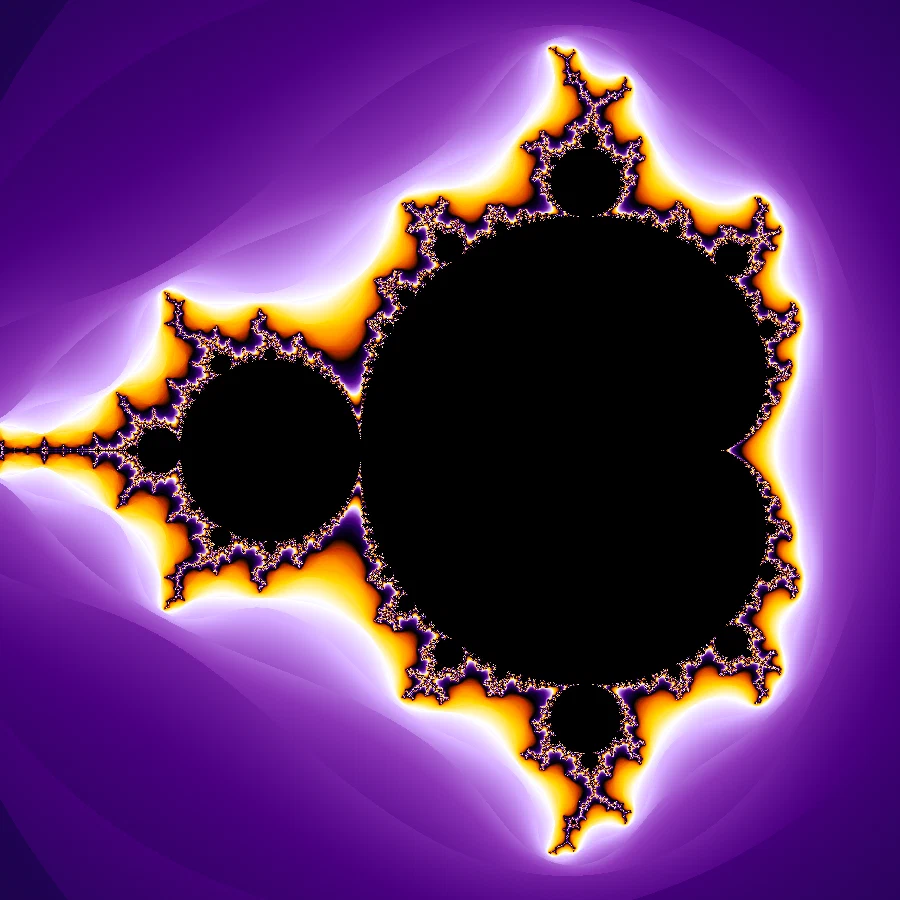
The full budget. As with any escape-time rendering, the black region is what has not
escaped yet rather than what will never escape — so it is always larger than the true
set, and shrinks with every increase in budget.
Four views
| Rendering | Centre | Half-height | Budget |
|---|
| Classic | −0.5 + 0i | 1.25 | 512 |
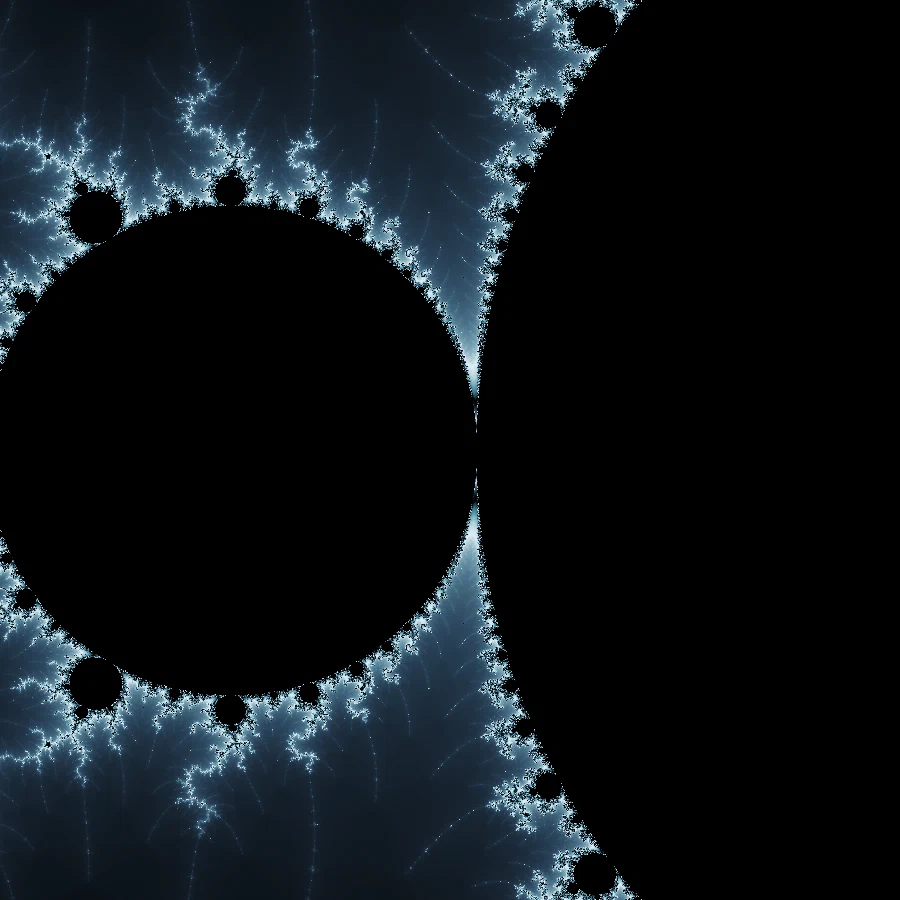
| Seahorse Valley | −0.7436 + 0.1318i | 0.00005 | 1024 |
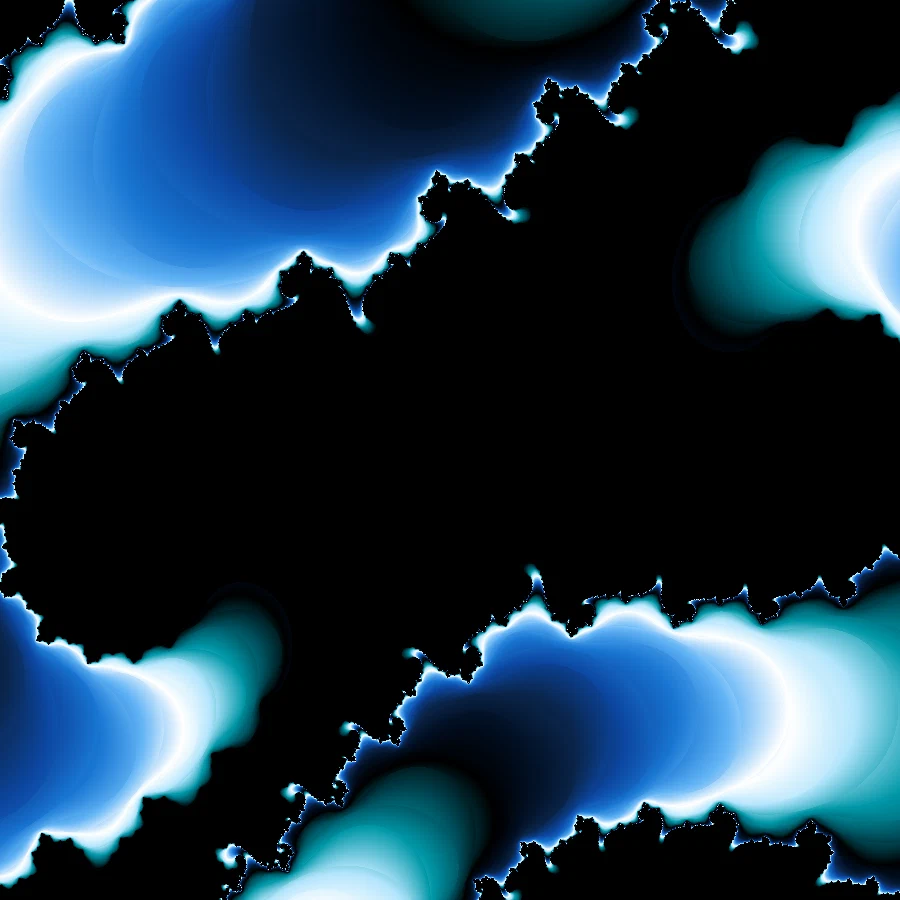
| Elephant Valley | −0.1226 + 0.7449i | 0.008 | 1000 |
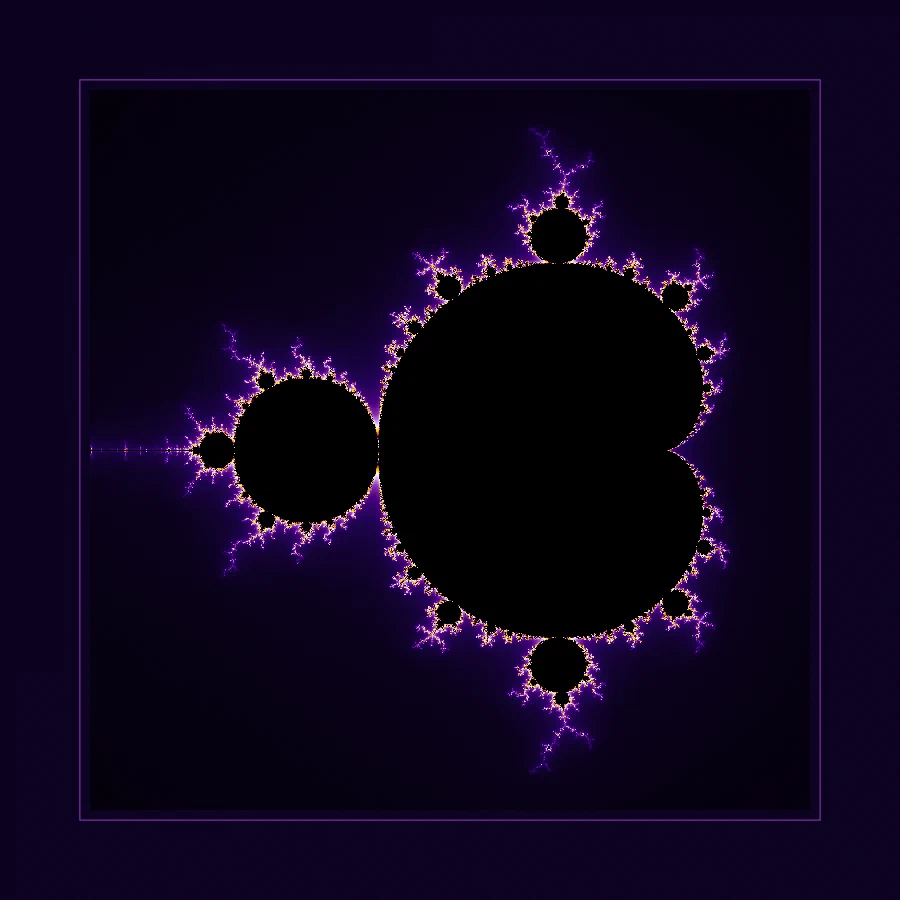
| Island | −1.769 + 0i | 0.008 | 1500 |
Seahorse Valley is the region on the boundary between the cardioid and the period-two
bulb — the point where two attracting behaviours meet — and the structures there are
the reason it needs twice the budget. Points near a boundary between behaviours take
much longer to decide which side they are on, and every zoom into the set is a zoom
towards more of that.
Elephant Valley is the equivalent region at the period-three bulb. The period-three bulb
attaches to the cardioid at approximately −0.1226 + 0.7449i, and its own boundary is
where orbits that settle into three-cycles give way to orbits that escape. The spirals
there are tighter and more numerous than at the period-two junction.
Island is a small copy of the complete set embedded in the filament that extends along
the real axis. The copy has its own cardioid, its own period-two bulb, and its own
cascade of attached smaller bulbs — the same structure at a reduced scale, separated
from the main body only by the filament connecting them.
Smooth colouring
Escape time is an integer, and colouring by it directly gives visible bands. The
correction uses how far past the escape radius the orbit landed:
var smooth = iter + 1.0 - Math.Log(Math.Log(Math.Sqrt(mag2))) / Math.Log(2.0);
Because z is squared each step, magnitude grows doubly exponentially, and the double
logarithm recovers the fractional escape time from the overshoot. The bands become a
gradient, and the eleven-stop palette is cycled across it.
Determinism
Nothing is seeded and nothing is random. Every pixel is an independent fixed-point
computation in double, written into the bitmap in scanline order.