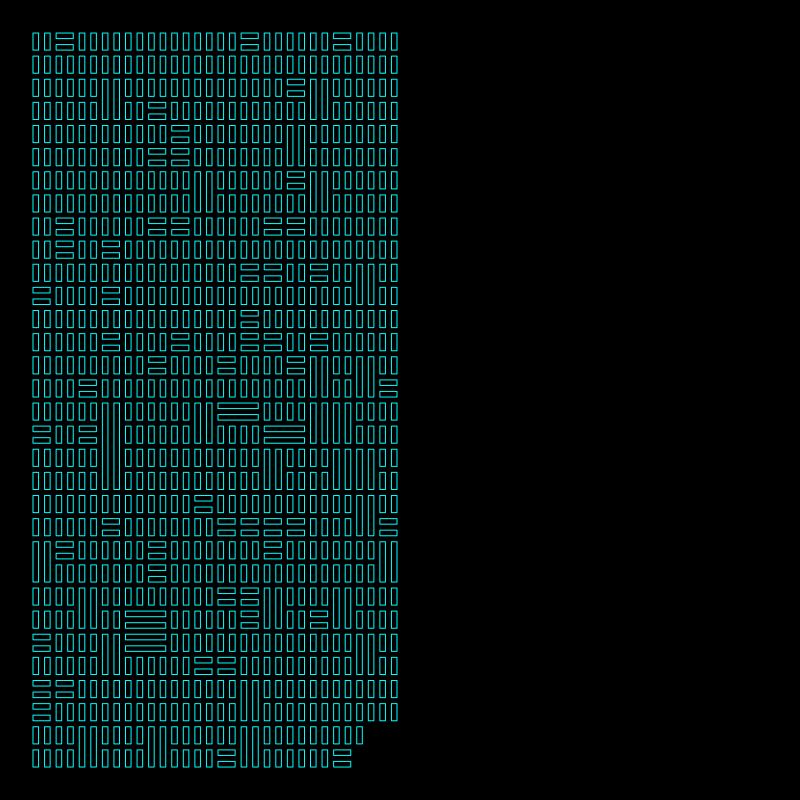
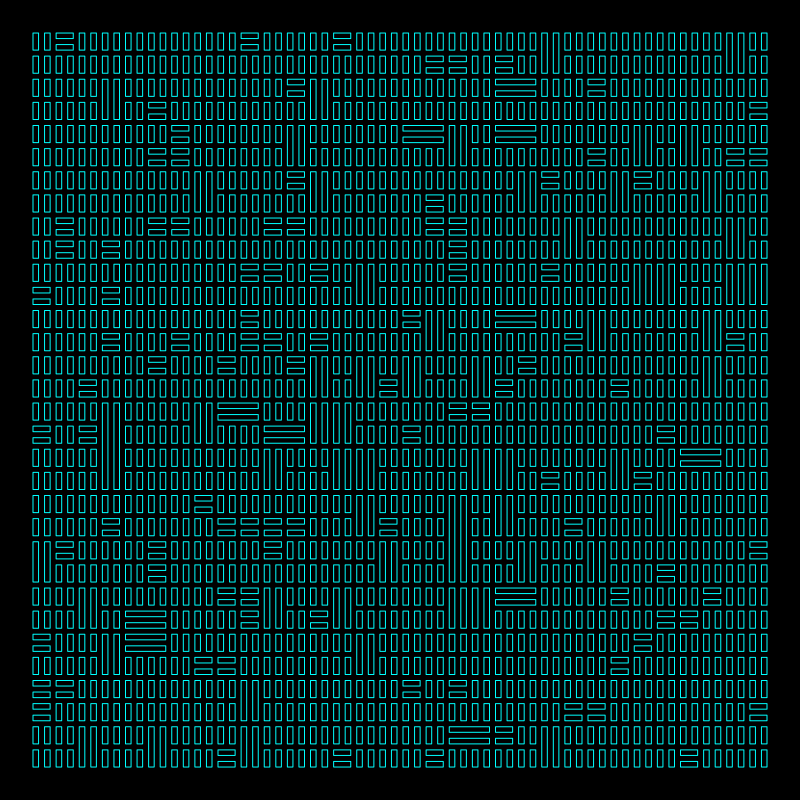
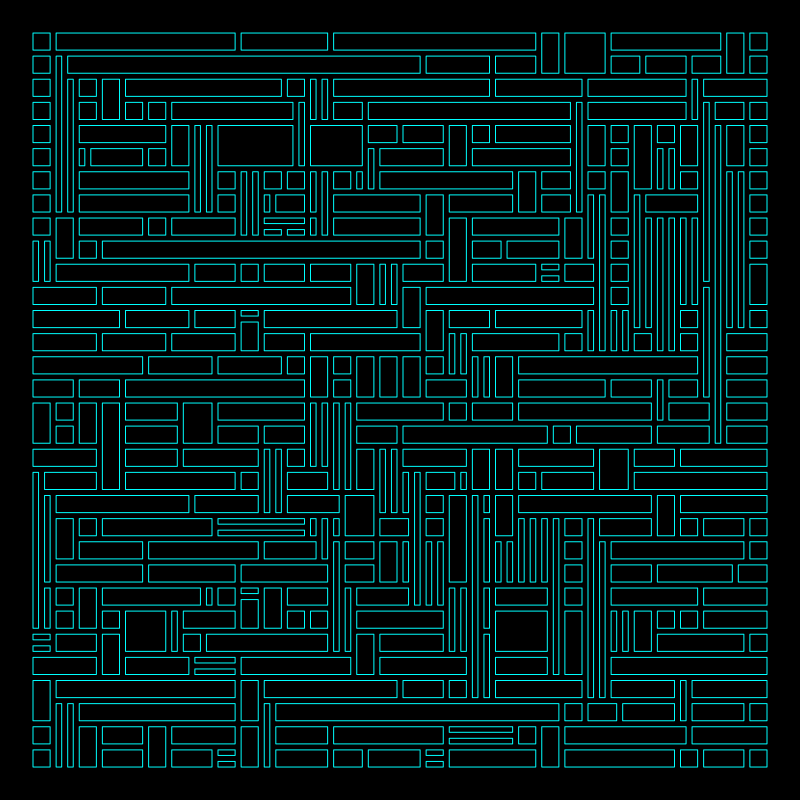
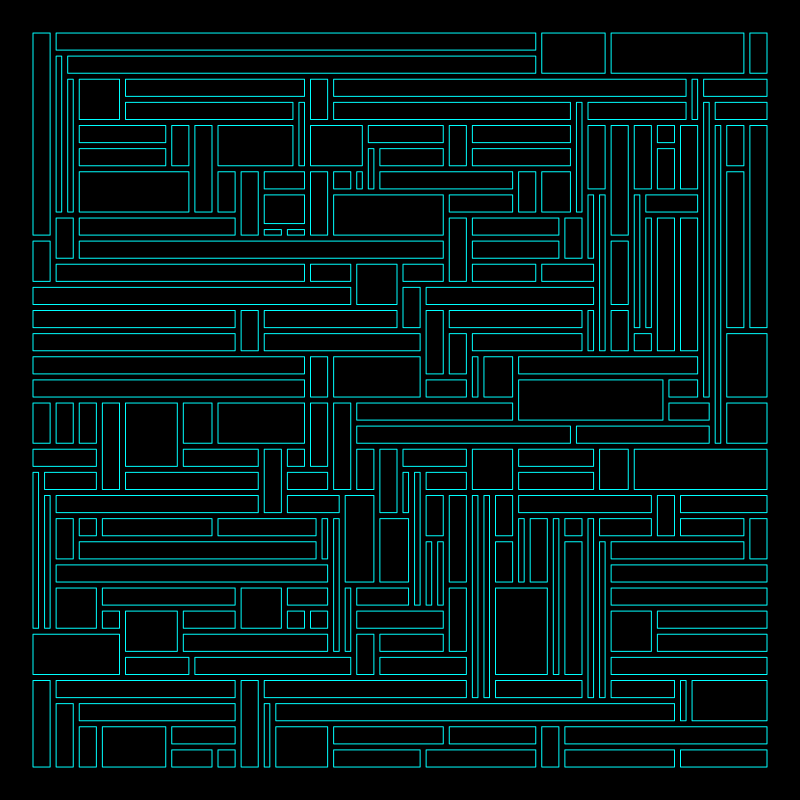
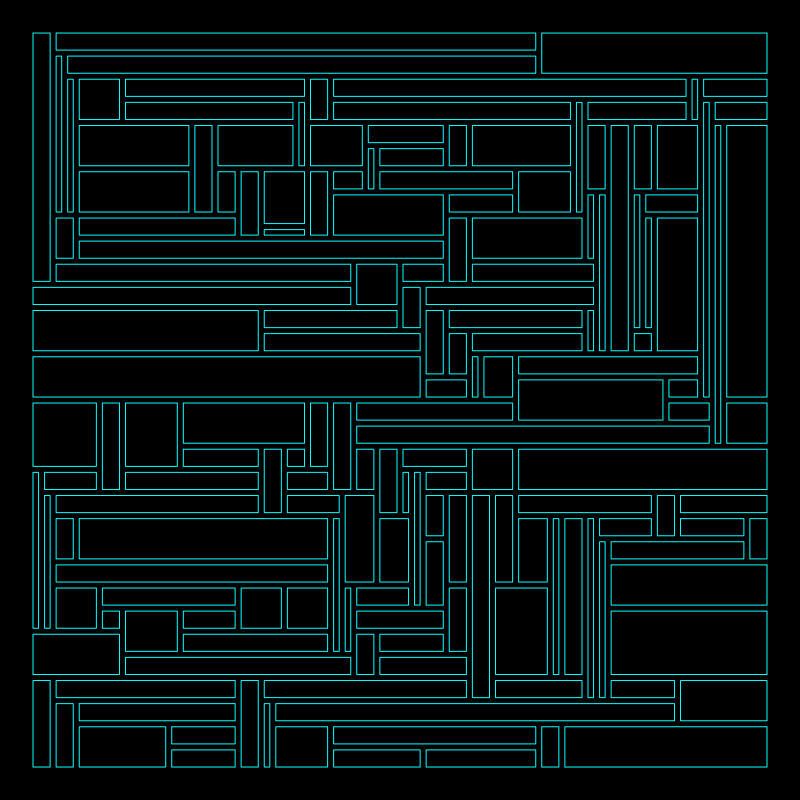
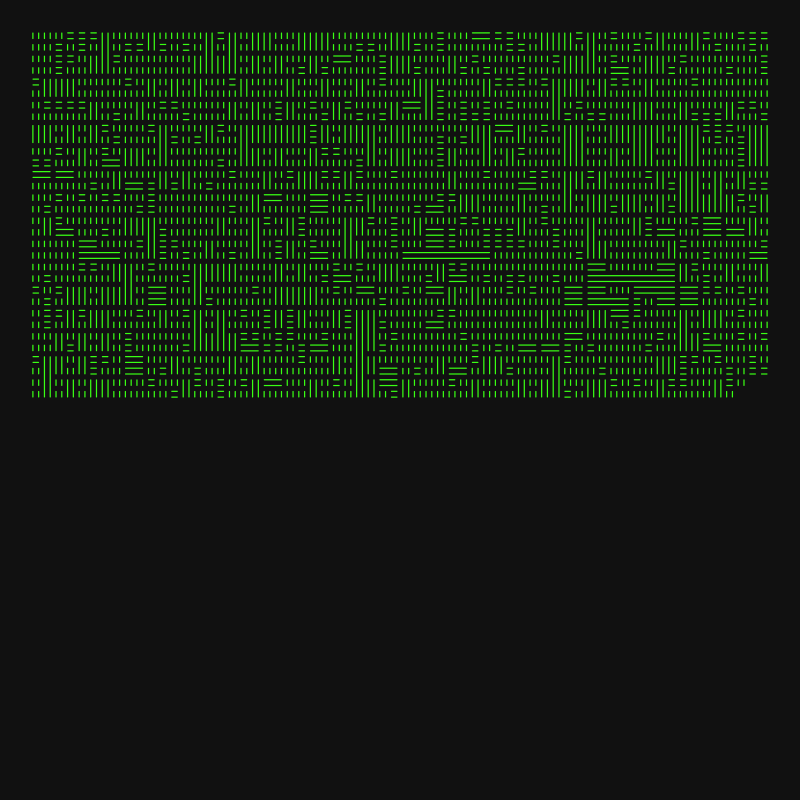
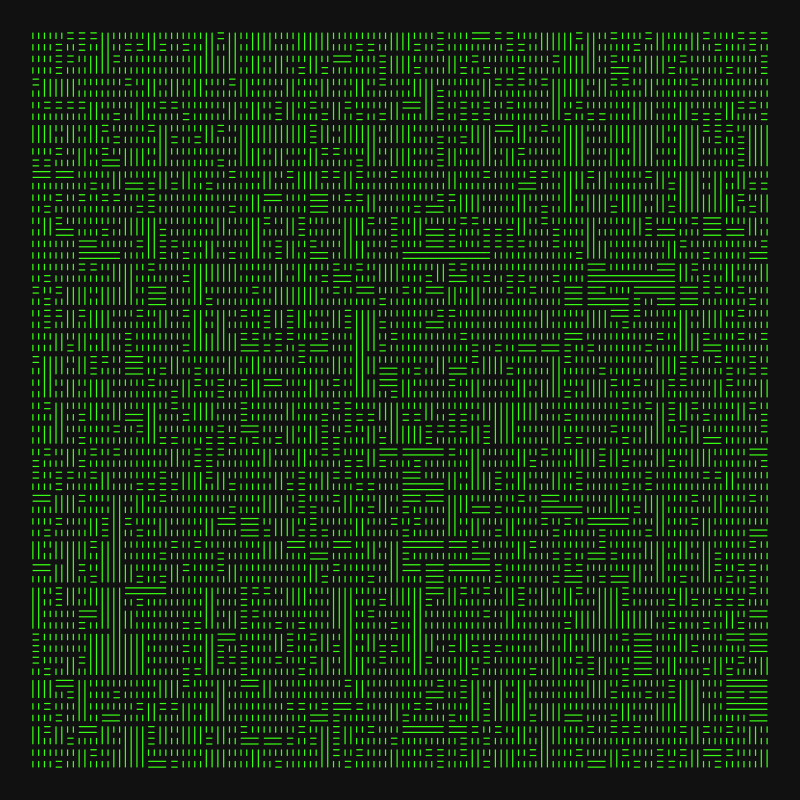
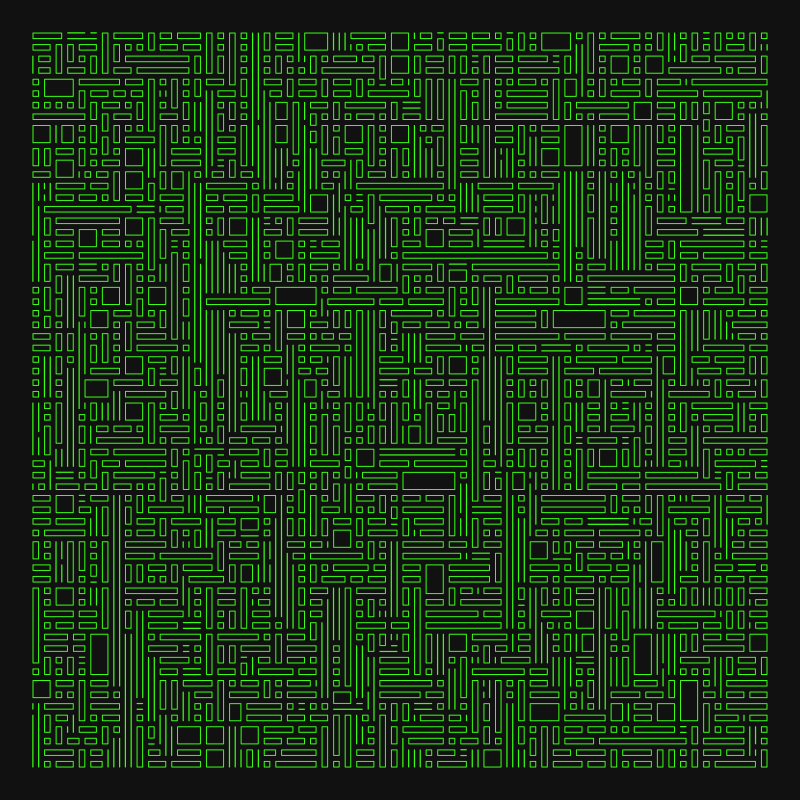
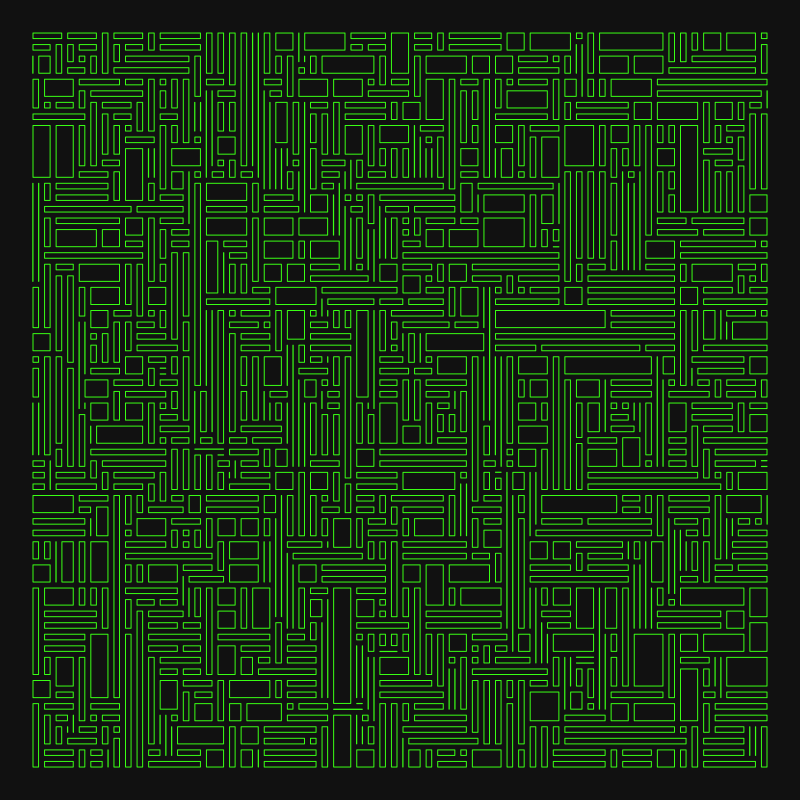
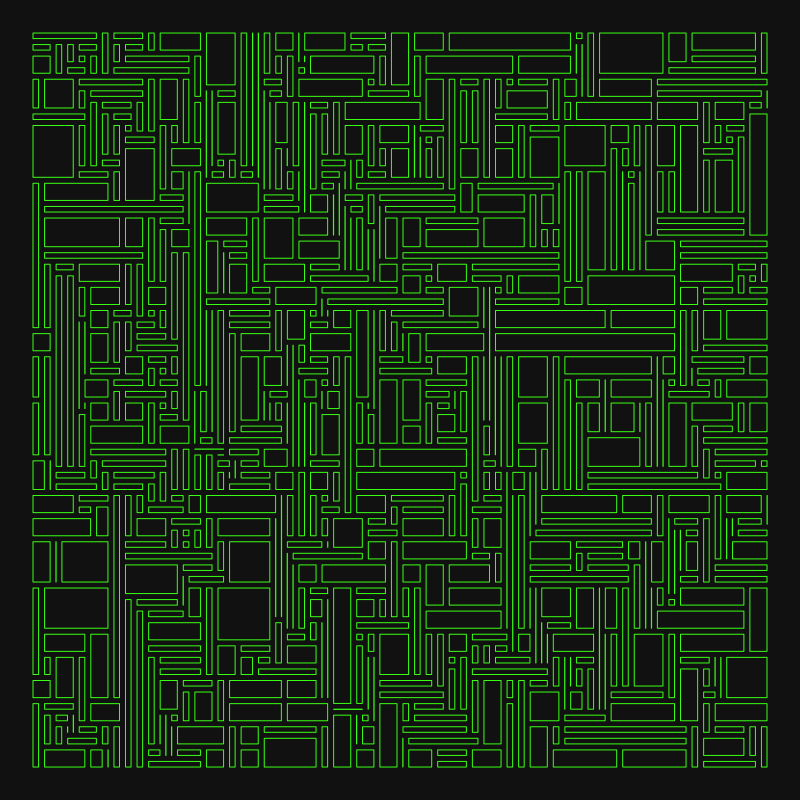
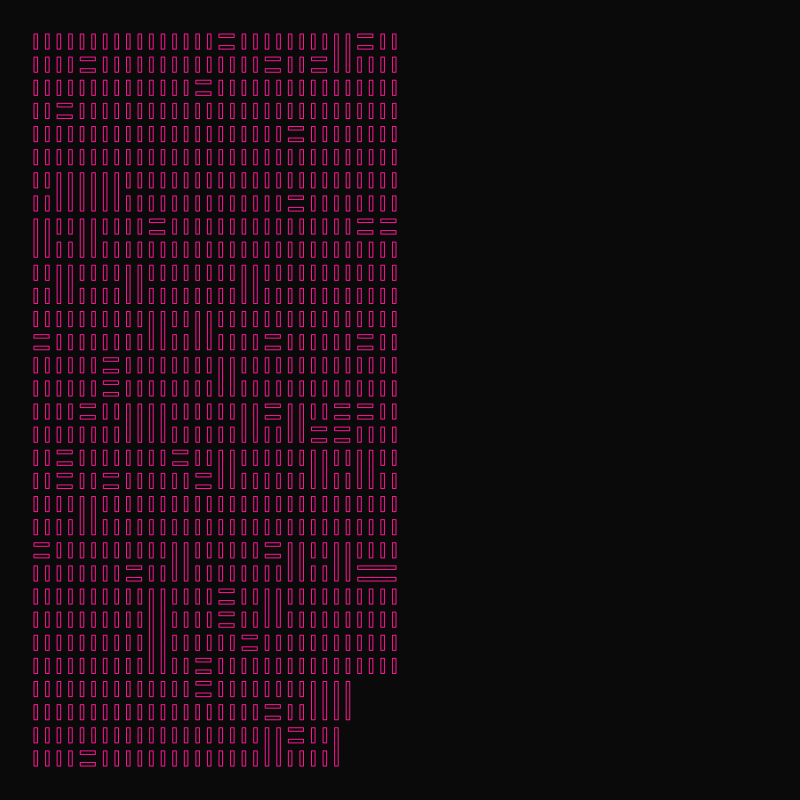
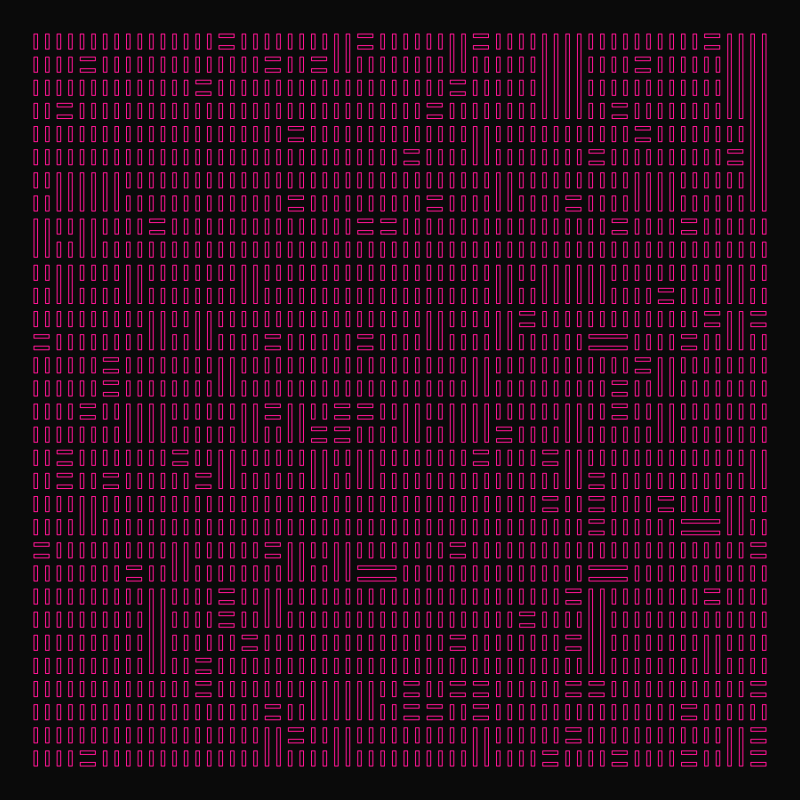
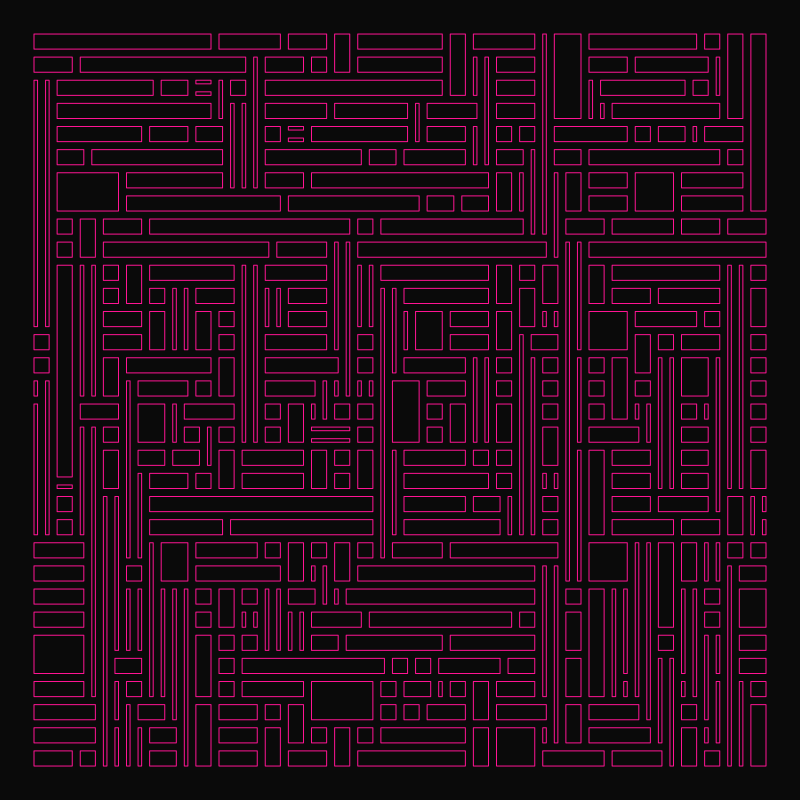
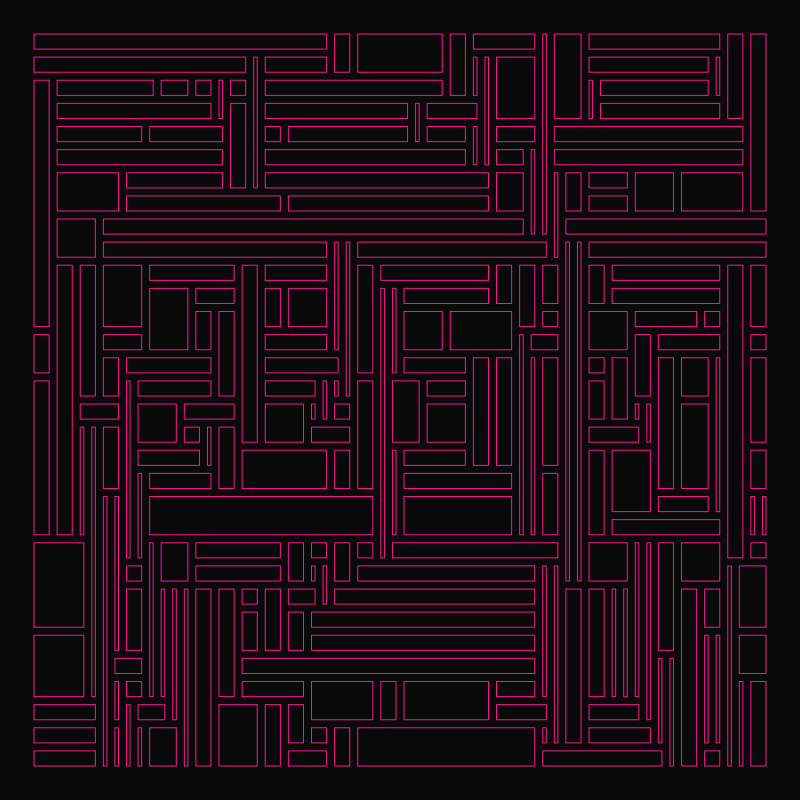
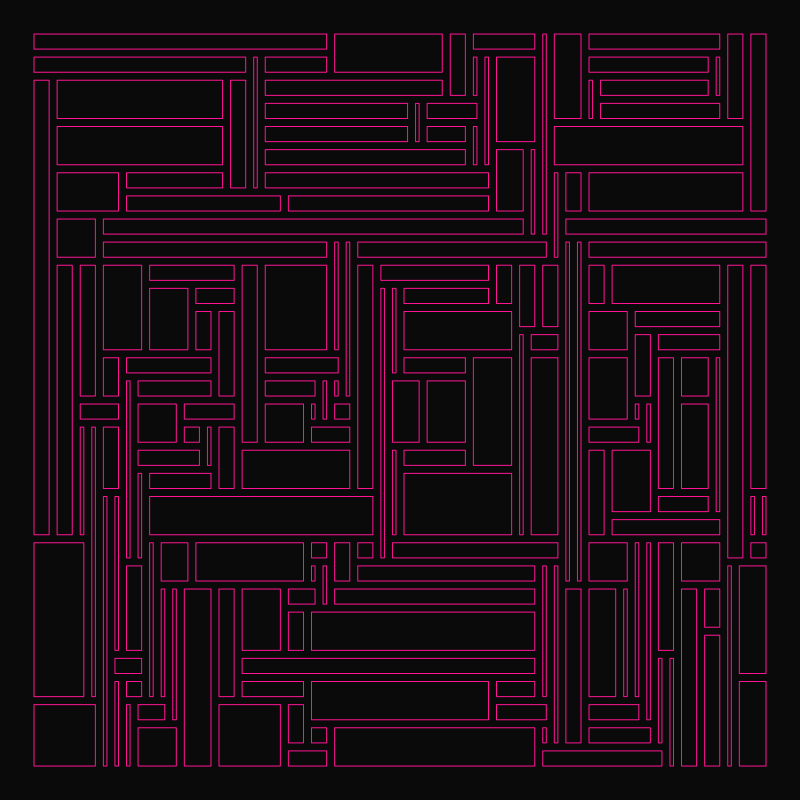
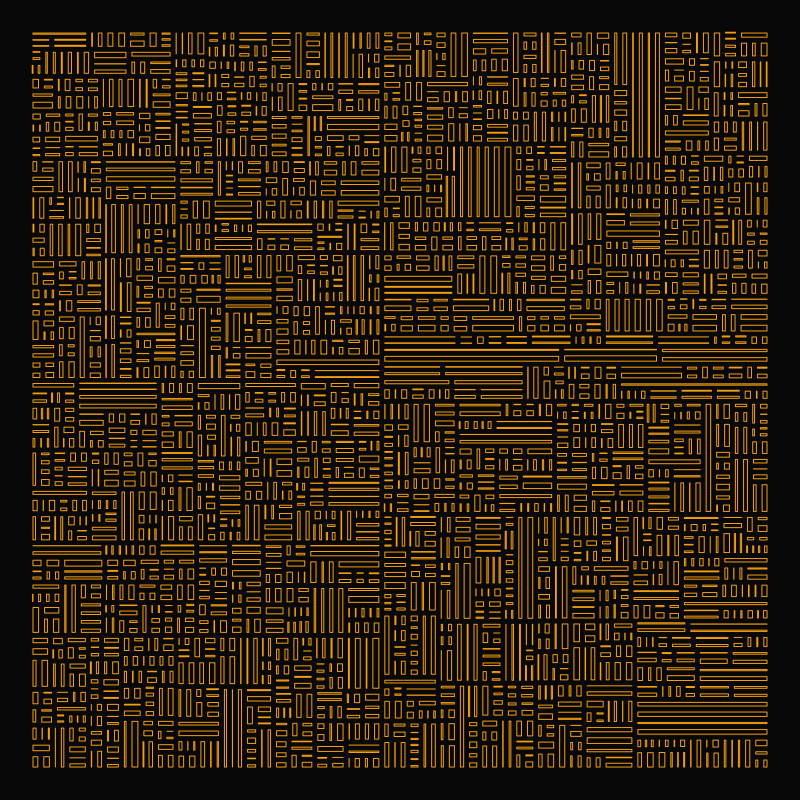
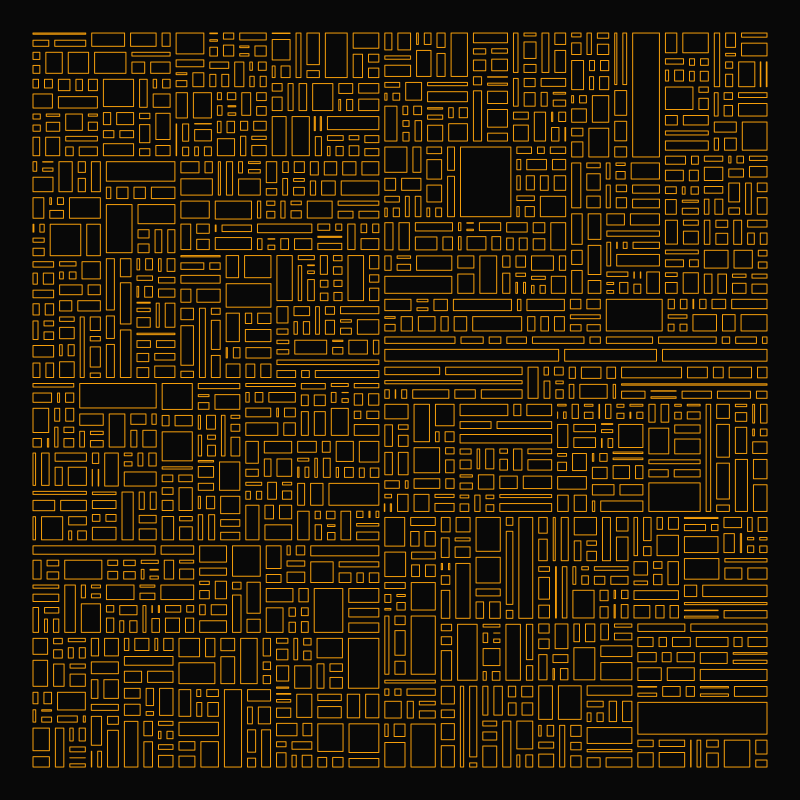
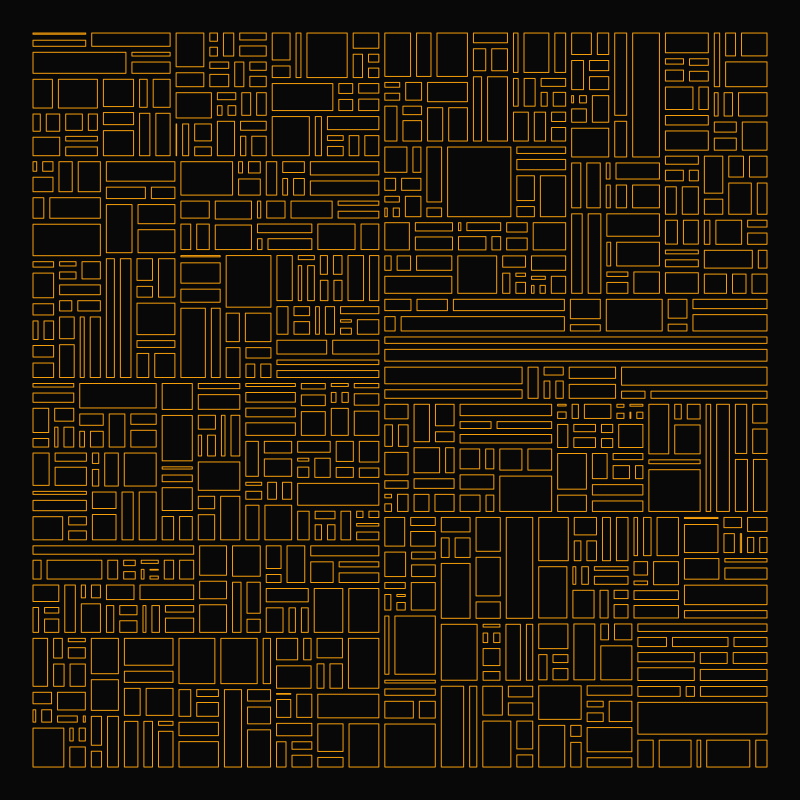
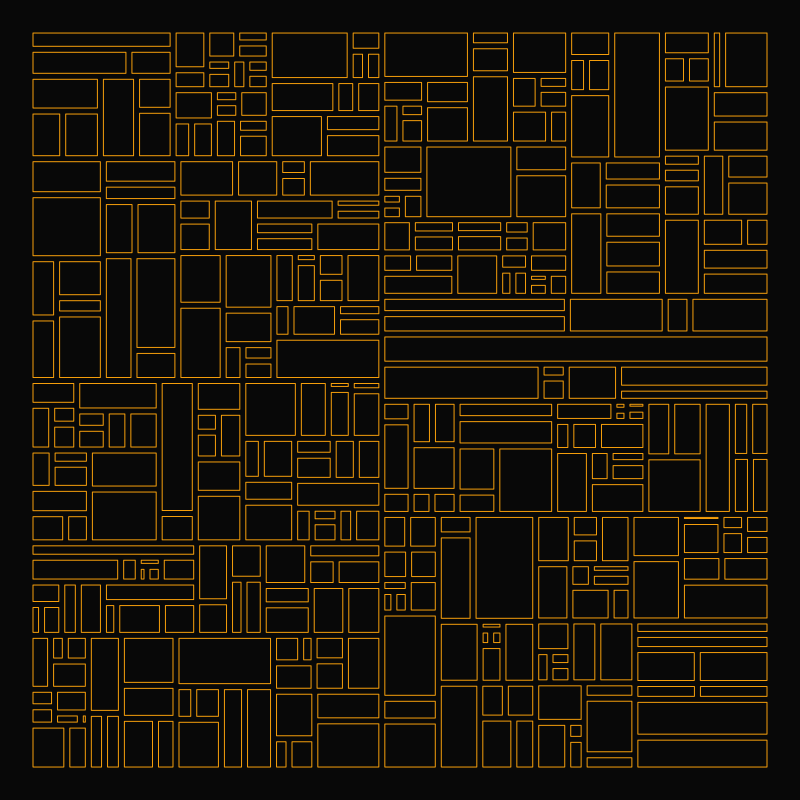
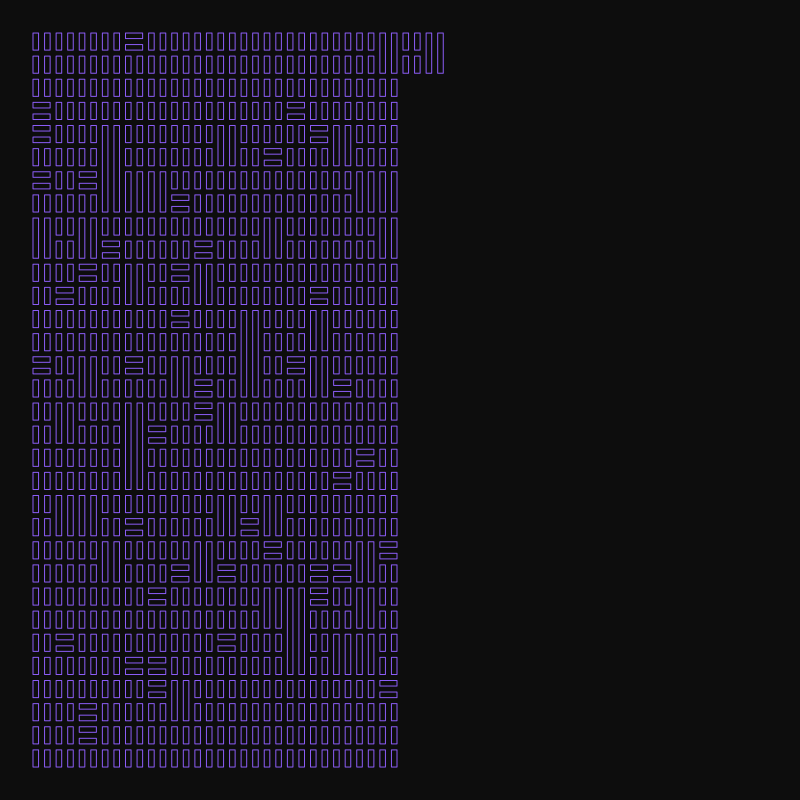
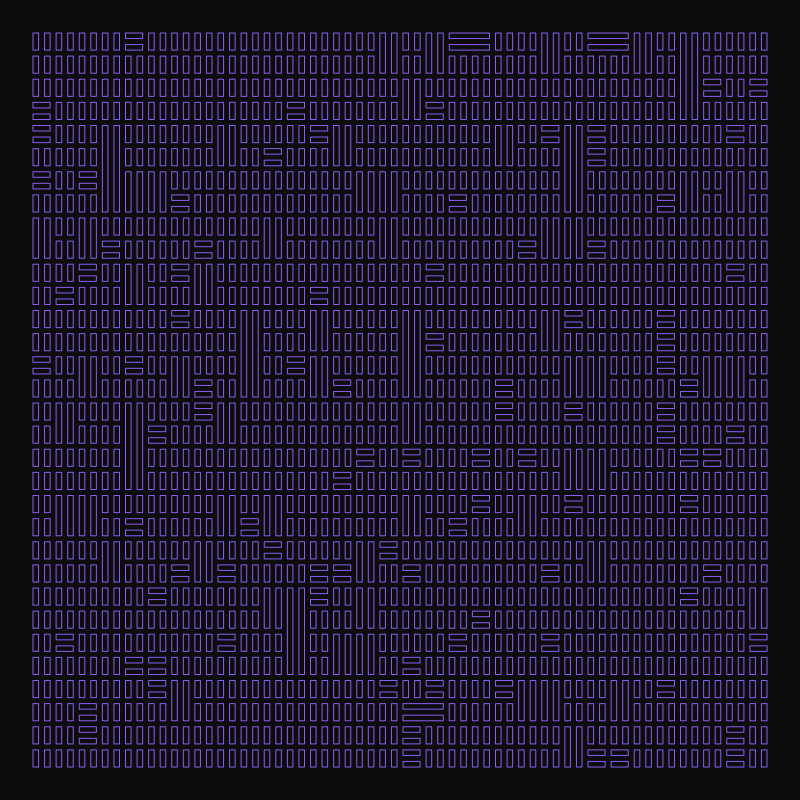
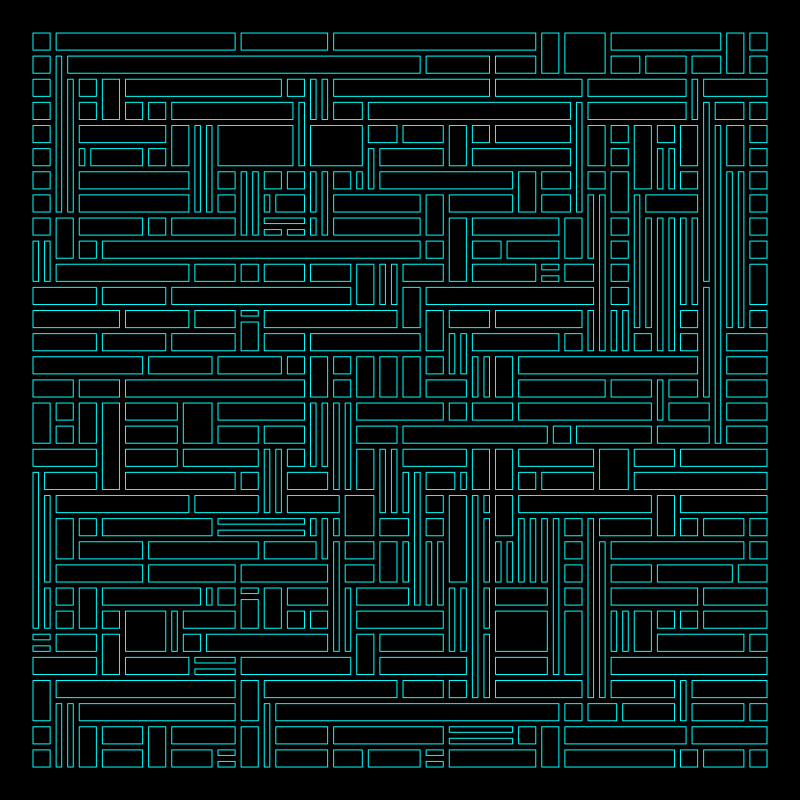
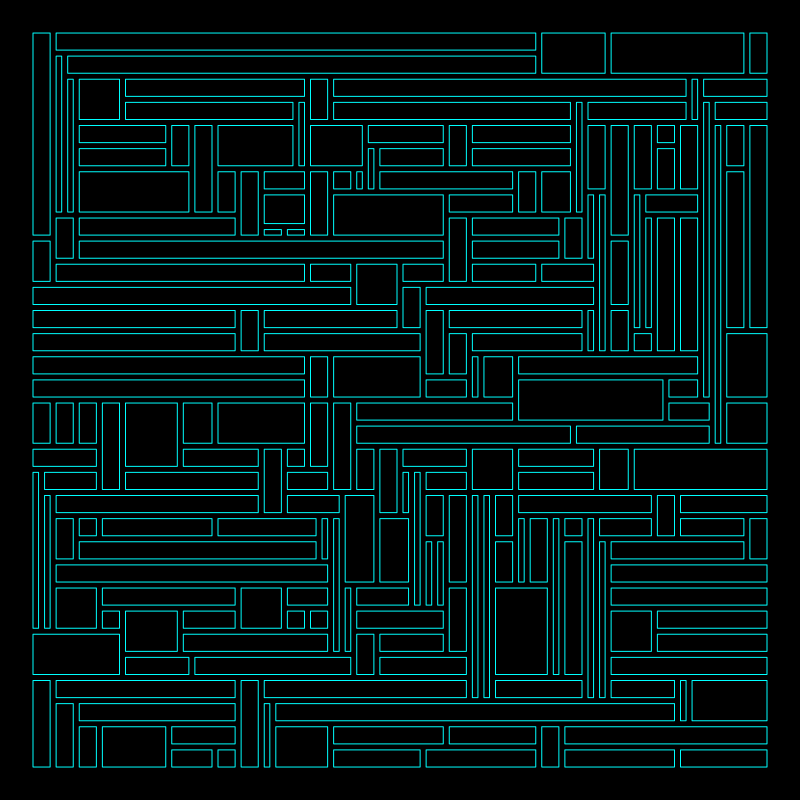
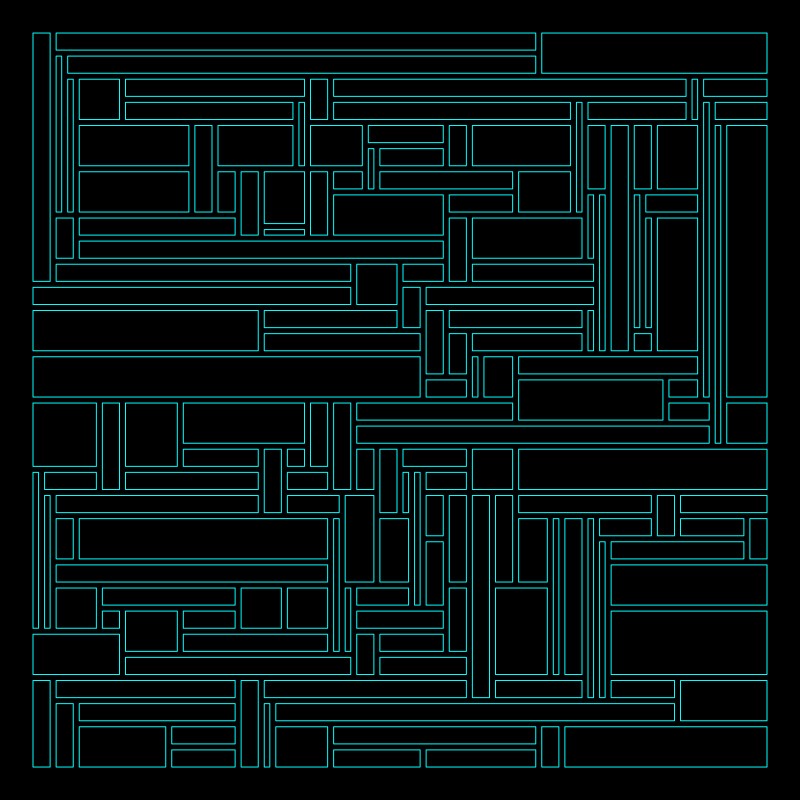
A k-d partition, then repeated passes that merge whichever rectangles happen to line up.
Subdivide, then undo some of it
The first phase is an ordinary k-d subdivision: split a rectangle in two, recurse, stop
when a cell is too small.
float r = 0.5f - b1 / 2f + (float)Rand() * b1 / 2f;
bool verticalSplit = Rand() > 0.5;
if (Rand() < Balance2) verticalSplit = area[2] < area[3];
At Balance1 = 1 the split is exactly at the midpoint every time, so this partition is
much more regular than a freely-cut one — which is what makes the second phase possible.
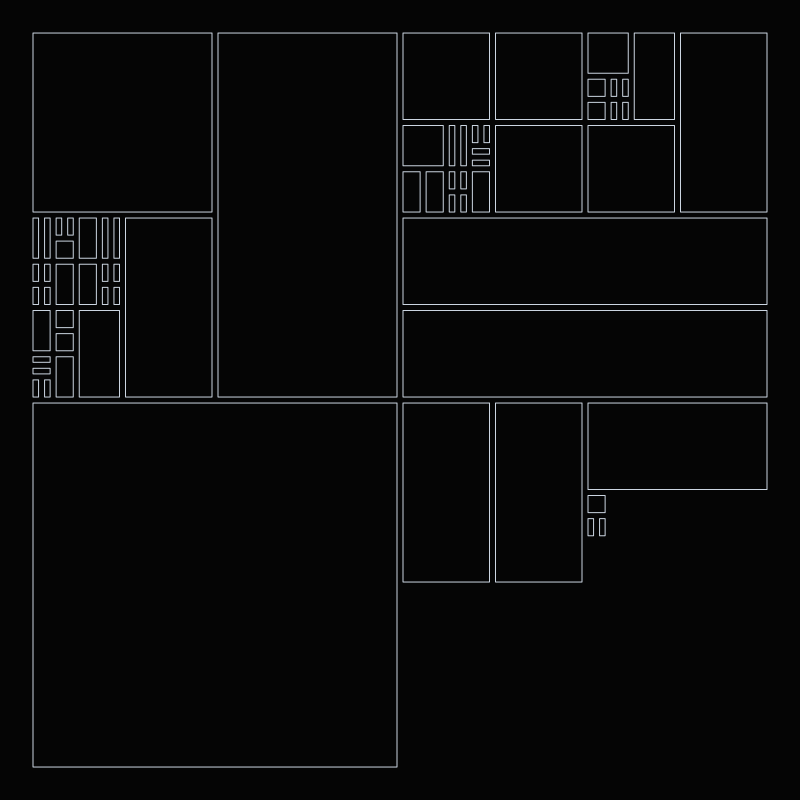
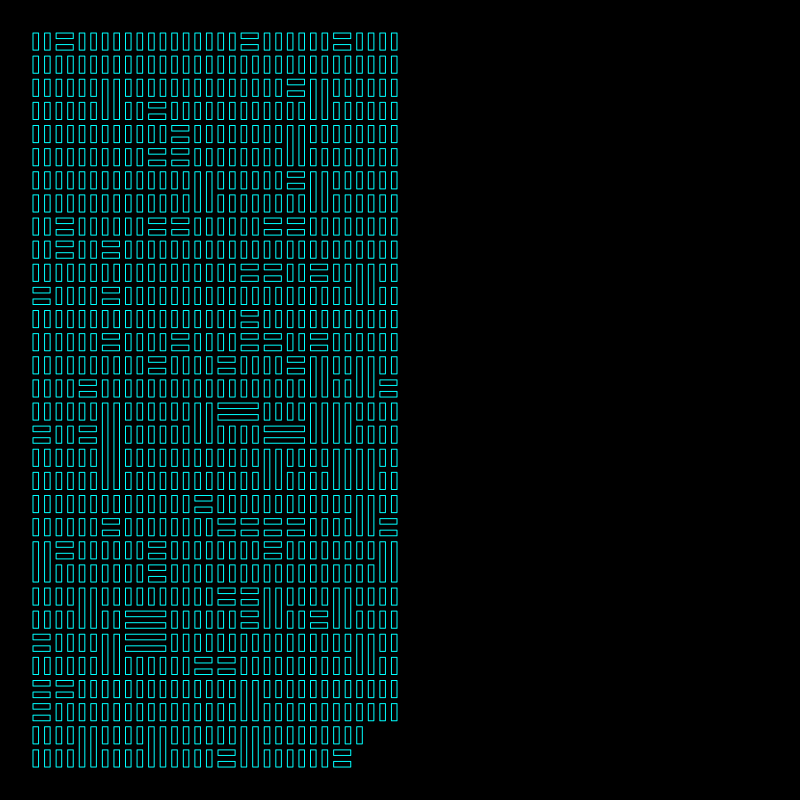
Half the raw partition.
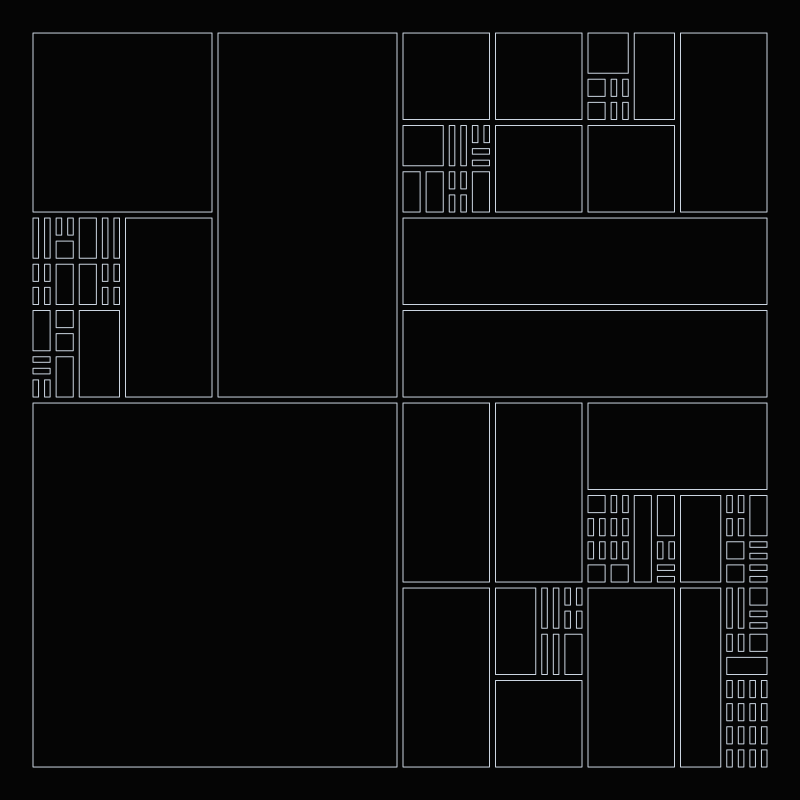
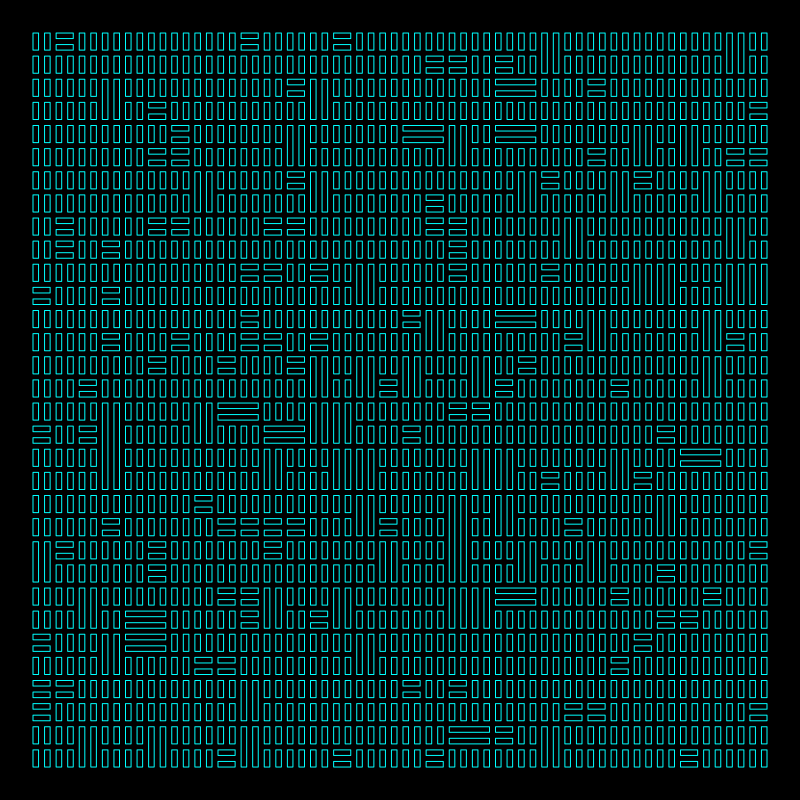
All of it. Because the cuts are at midpoints, a great many pairs of neighbouring
rectangles share a full edge — the same length, exactly aligned — and those pairs
can be replaced by a single rectangle without changing the region covered.
Merging
for (int i = 0; i < optimizations; i++)
{
    if (ShuffleBeforeOptimize != 0) Shuffle(rects);
    OptimizeRects(rects);
}
Each pass walks the rectangle list looking for exactly that: two rectangles that abut
along a complete shared edge. Where it finds a pair it replaces them with their union.
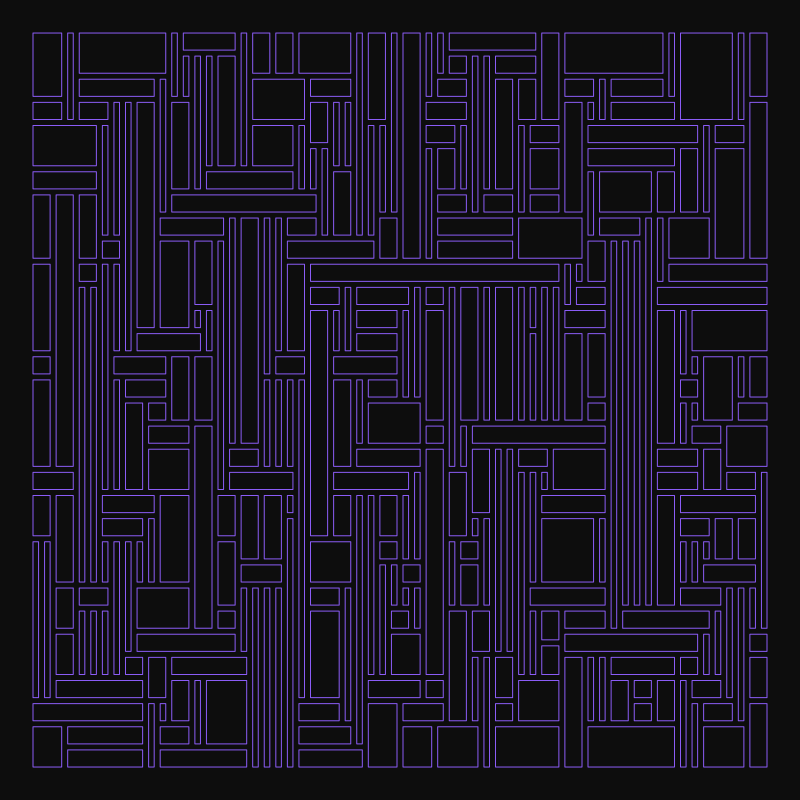
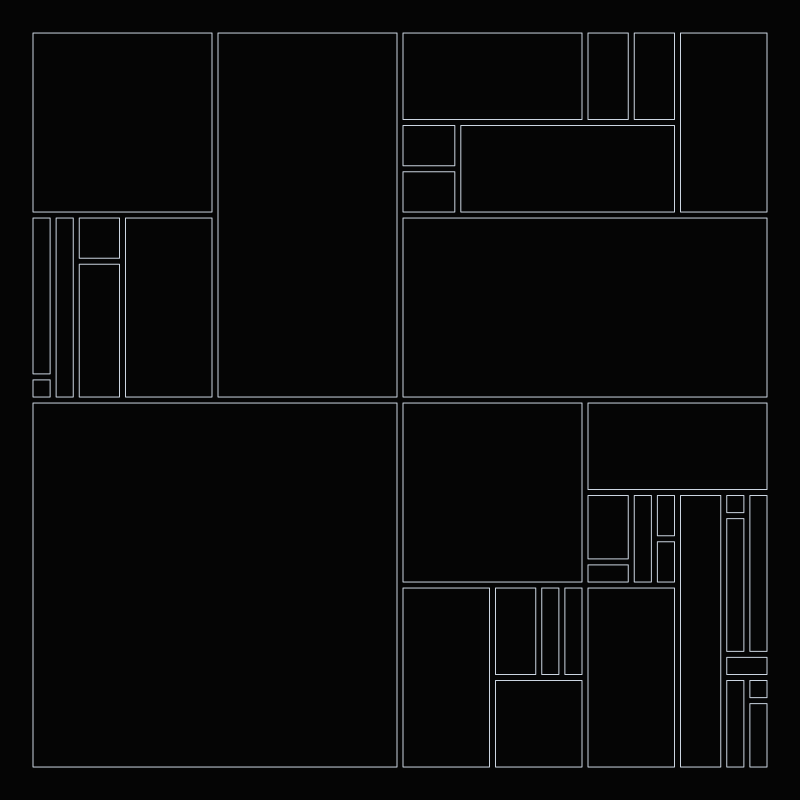
One pass. The cell count has dropped noticeably, and the surviving cells have a wider
range of aspect ratios than the partition produced.
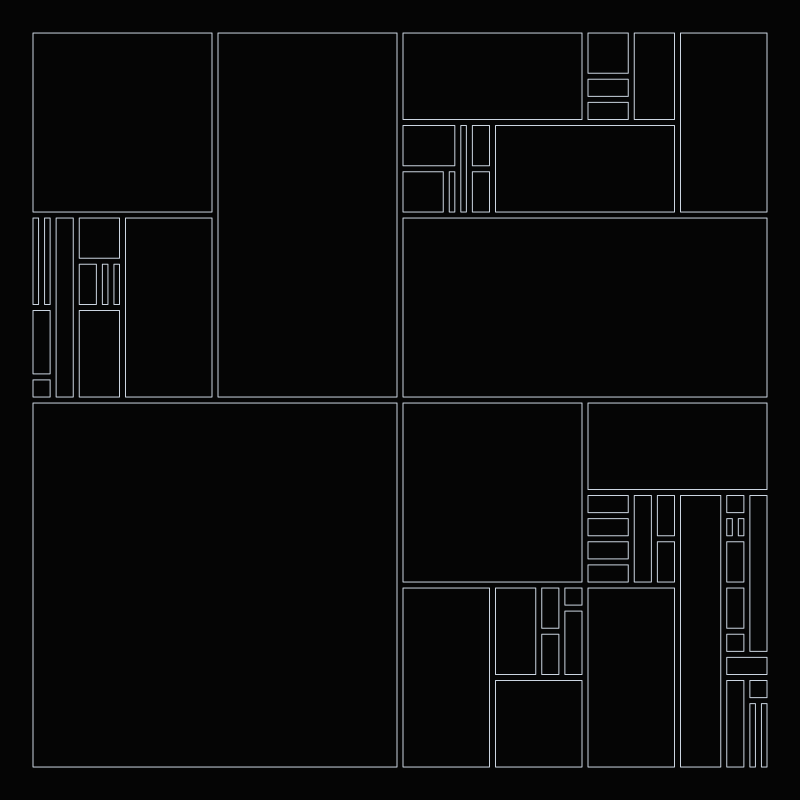
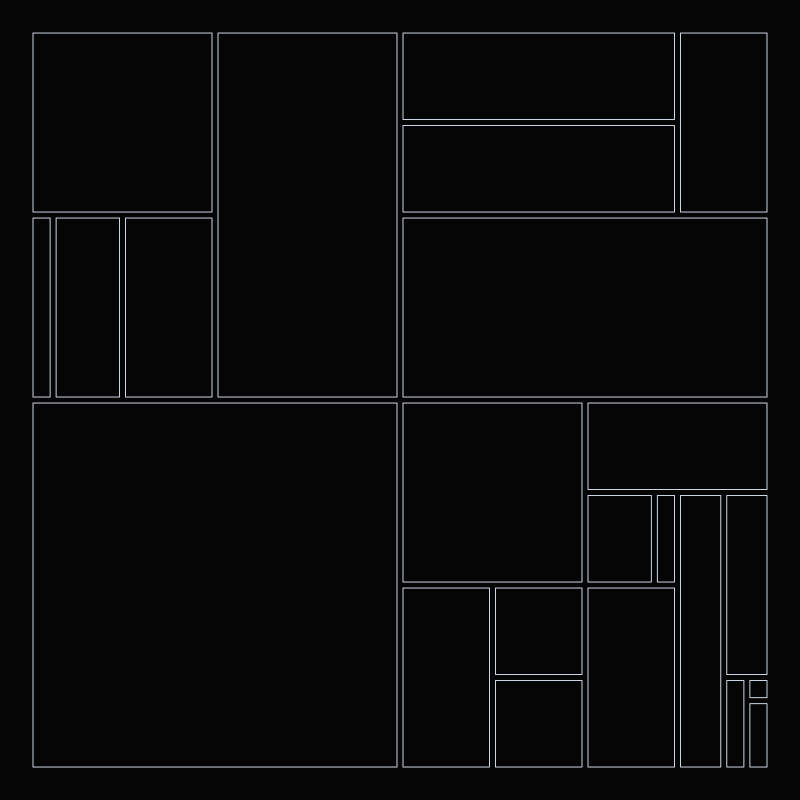
Two passes. The second pass is not redundant, because a merge creates new
opportunities: two cells that each merged with a neighbour may now themselves share a
full edge, which they did not before.
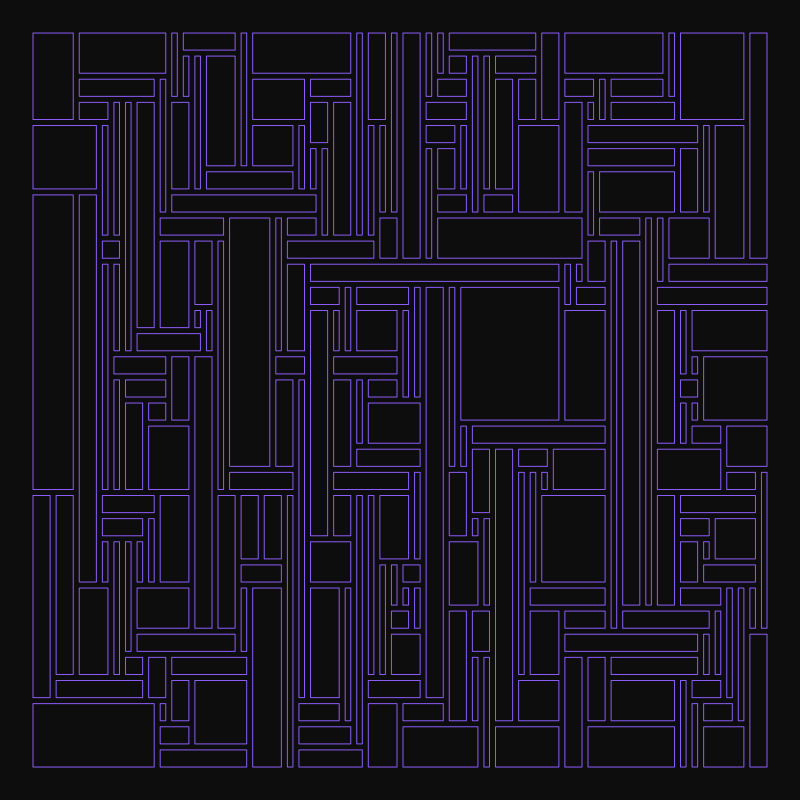
Three passes. The returns diminish quickly — each pass finds fewer pairs than the one
before, and by the third the partition is close to stable.
Why shuffle
ShuffleBeforeOptimize reorders the list before each pass. That matters because
merging is greedy: when a rectangle has two possible partners, the one it takes depends
on which is encountered first, and that choice forecloses the other.
Shuffling makes each pass explore a different order and therefore reach a different
local optimum. It is the difference between a deterministic layout and one that varies
with the seed even though the partition underneath it does not.
A hand-rolled generator
This piece does not use Random. It uses an integer hash advanced by a counter:
private double Rand()
{
    int s = _rseed;
    _rseed++;
    int v = (s >> 1) ^ s;
    int r = (int)(1103515245L * v);
    r = (int)(1103515245L * (r ^ (r >> 3)));
    r = r ^ (r >> 16);
    return (double)r / 1103515245.0 % 1.0;
}
That is a counter-based generator carried over from the Turtletoy original, where it
replaced a Math.random() that could not be seeded. Because it is a pure function of
the counter, it produces the same sequence on every platform — which makes this piece
more portable than the ones using System.Random, by accident rather than by design.
Six renderings
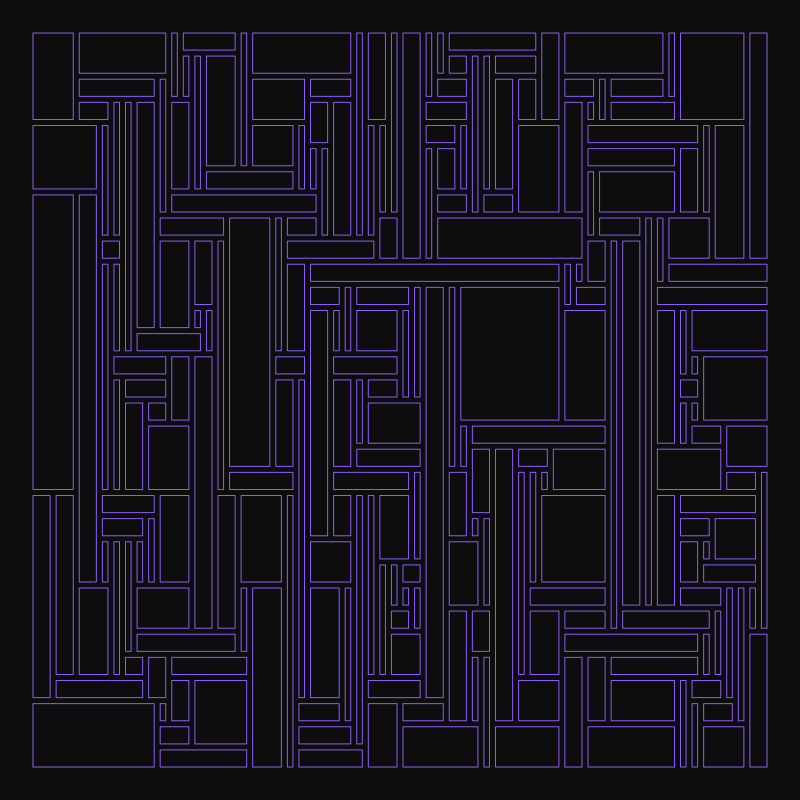
| Rendering | Colour | Key parameters |
|---|
| Cyan Subdivide | cyan on black | All defaults |
| Lime Partition | lime on #111111 | MinSize 1.0, Balance2 0.5 |
| Pink Grid | pink on #0a0a0a | MinSize 2.0, Spacing 2.0 |
| Amber Fracture | amber on #080808 | Balance1 0.7, Balance2 0.4 |
| Violet Streams | violet on #0d0d0d | Optimizations 6, ShuffleBeforeOptimize 1 |
| Glacier | slate on #050505 | Balance3 0.65 |
Gallery presentation
Gallery presents the same cyan subdivision on a wall, behind a mat, inside a frame —
SkiaSharp.Extensions’ MuseumFrame wrapping the piece rather than the piece drawing
its own surround. The generative parameters are identical to Cyan Subdivide — same
seed, same algorithm — only the presentation changes. The artwork is contain-fitted
into the opening and isolated from the dark gallery wall by an off-white mat and a
framed, shadowed edge.
Determinism
The generator is a counter-based hash seeded from the preset and advanced once per
call, in a fixed order. There is no System.Random anywhere, so the piece is stable
across runtimes as well as across runs.
Origin
Ported from a Turtletoy sketch; the original JavaScript is kept beside the source as
main.js, with its link in url.