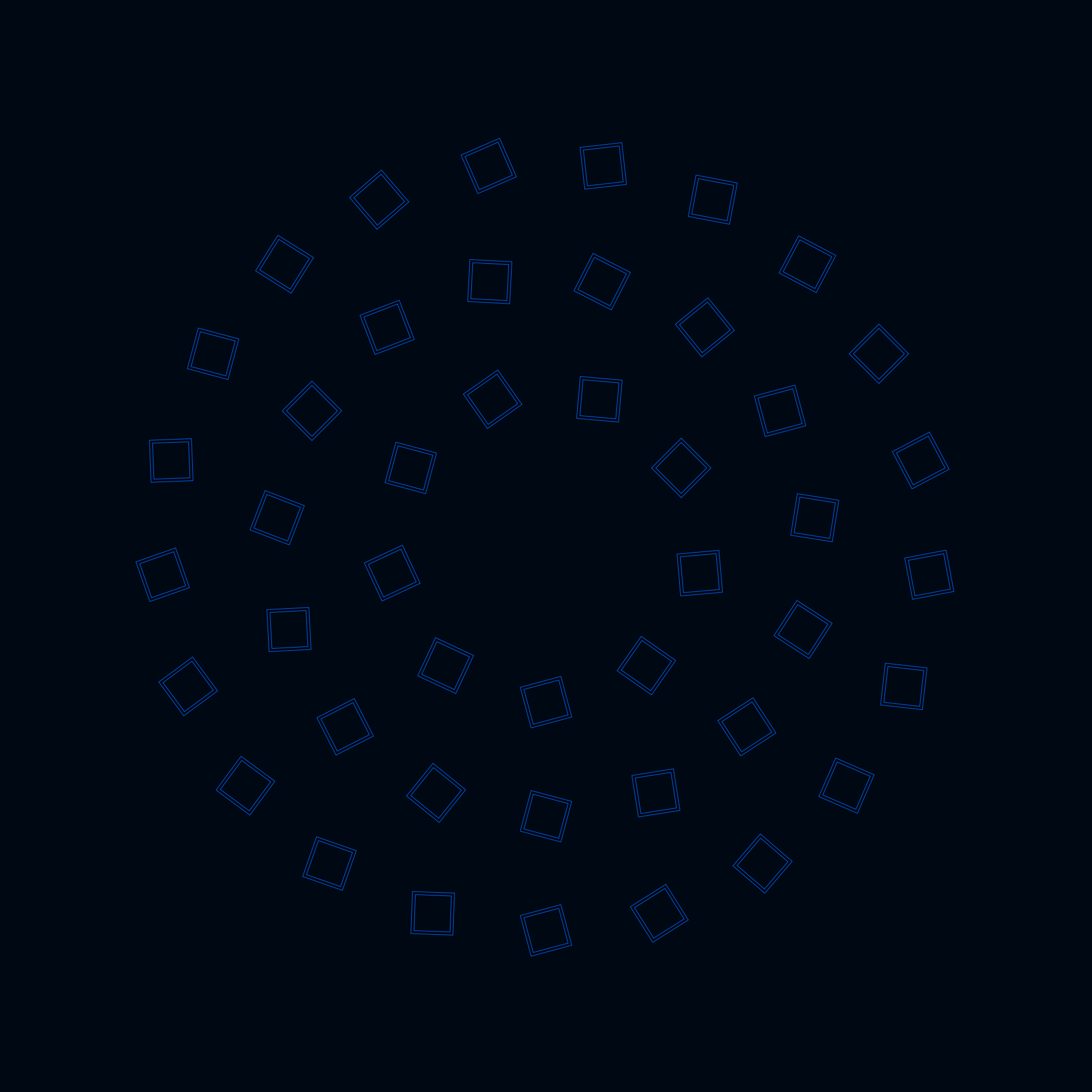
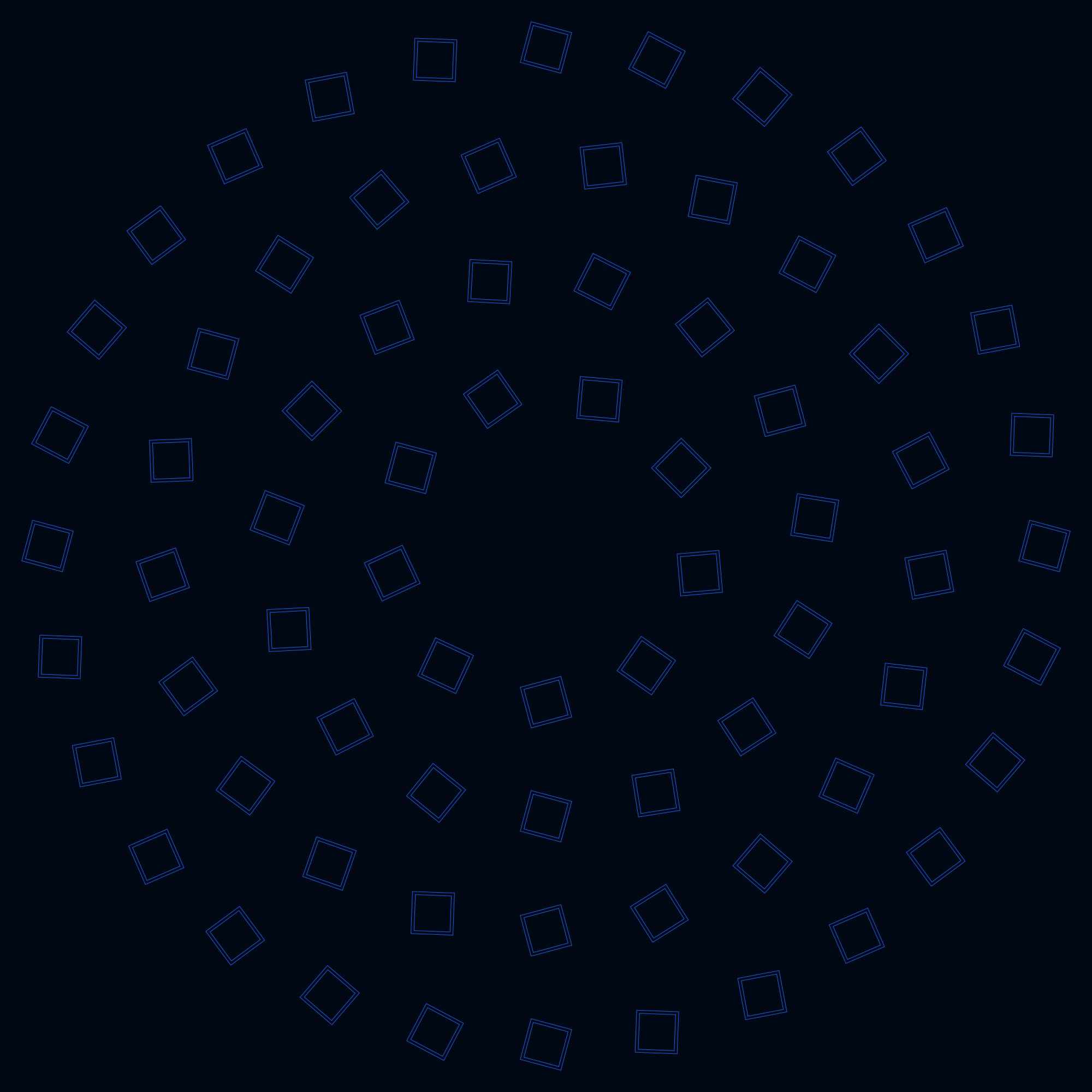
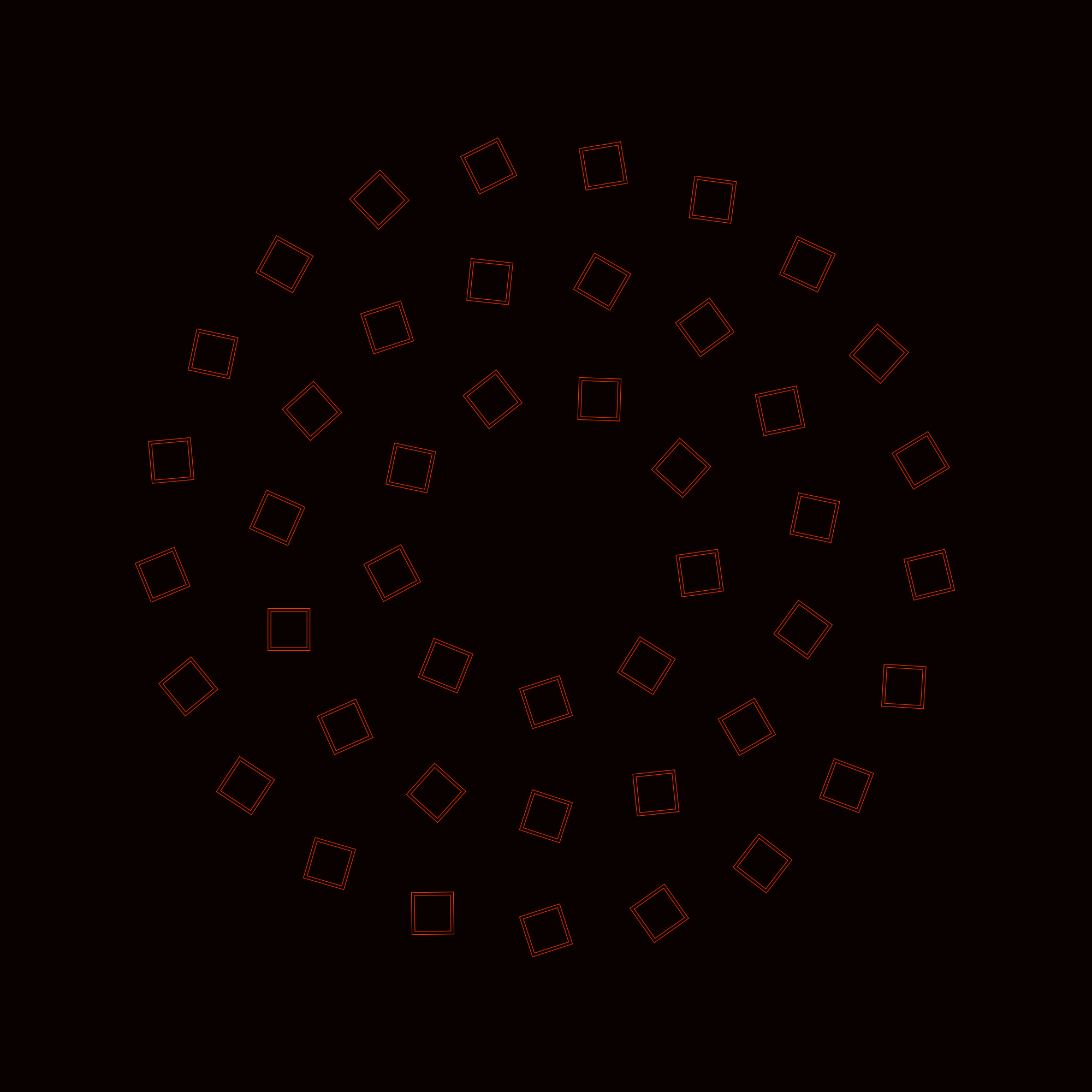
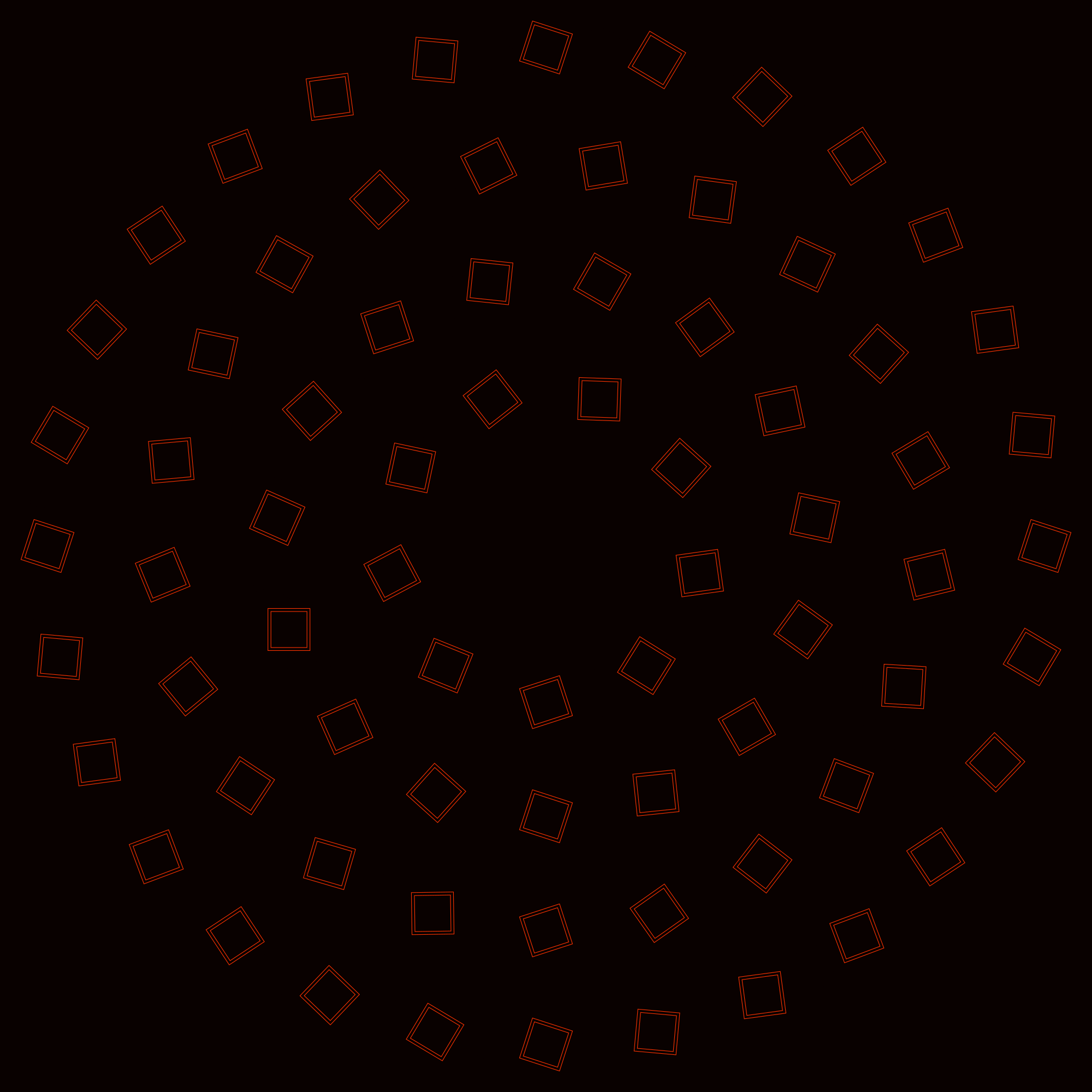
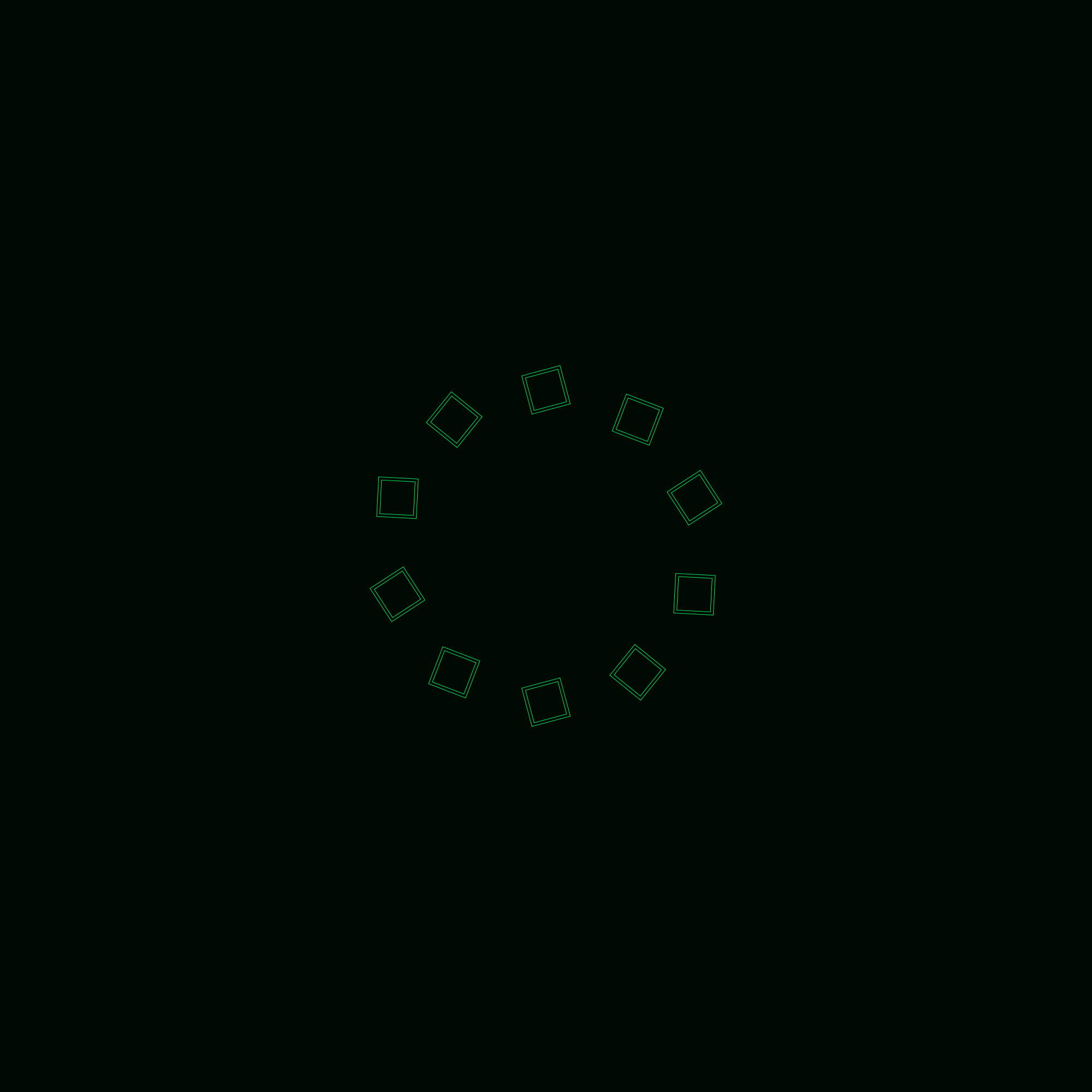
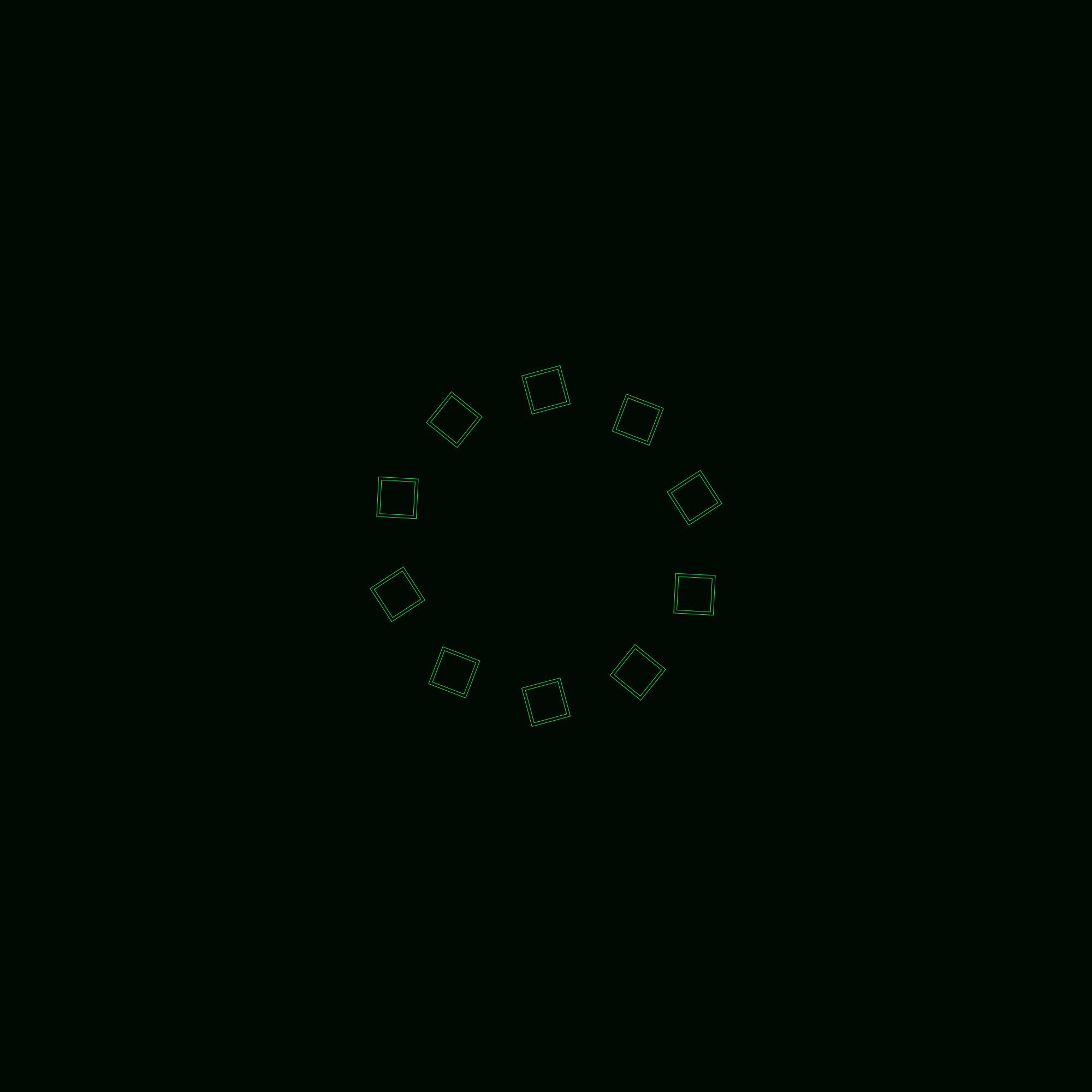
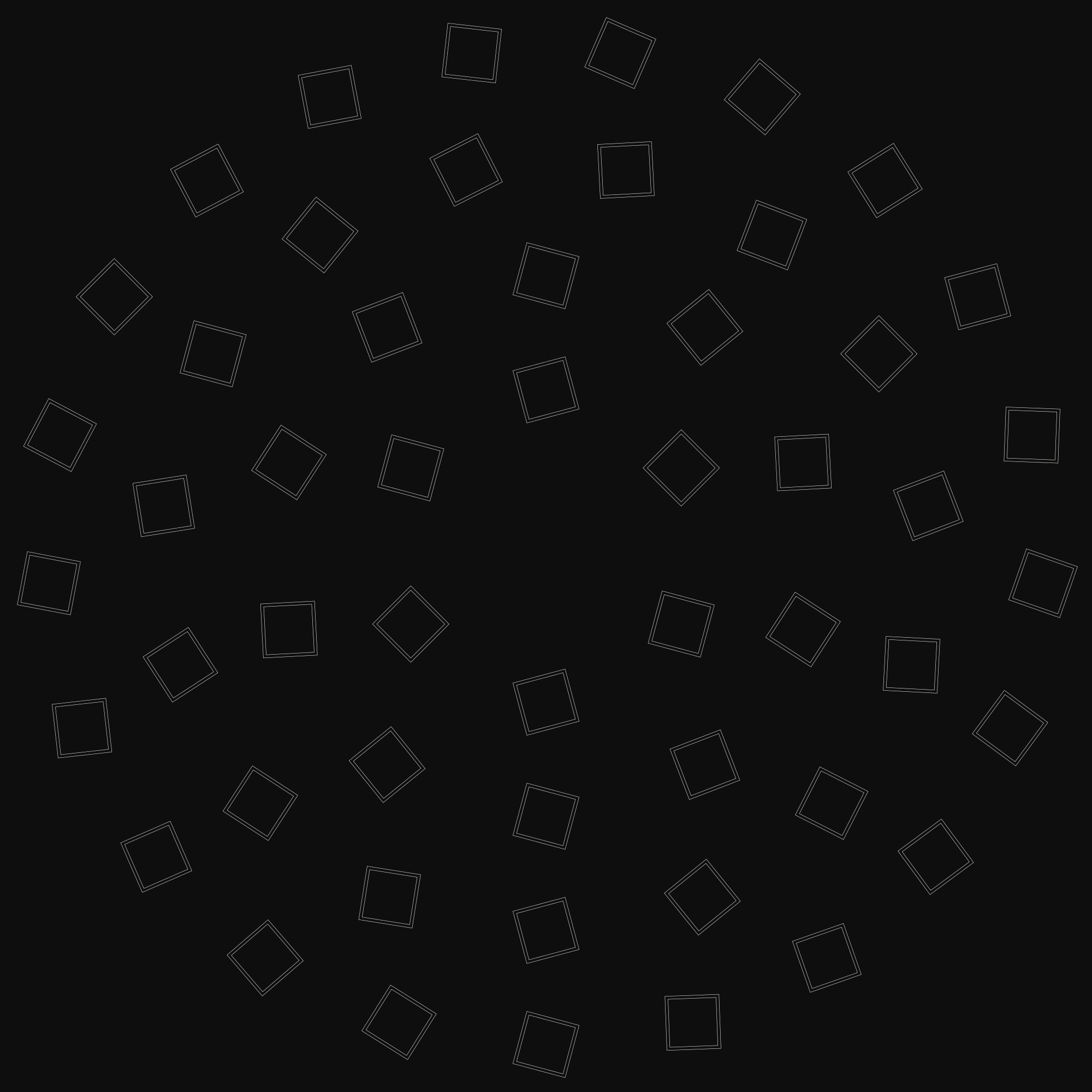
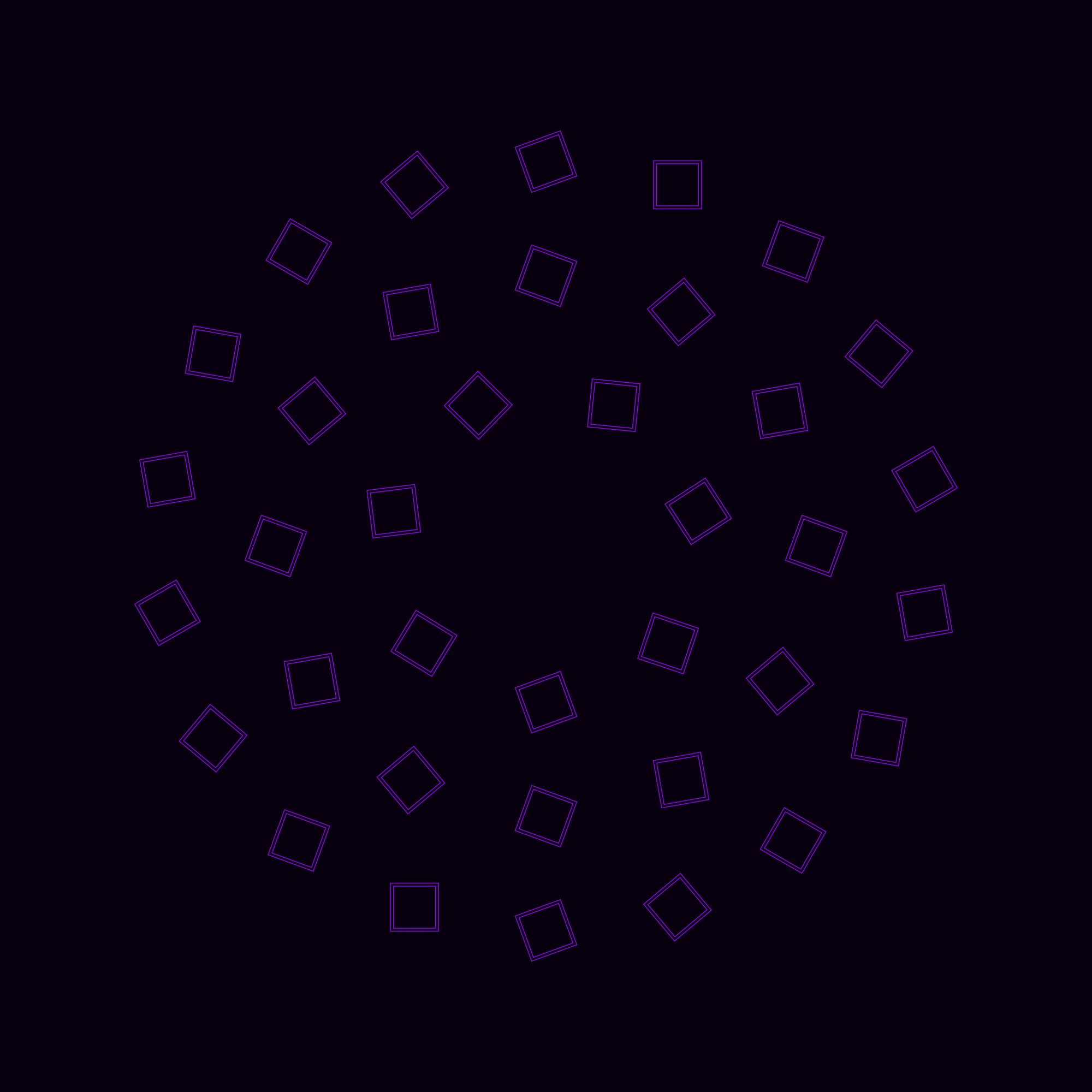
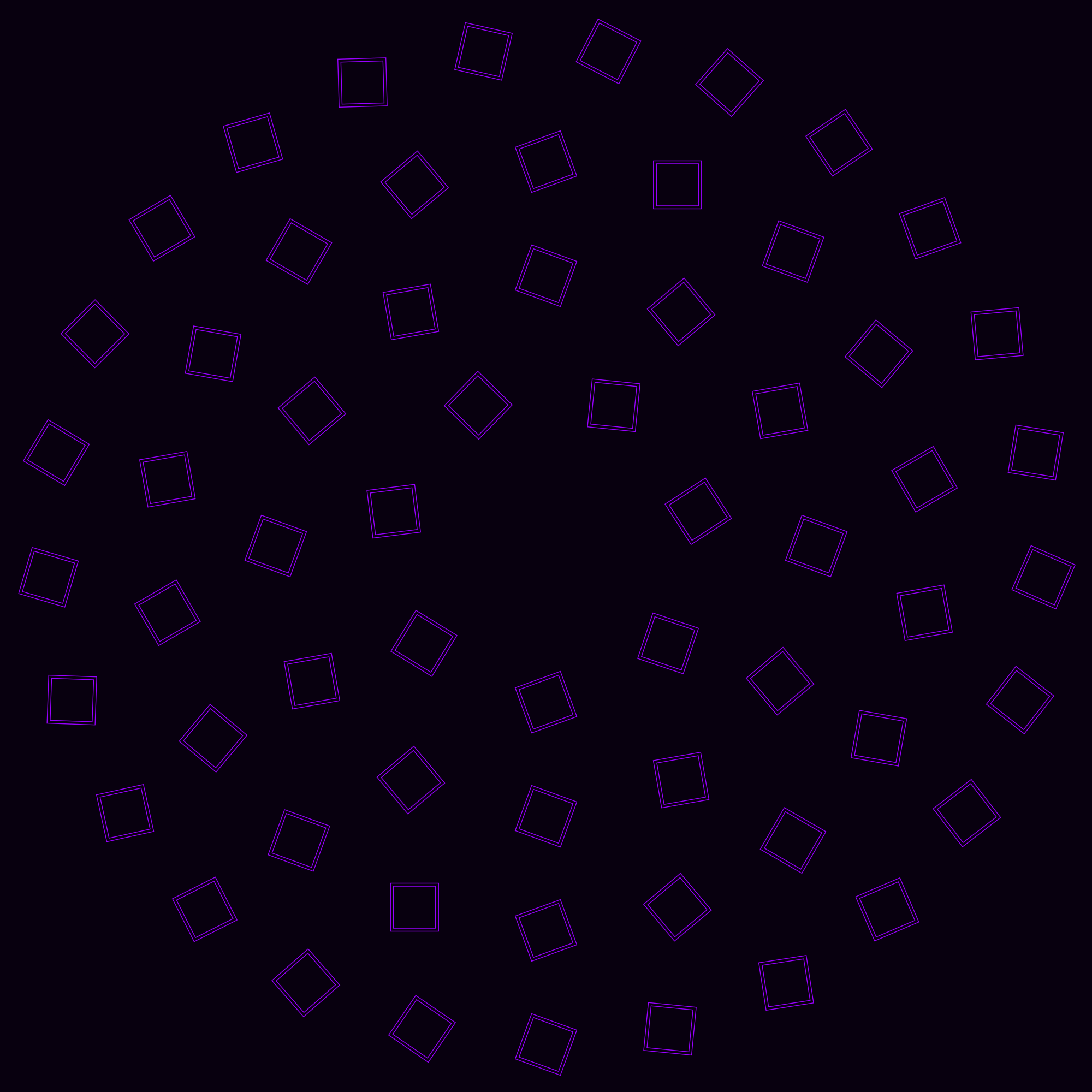
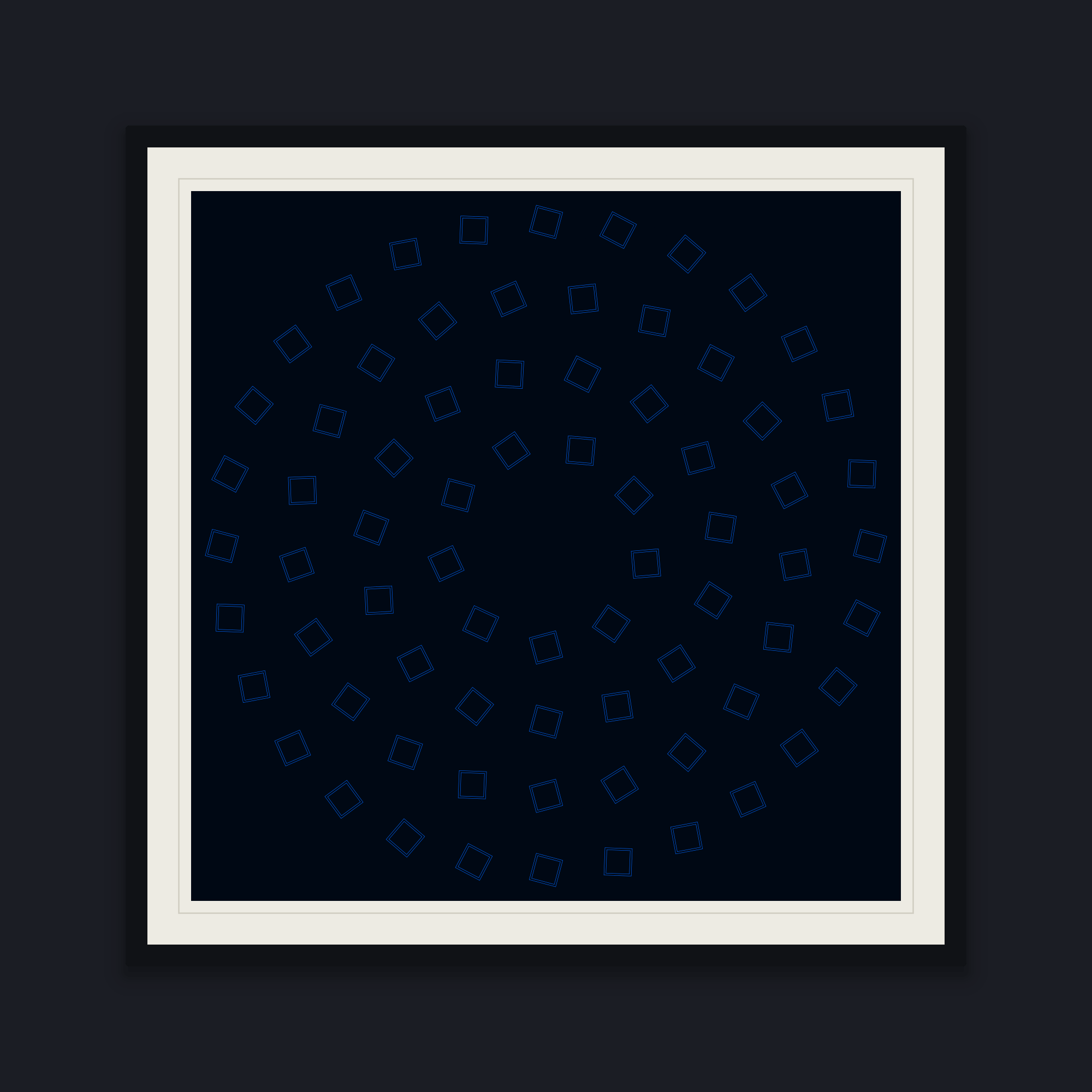
Four rings of tilted squares, alternately black and white, that appear to rotate when nothing does.
The Pinna illusion
Baingio Pinna described this in 1990. Concentric rings of small squares, each square
tilted slightly from the radial direction, with the tilt alternating in sign from one
ring to the next. Fixate the centre and move your head towards the page: the rings
appear to counter-rotate.
Nothing rotates. Nothing in the drawing is even curved.
var iAngle = CRotation * (i % 2 == 0 ? -1 : 1);
float r = 26 + 19 * i;
The tilt is ±π/12 — fifteen degrees — alternating by ring index. That sign flip is the
entire illusion.
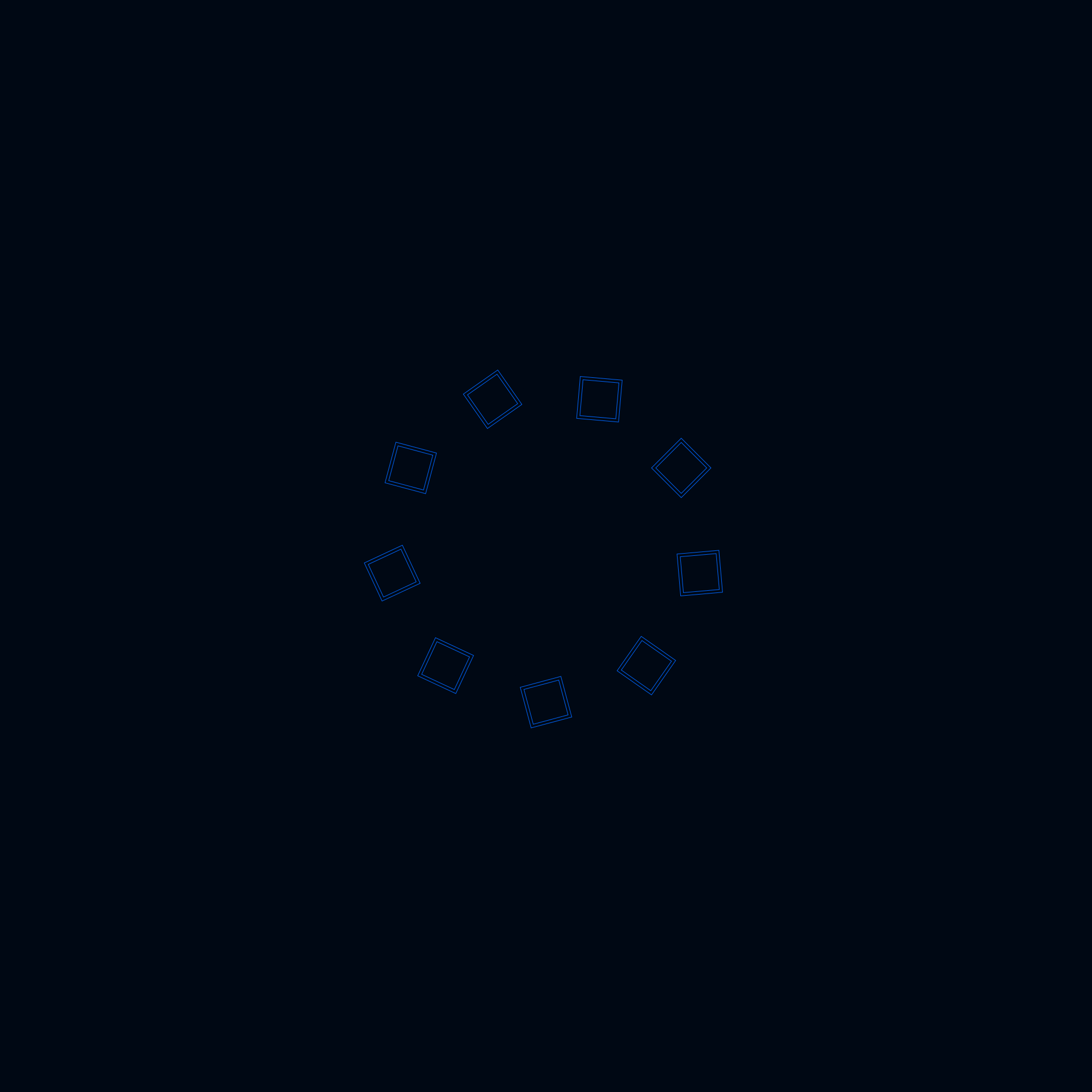
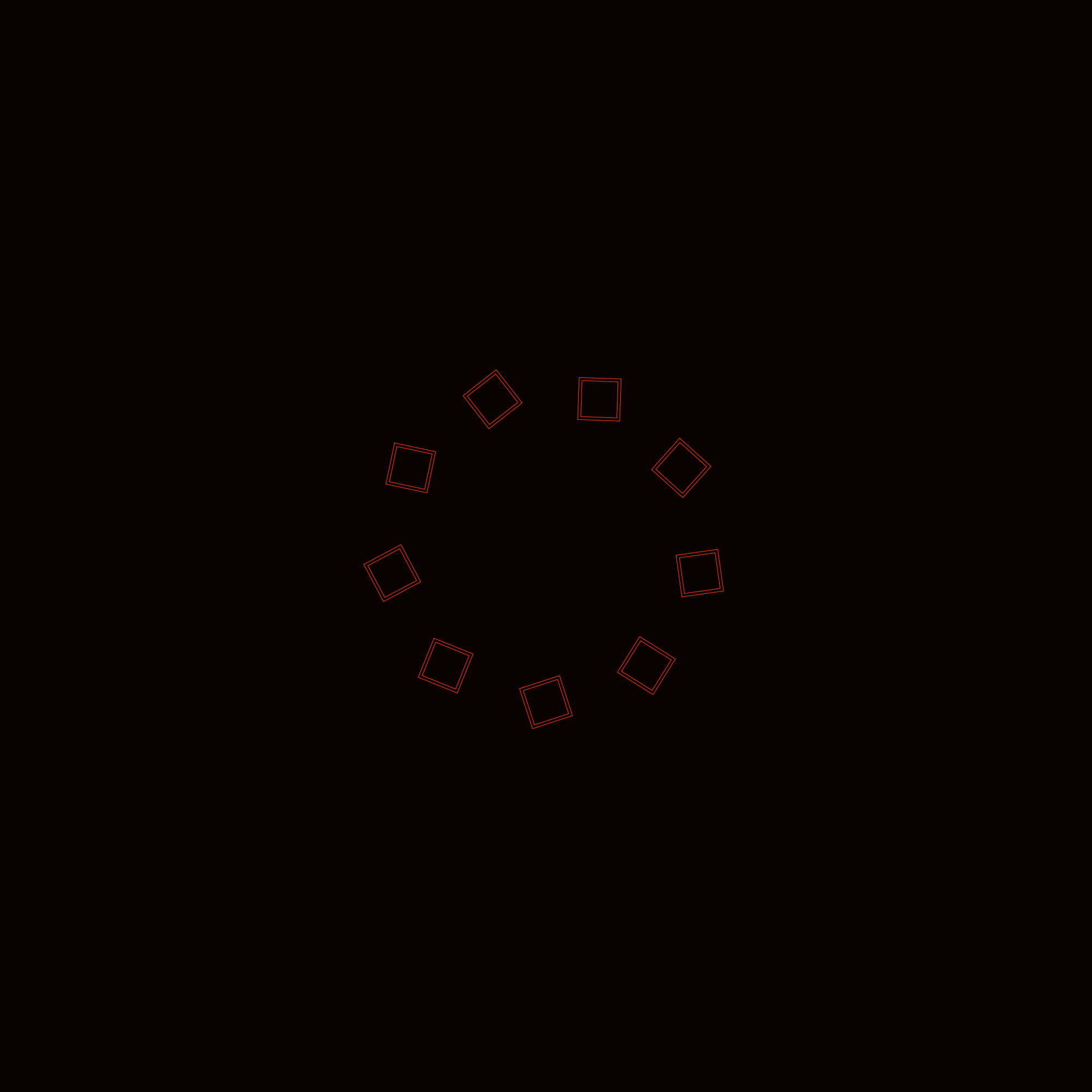
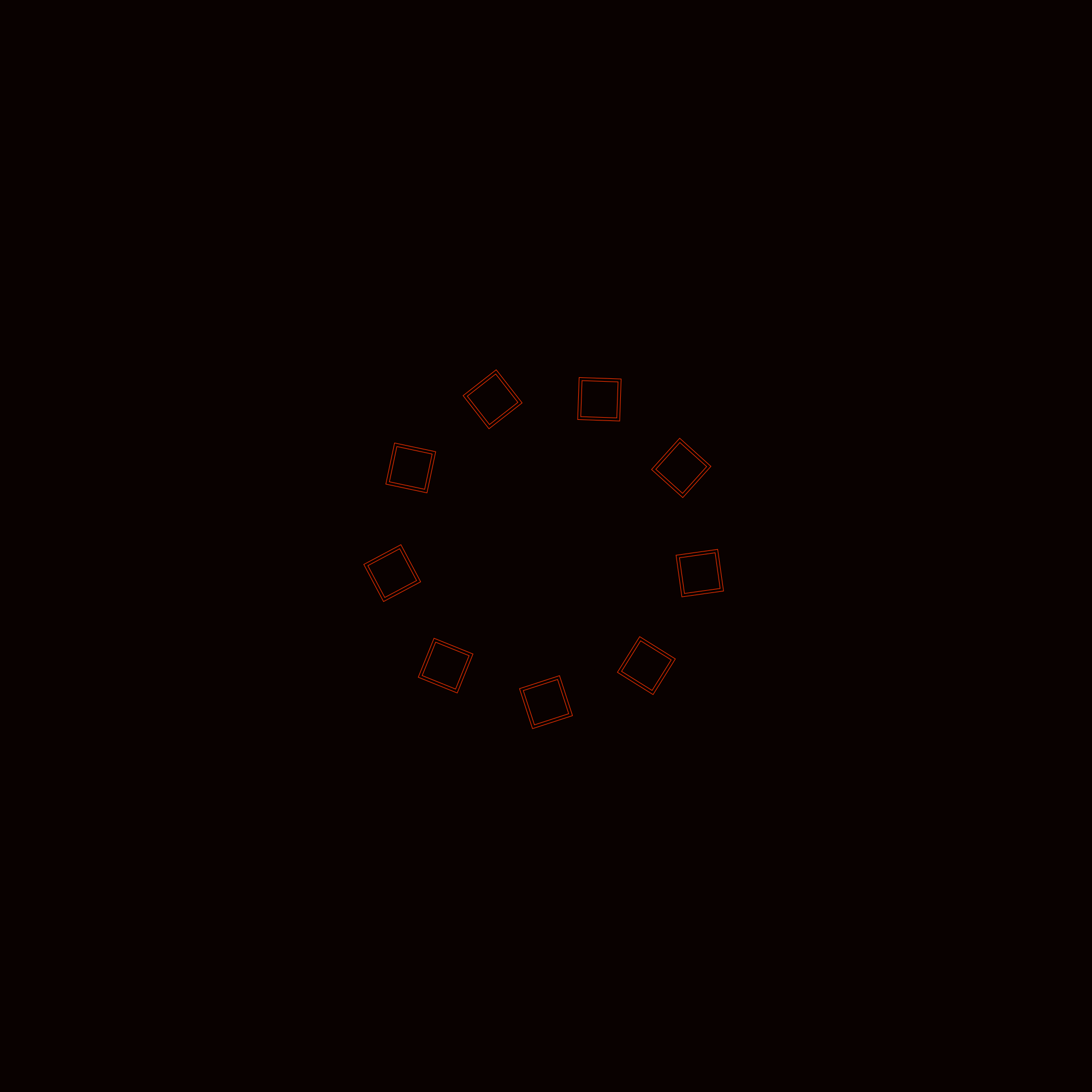
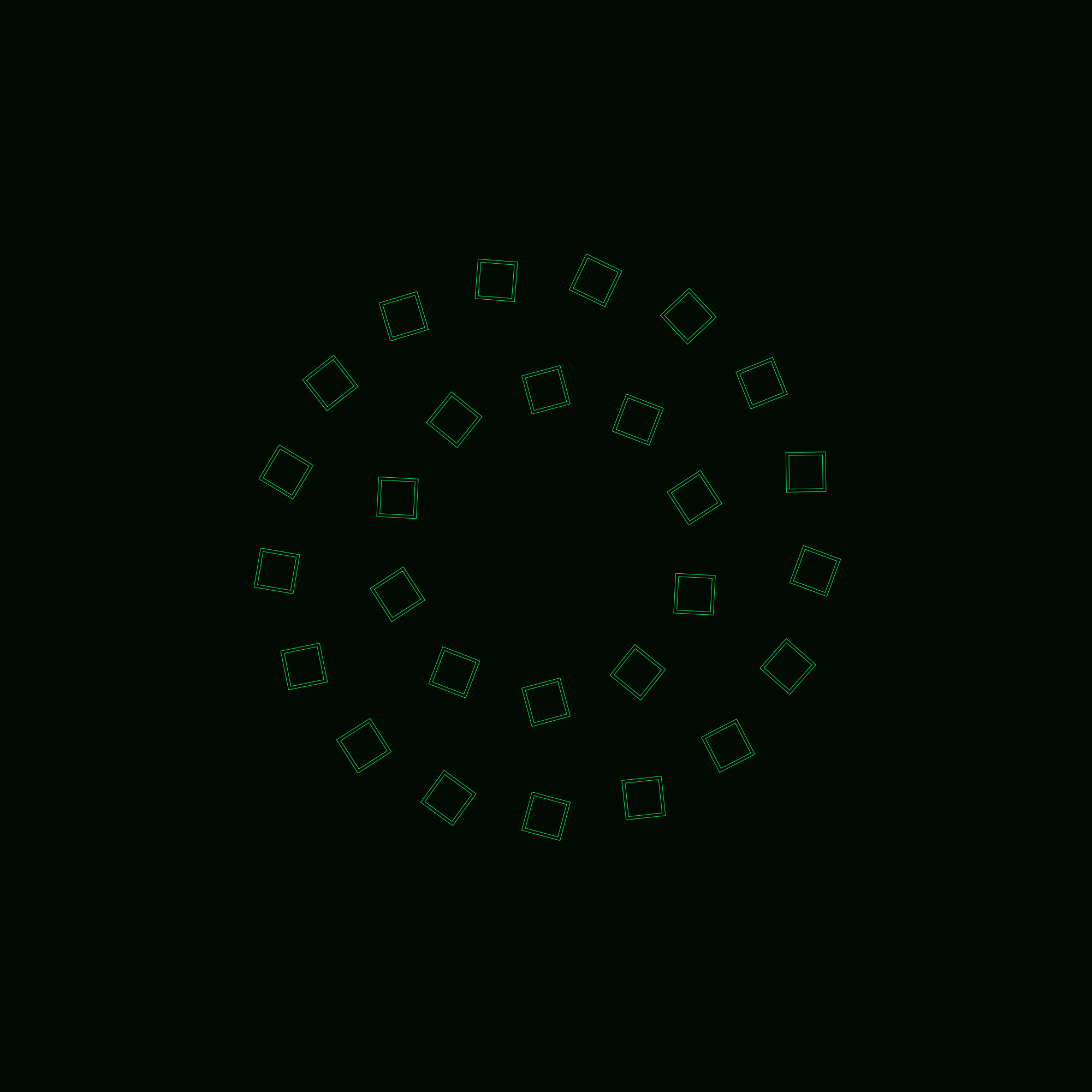
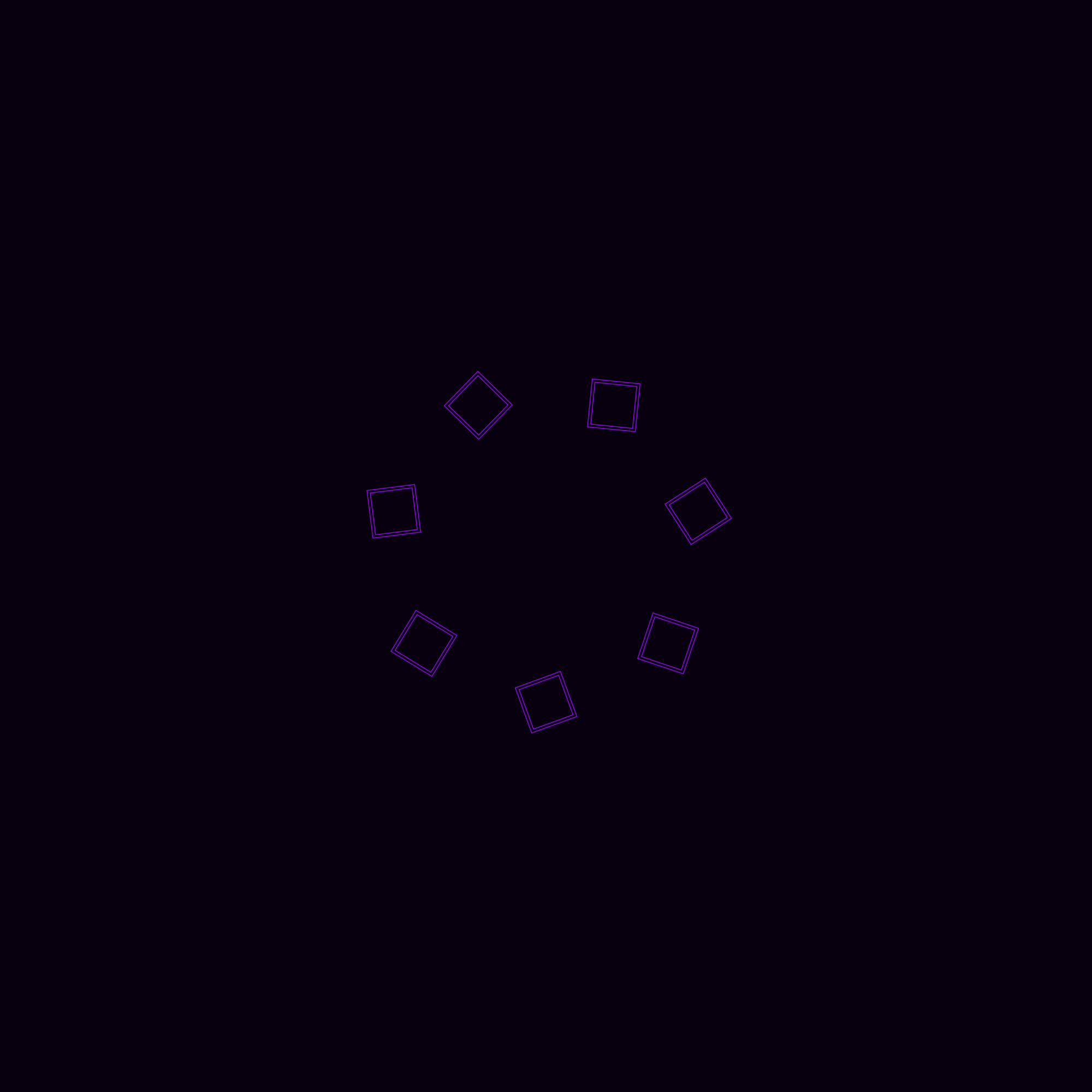
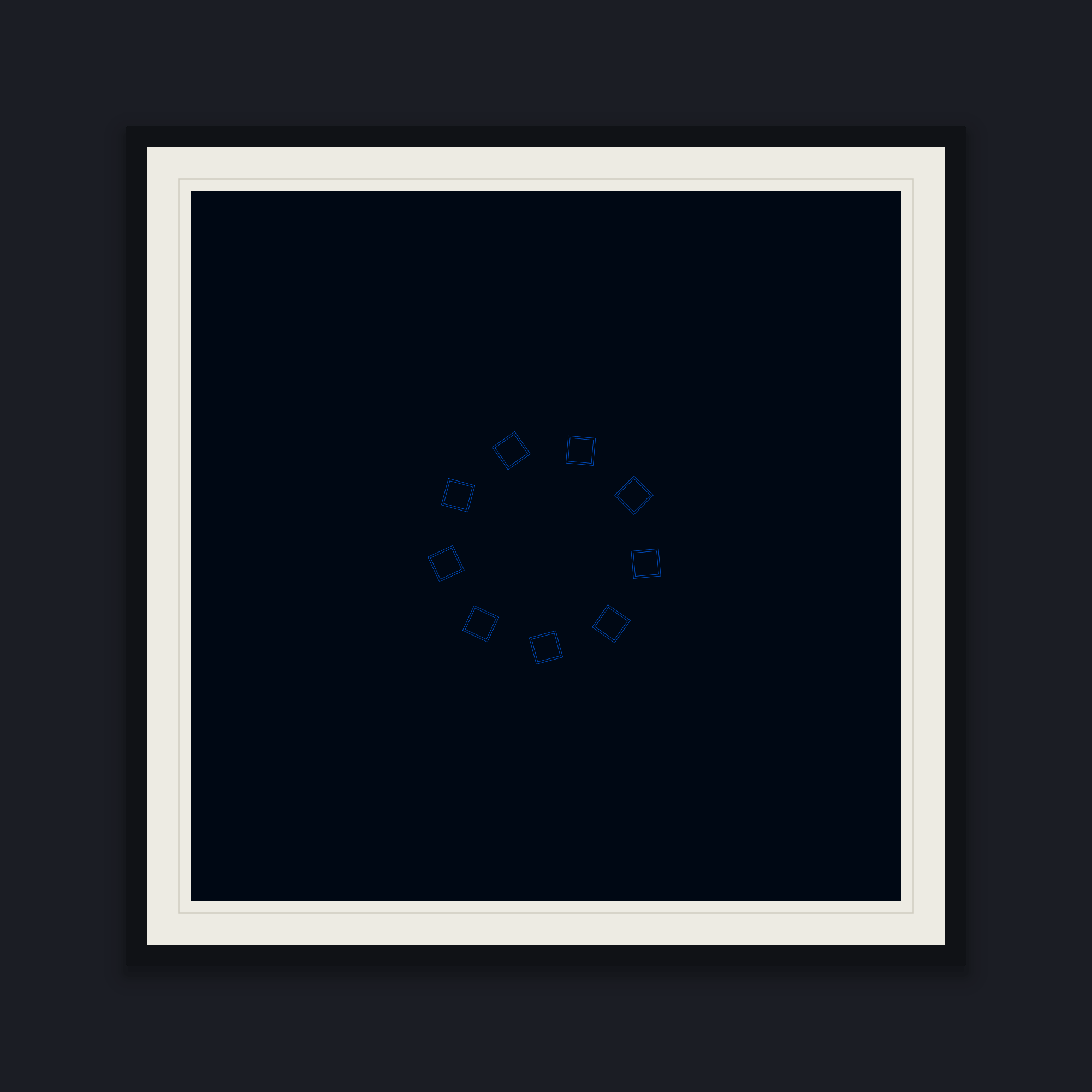
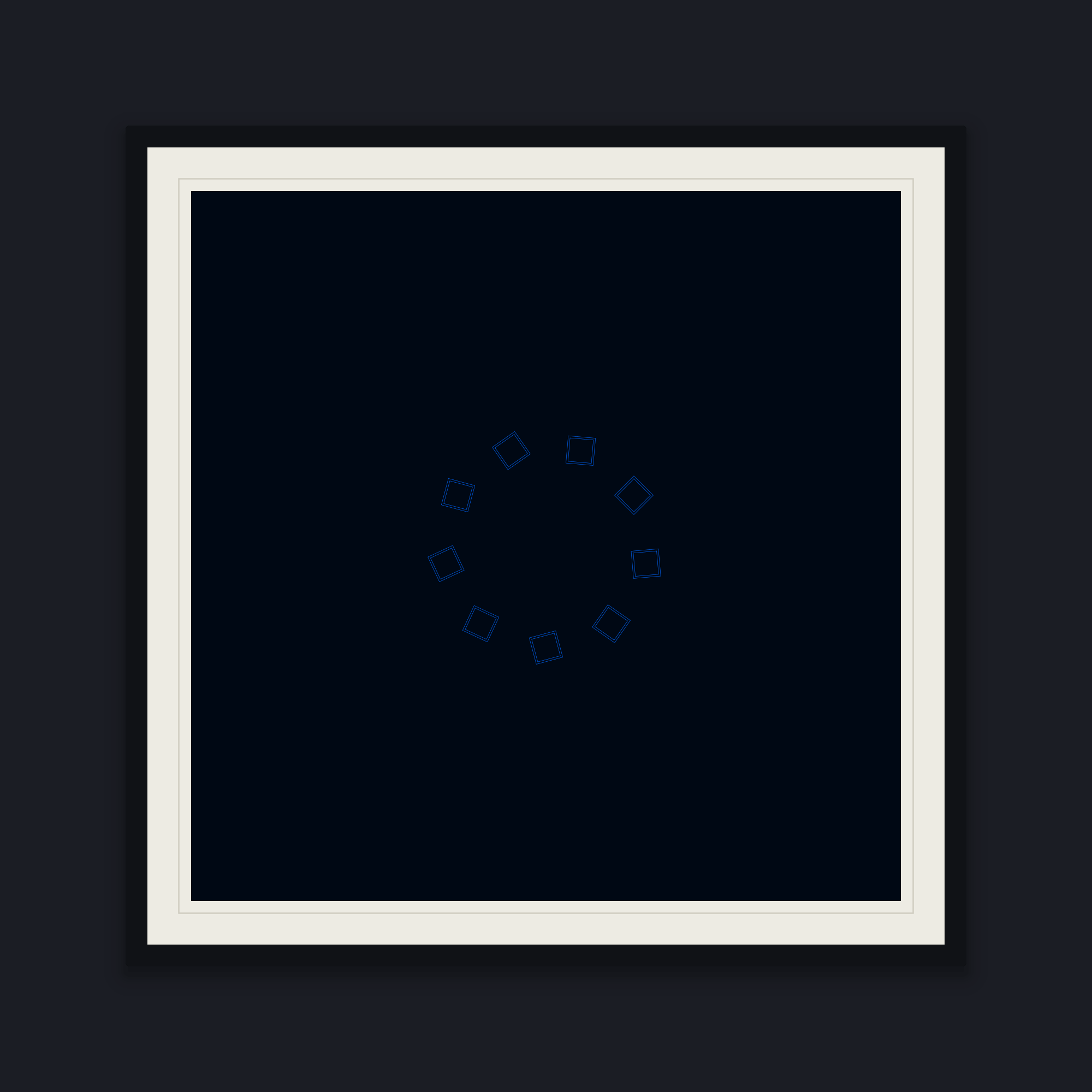
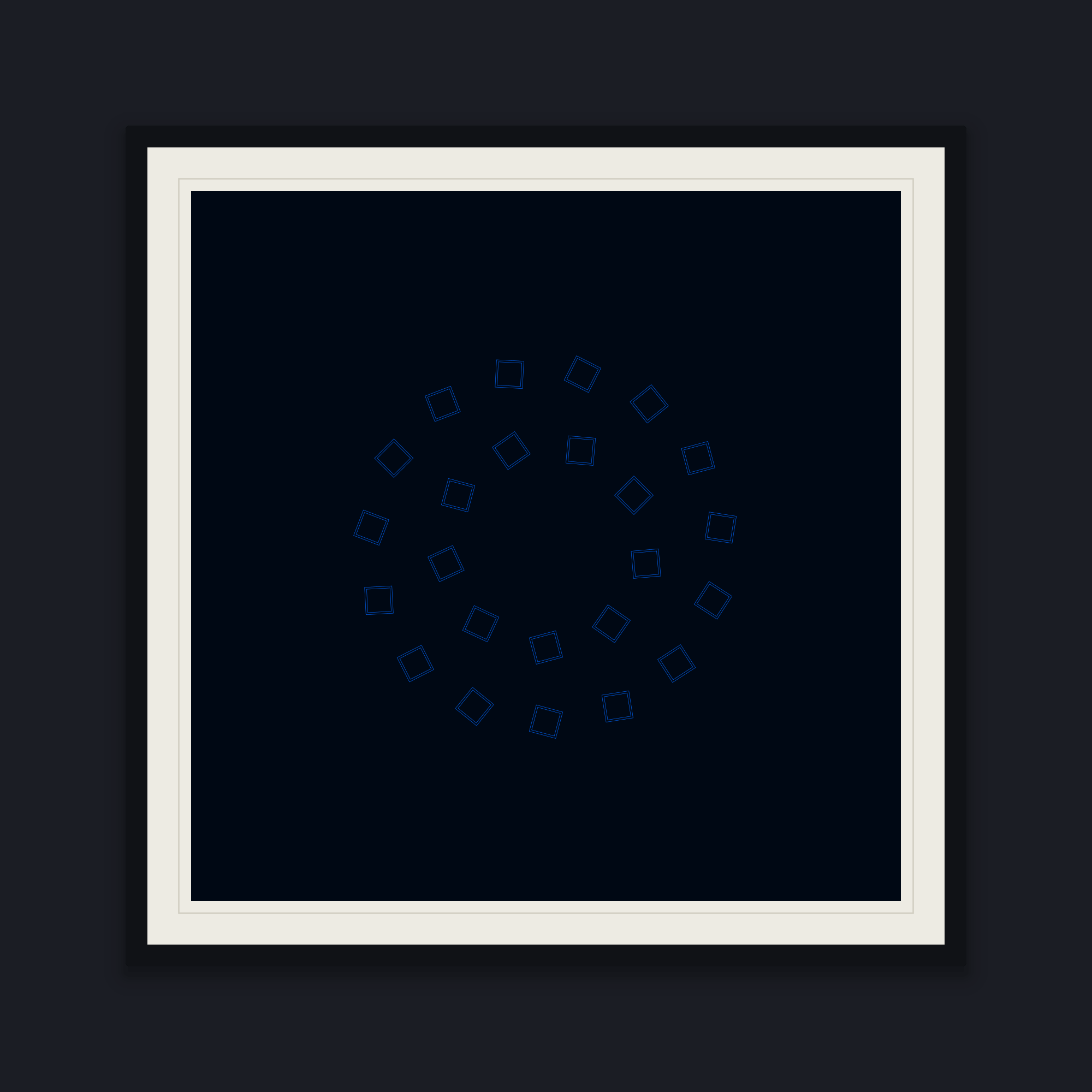
The first ring alone: eighteen squares, all tilted the same way. There is no illusion in
a single ring, because there is nothing for it to be tilted against.
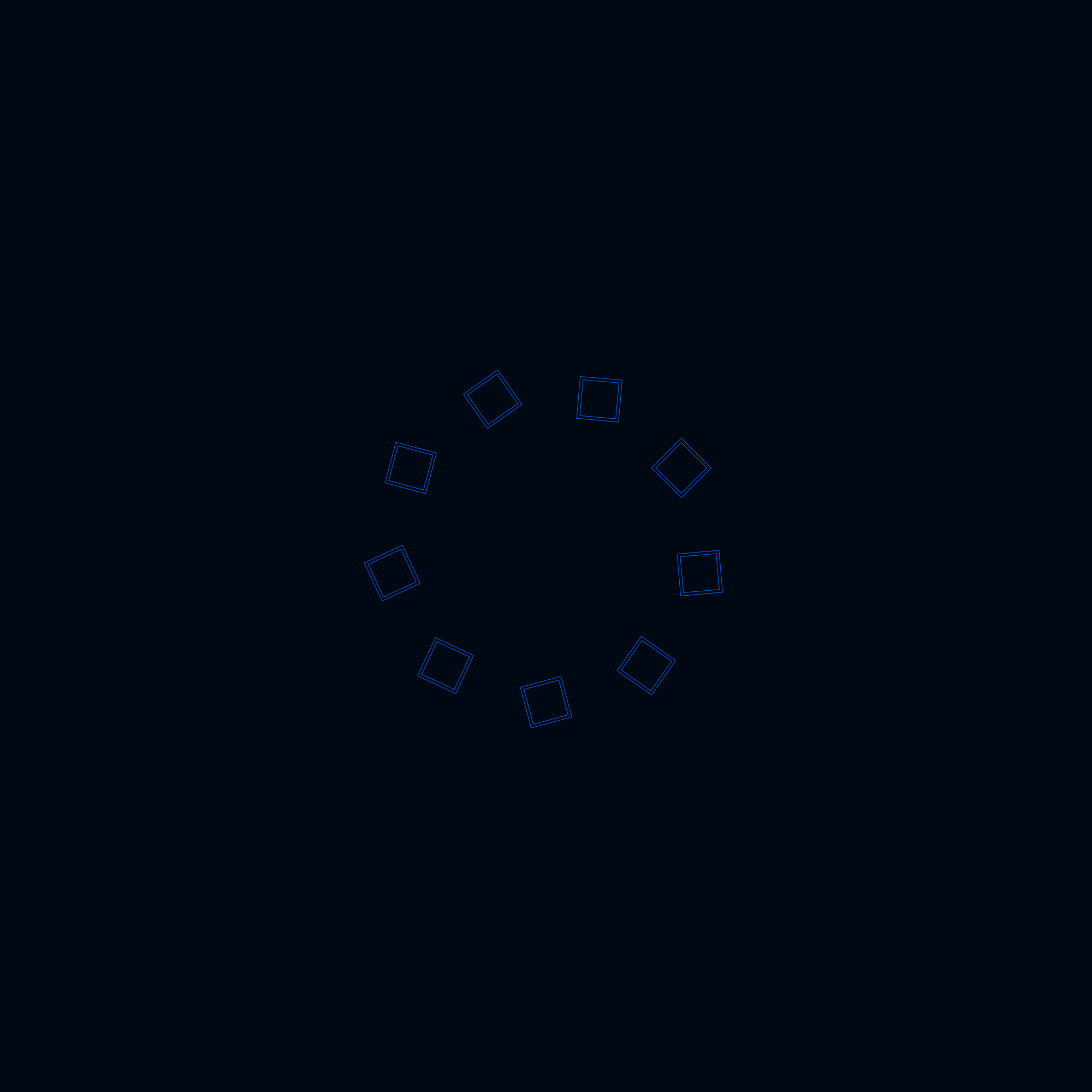
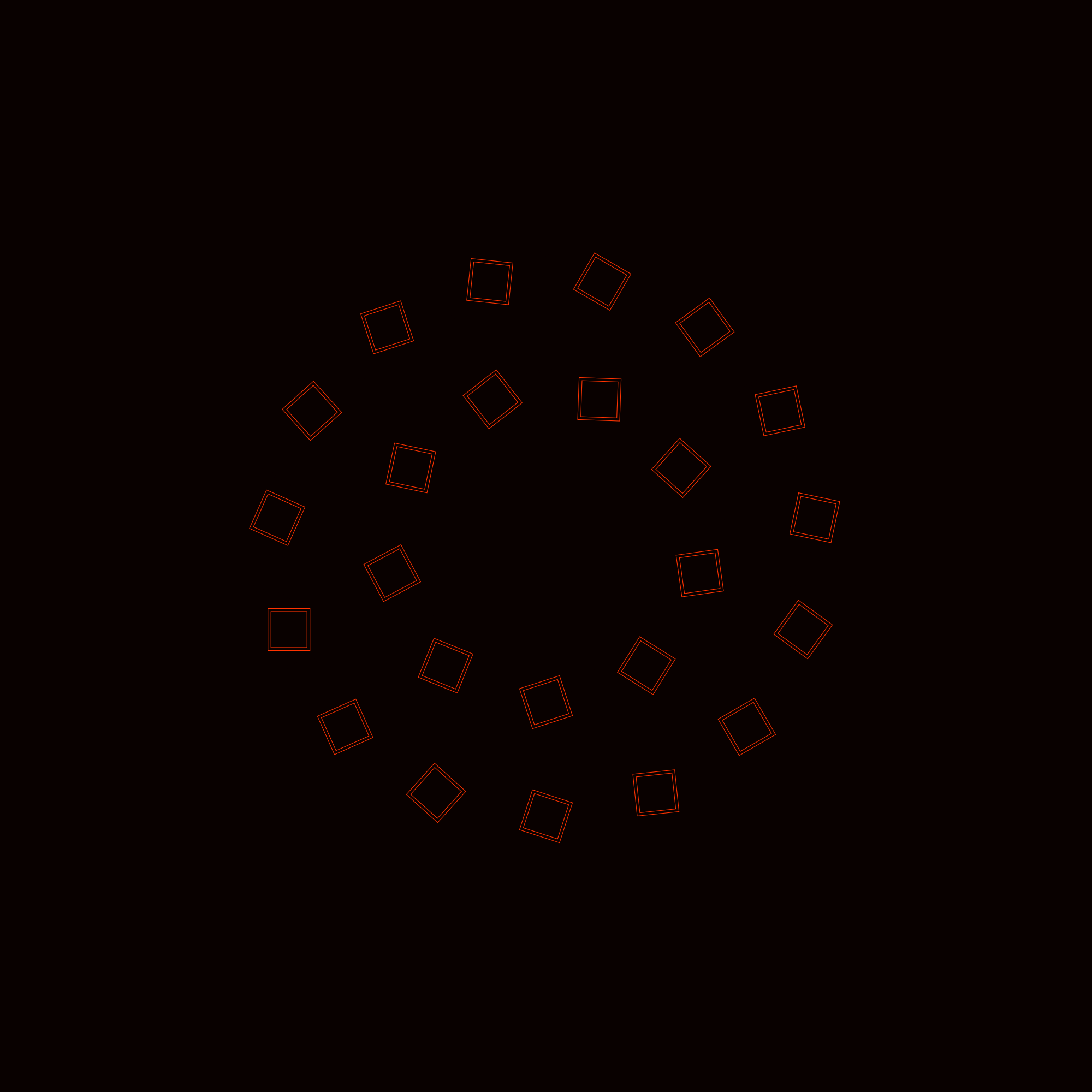
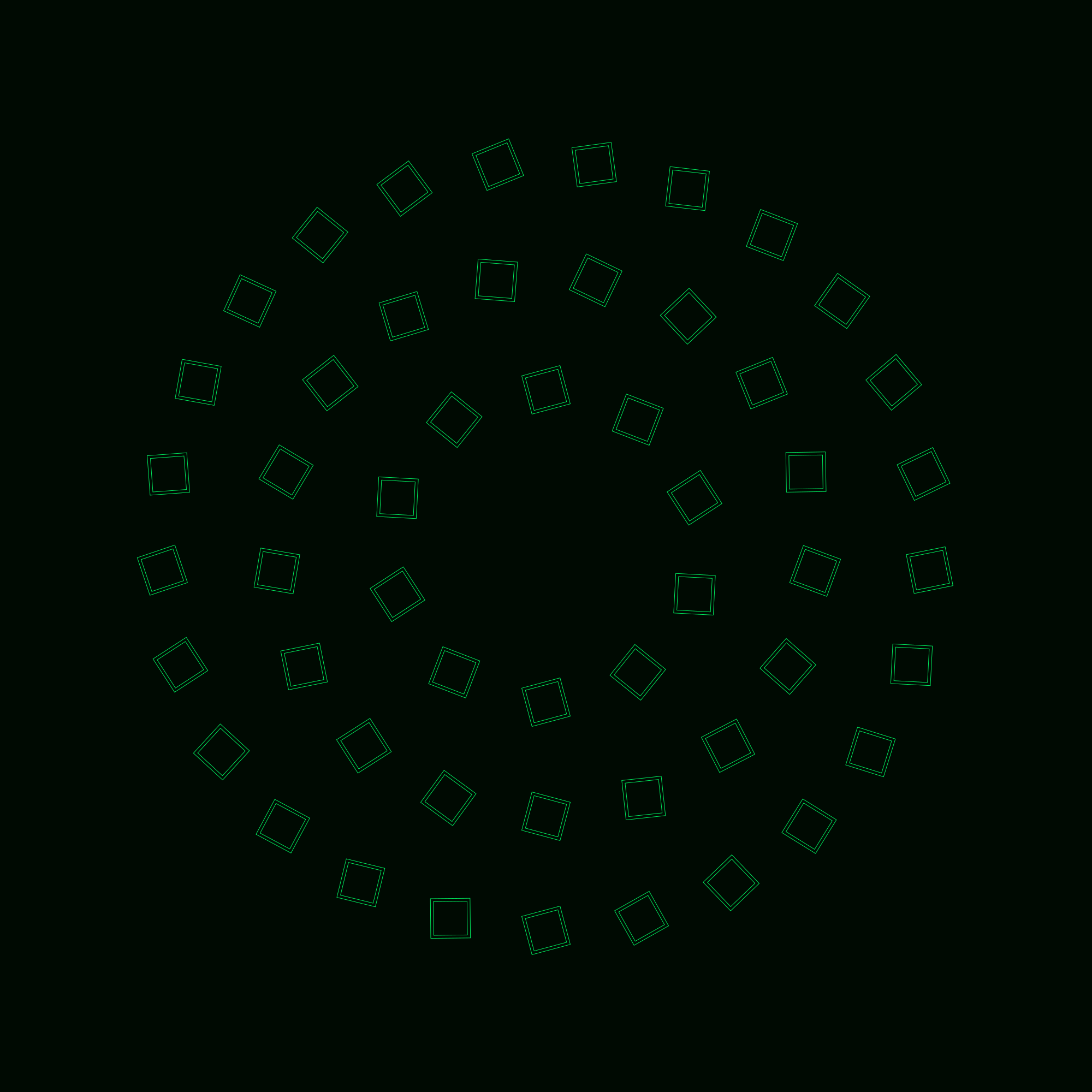
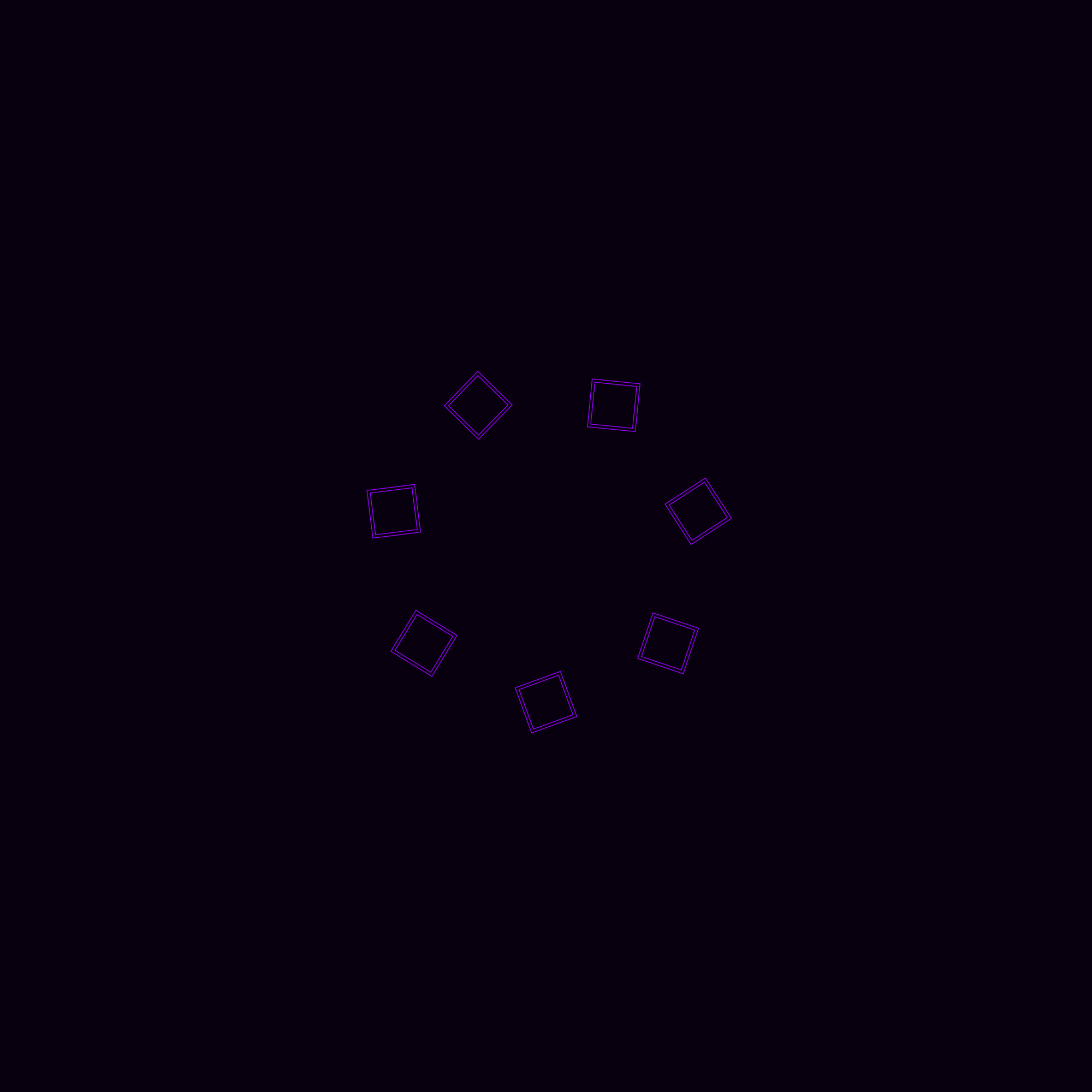
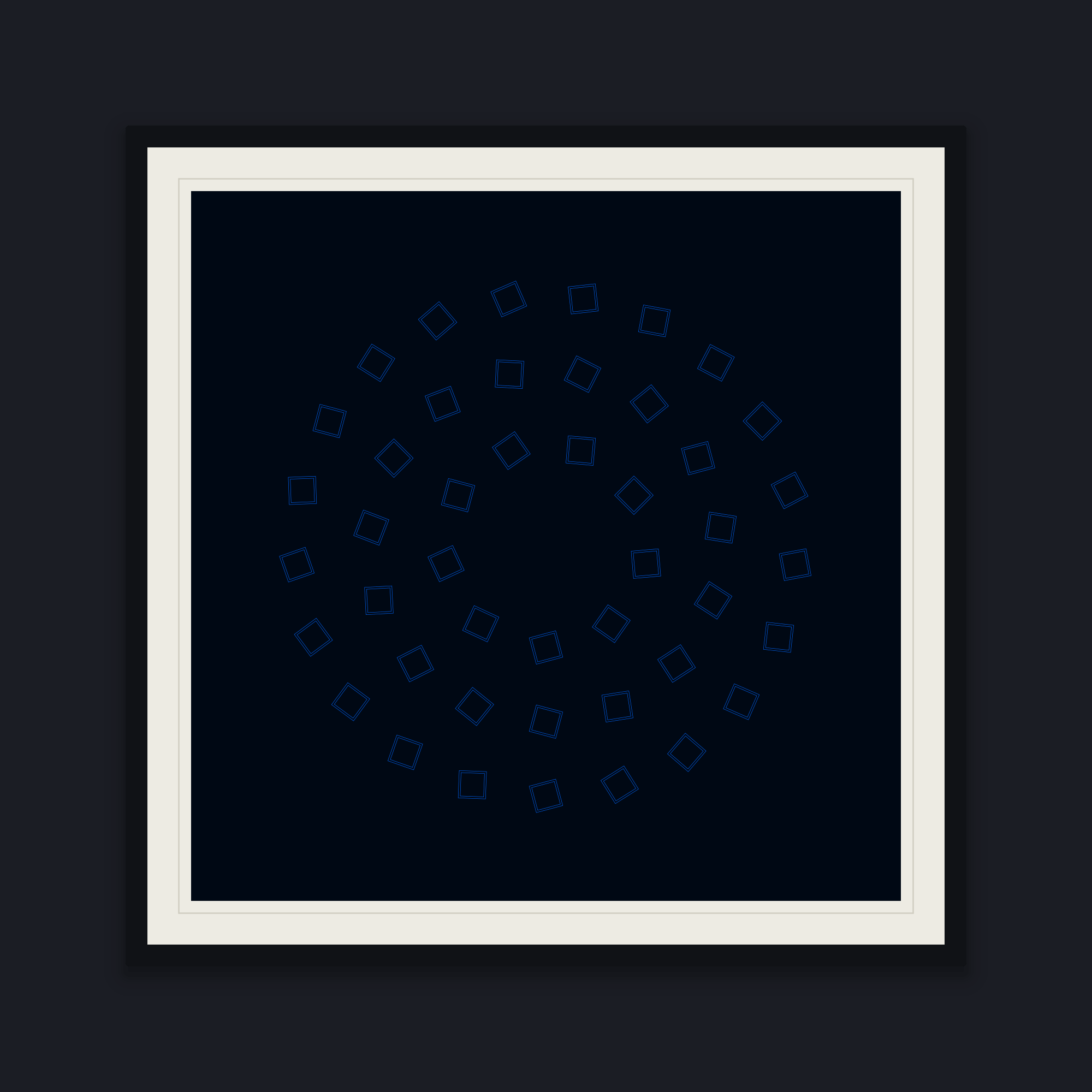
Two rings. The second is tilted the other way, and the pair already reads as two things
turning in opposite directions.
Why the eye is fooled
The effect comes from how the visual system estimates motion at edges. A tilted edge
gives an ambiguous local motion signal — the aperture problem — and the brain resolves
it by assuming the motion is perpendicular to the edge. Expanding or contracting the
image (which is what moving your head does) then produces a radial signal that gets
biased tangentially by the tilt, in opposite directions for the two ring families.
The alternating black-and-white fill matters too:
var squareColor = flipSwitch ? paintOne : paintTwo;
flipSwitch = !flipSwitch;
The checkering runs continuously across rings rather than restarting, so the boundaries
between light and dark do not line up radially — which strengthens the local motion
signals the illusion depends on.
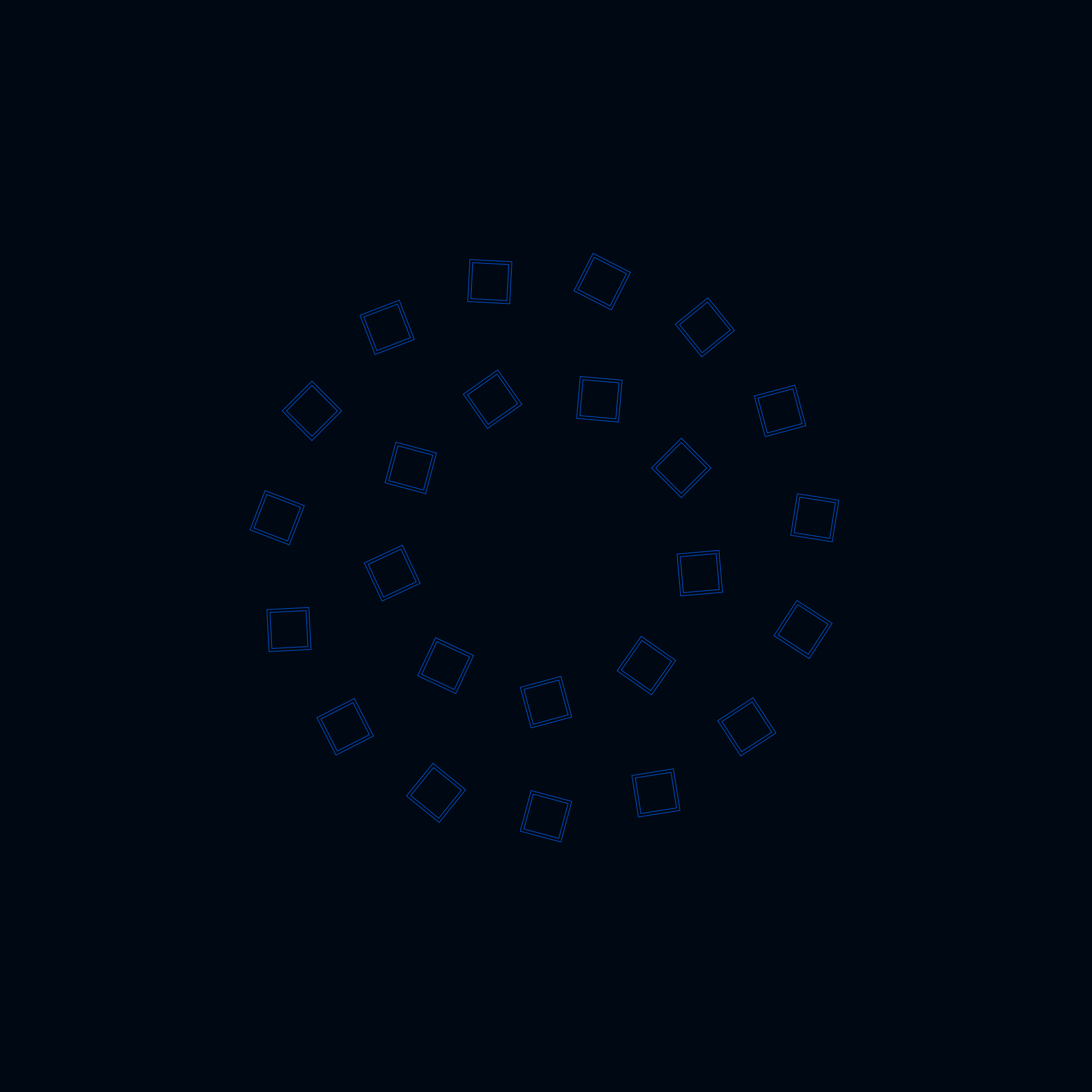
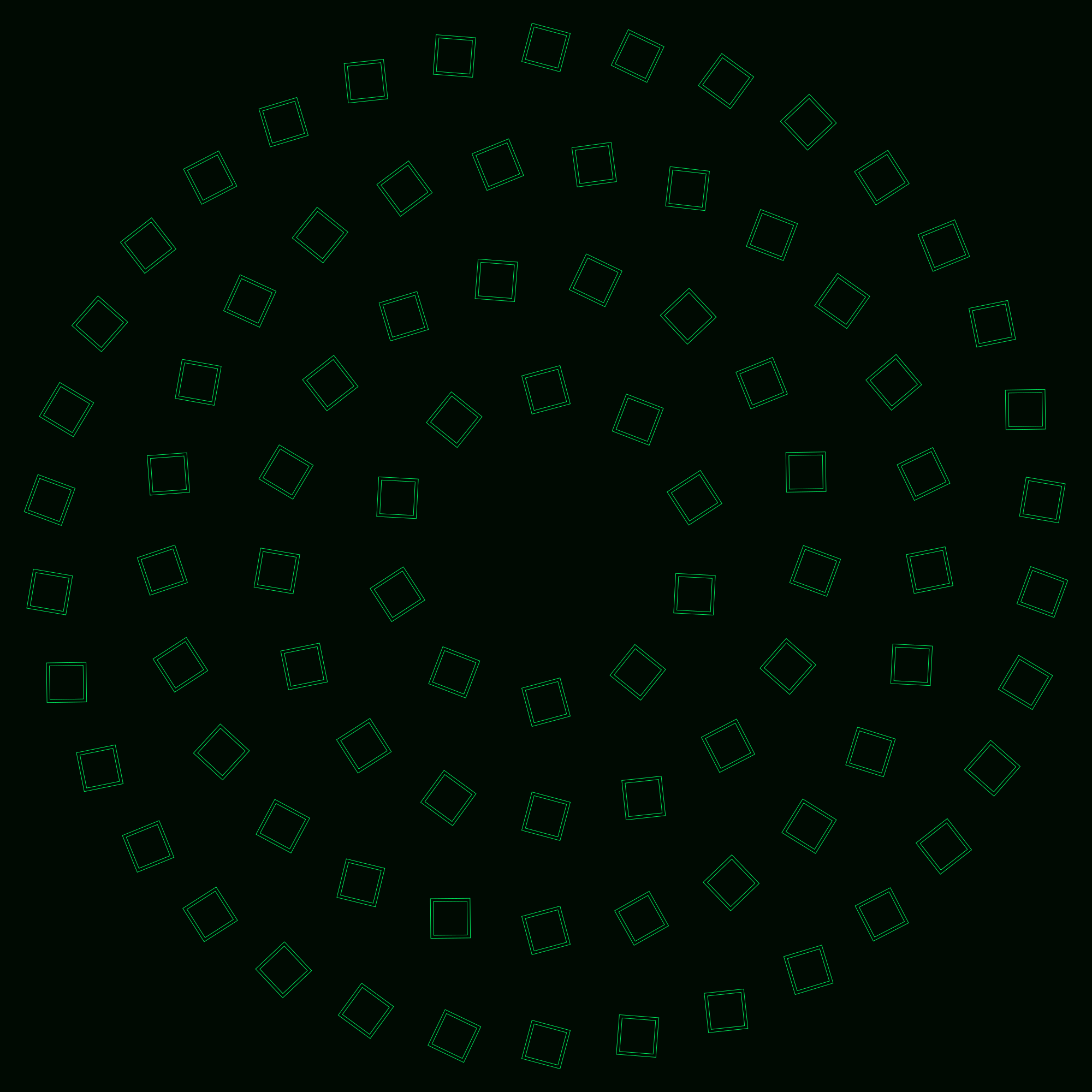
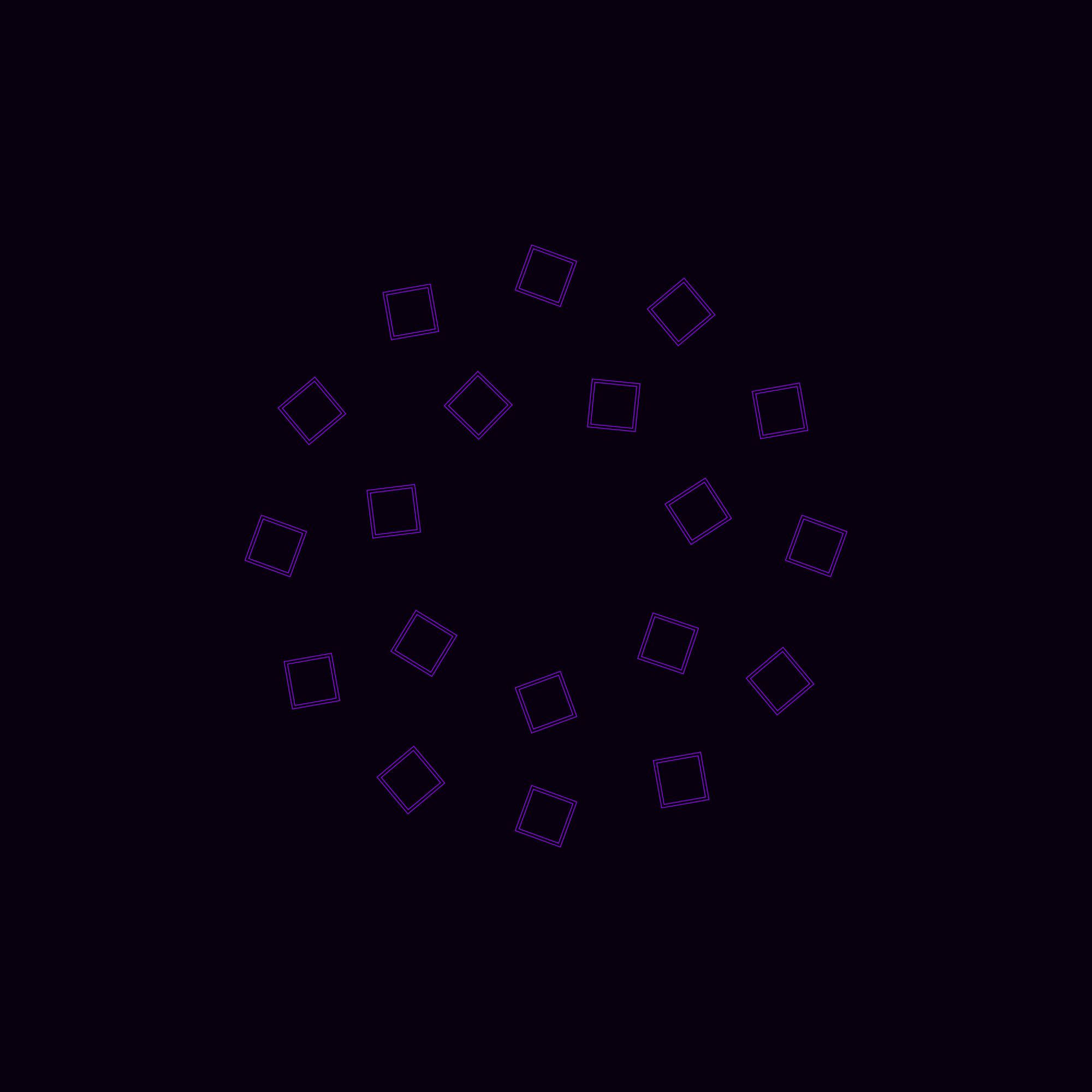
Three rings.
The rings are constructed, not drawn
RingCounts is [18, 30, 42, 56] and the radius is 26 + 19i. Both grow, and they grow
together: more squares at a larger radius means the spacing between squares stays
roughly constant, so every square in the picture is about the same size and about the
same distance from its neighbours.
That regularity is necessary. A ring with too few squares for its radius would read as
a dotted circle rather than as a textured band, and the illusion would weaken.
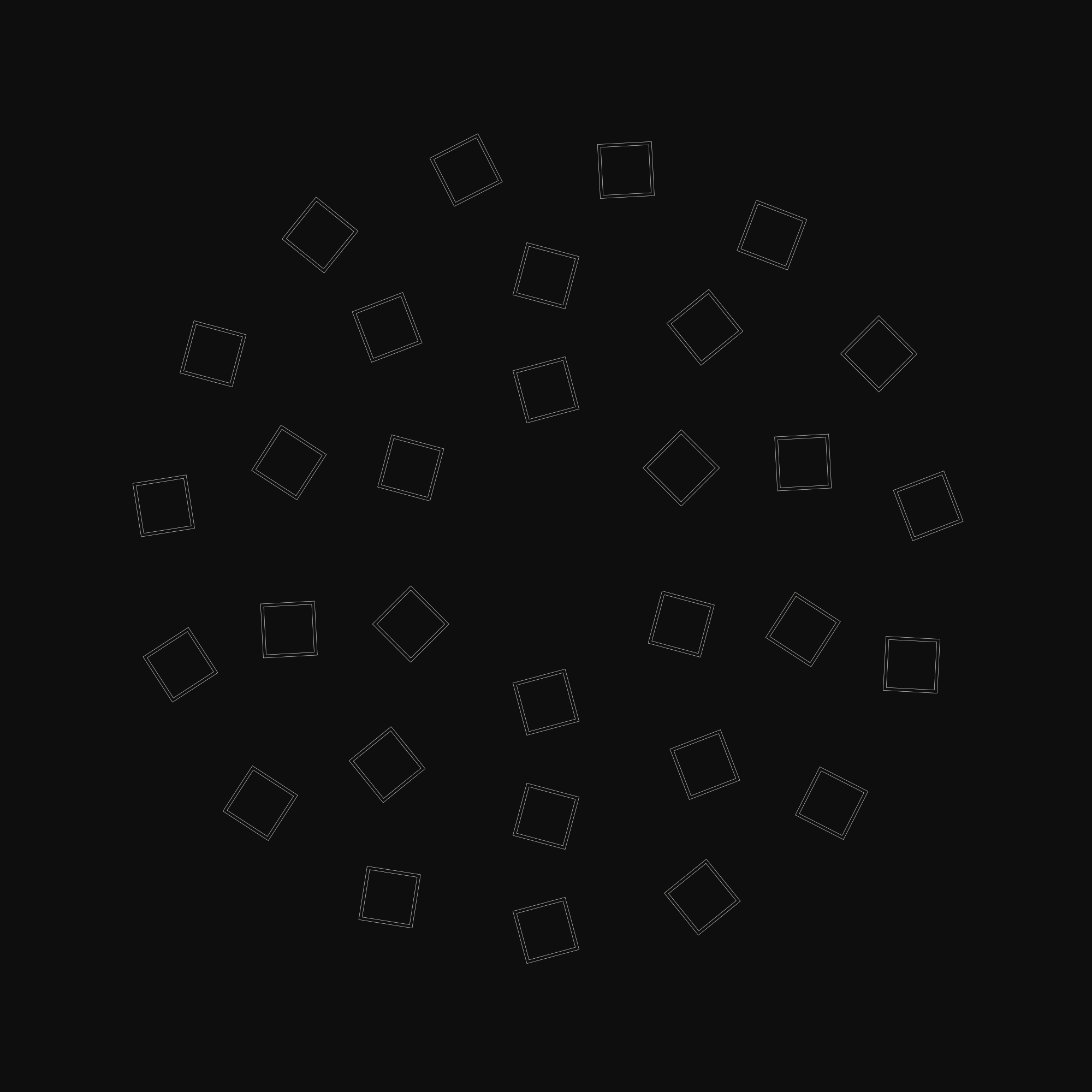
Four rings.
All of them. Look at the centre and move closer to the screen.
Five renderings
| Rendering | Rings | Tilt | Ink |
|---|
| Cobalt | 18, 30, 42, 56 | ±15° | blue on near-black |
| Ember | 18, 30, 42, 56 | ±18° | red on near-black |
| Aurora | 20, 34, 50, 68 | ±15° | green on near-black |
| Chalk | 12, 20, 30, 42 | ±15° | white on charcoal |
| Violet | 14, 24, 36, 50 | ±20° | violet on near-black |
The illusion is strongest with high contrast between the two square colours, which is
why every rendering pairs a bright foreground with a near-black ground.
Determinism
Nothing is seeded and nothing is random. Every square’s position and tilt is a closed
form in its ring and index.